
パウエルのタカ派発言が利下げ期待を直撃、世界市場は「新たな嵐」に直面!

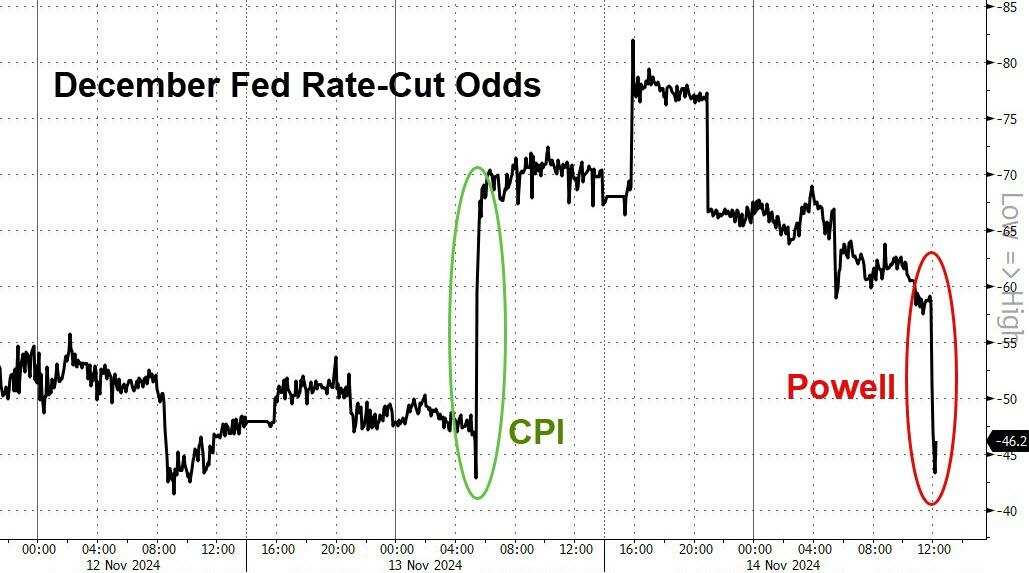
 パウエルはこの日、ダラス連邦準備銀行が主催した地元企業リーダーとの対話の中で、「
① Powell stated in his latest speech that the Federal Reserve is not in a hurry to cut interest rates in a strong economy; ② This hawkish rhetoric quickly stirred up a storm in the global market.
On November 15th, Caixin Media (Editor Xiaoxiang) reported that following the speech by Federal Reserve Chairman Powell in the early hours of Friday Beijing time, Powell stated that the Federal Reserve is not in a hurry to cut interest rates in a strong economy. This hawkish rhetoric quickly stirred up a storm in the global market.
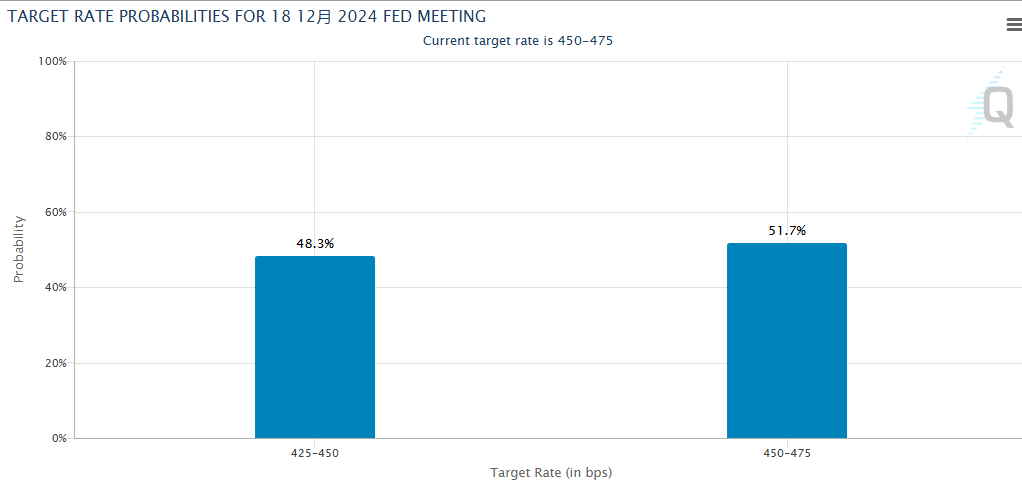
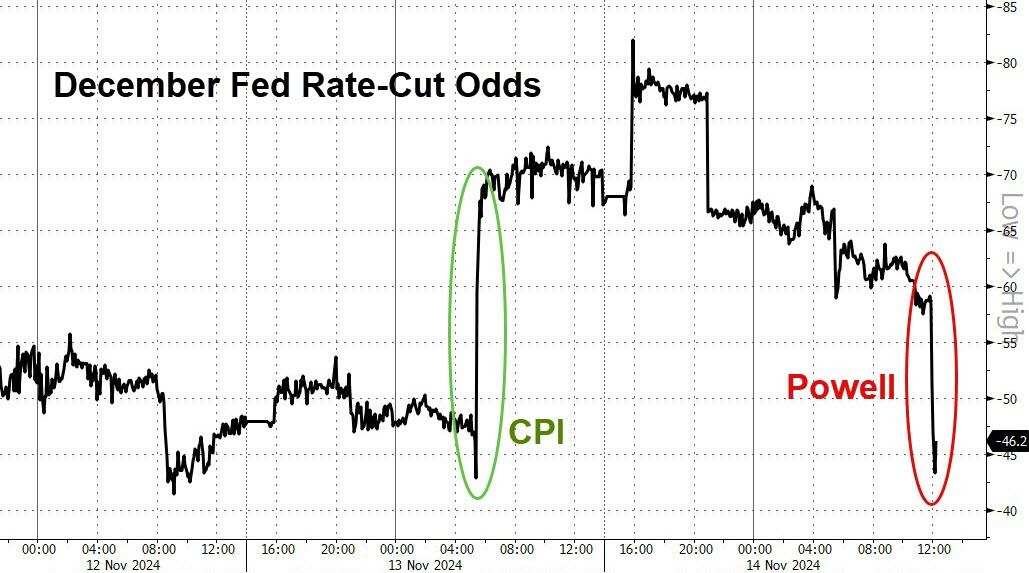
After Powell's speech, the US stock market closed near intraday lows, and the US dollar surged along with US bond yields, with the ICE US Dollar Index hitting a one-year high. Traders reduced the probability of a December rate cut from 80% the previous day to around 50%, sharply contrasting with the CPI release day before.
 During a dialogue with local business leaders hosted by the Dallas Fed, Powell said, "The economy has not shown any signals that require an urgent rate cut. A good economic situation gives us the ability to act prudently when making decisions."
Regarding inflation, Powell pointed out, "The inflation rate is getting closer to our long-term target of 2%, but has not yet been achieved. We are committed to this mission. With the labor market roughly balanced and inflation expectations well anchored, I expect the inflation rate to continue to trend towards the 2% target, albeit with some fluctuations."
To combat inflation, the Fed raised rates to the highest level in 20 years last year and then kept rates at that level for over a year to ensure that price pressures do not return. Since mid-2023, although US inflation has significantly decreased, the slowdown in price growth is sometimes uneven, including in the past two months.
Powell reiterated that the Fed's policy rate path will depend on upcoming data and the evolution of the economic outlook, closely monitoring core indicators of goods and services inflation, excluding housing, which have been declining over the past two years.
The Fed has cut rates in the last two meetings, first making a significant 50 basis point cut in September when there were signs that the labor market might be weakening. At the meeting last week, officials cut the benchmark rate again by 25 basis points to a range of 4.5% - 4.75%.
The next meeting of the Federal Reserve will be held on December 17-18. In his latest speech, Powell did not comment on the possibility of a rate cut at the December meeting. However, his remarks clearly dealt a significant blow to the market's expectations for a rate cut next month. The CME FedWatch Tool shows that the likelihood of the Fed achieving a third consecutive rate cut next month has once again become uncertain.
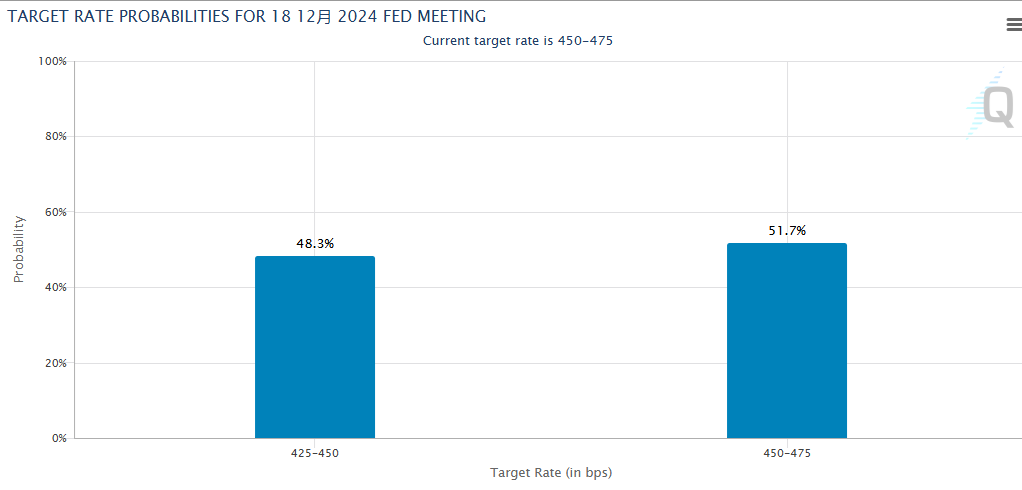
And market traders undoubtedly also quickly reacted to the news.
Global markets face a "new storm".
Most maturities of US Treasury yields rose after Powell's speech overnight, especially short-term yields surged, with the 2-year Treasury yield rebounding 8 basis points to 4.36% at one point.
Major US stock indexes also fell in response. The Dow fell by 0.5%. The S&P 500 index and the Nasdaq both fell by 0.6%, marking the largest single-day decline of the month.
In the forex market, the dollar further strengthened against major currencies on Thursday, with the ICE Dollar Index breaking above the 107 level, reaching a new high in a year, and rising for the fifth consecutive trading day.
Zachary Griffiths, director of credit investments and macro strategy at CreditSights in the US, said, "Powell's speech leans more towards hawkishness, with his future monetary policy bias towards risk management."
"Powell's speech is hawkish," Neil Dutta, Head of Economic Research at Renaissance Macro Research, also pointed out, "I believe they will still cut rates in December because the interest rate policy is still restrictive, and they aim to achieve the neutral rate setting. However, despite this, I think Powell (and the broader consensus) are complacent on the economic front. The downside risks in the short term are greater than people realize."
In fact, even aside from Powell's hawkish speech, a series of recent US economic data does not seem to support a rate cut much. As shown in the chart below, the number of initial jobless claims in the US has now dropped to a six-month low, and inflation data is generally stronger than expected. The economic and inflation situation still seems to face the risk of "not landing".
Market strategist at Murphy & Sylvest, senior wealth advisor Paul Nolte, said that based on the data of the past two days (consumer prices, producer prices, and weekly initial jobless claims), Powell would also find it difficult to become super dovish. All information indicates that job growth remains significant, and inflation continues to exceed the 2% target.
This also raises a question: if the scenario of "Trump comes to power, and Powell suspends rate cuts" really occurs (currently it seems very likely that the Fed will slow down its easing pace early next year), how angry would the "understanding king" who is always unhappy with Powell be?
Michael Feroli, Chief US Economist at JPMorgan, expects that Powell's speech may imply that the Fed will slow down its rate cuts before March next year. He wrote: "We still believe that the FOMC may cut rates in December. But today's speech has opened the door to slowing down the easing pace as early as January next year."
Editor / jayden
免責事項:本記事の内容はあくまでも筆者の意見を反映したものであり、いかなる立場においても当プラットフォームを代表するものではありません。また、本記事は投資判断の参考となることを目的としたものではありません。
こちらもいかがですか?
恐怖は最大のショートだ!モルガン・スタンレーが半導体の底値買いを強調:土地や電力不足は問題ではなく、承認されたプロジェクトも供給不足
モルガン・スタンレーは、半導体セクターの最近の売却が過度であり、市場のパニックが最大のリスクであり、ファンダメンタルズではないと考えています。AIインフラ需要により、下流の注文が引き続き加速しており、半導体供給が依然としてコアのボトルネックとなっています。LPSの制約がむしろ成長を安定させています。セクターは短期的にレンジで推移する可能性があり、現在はほぼ底値に達しており、算力とストレージのセクターに強気です。

ハッシュレート注文が爆発、「AI取引」がなぜ潮流から外れたのか?モルガン・チェースがAI投資と生産性実現のタイムラグを明らかに
JPモルガン・グローバル経済調査チームのJoseph Luptonは11月10日の調査で、最近の労働生産性の向上は主に資本の深化と生産要素の利用強度の向上によるものであり、AIがプロセス再構築やデータ統合、組織調整を通じてもたらす広範な効率向上の恩恵には、依然として時間が必要であると指摘しました。これは、チップ、サーバー、電力設備の受注は先行して増加する可能性がある一方で、算力運営者や最終利用者の持続的な投資リターンが必ずしも同時に実現するとは限らないことを意味しています。
AI投資が「幻滅の谷」に突入、今後18ヶ月は生死を分ける大試練!
ゴールドマン・サックスは、AI投資のサイクルが「幻想の谷底」にあると考えていますが、これは初めてのことではありません。核心の矛盾は、新たなクラウドコンピューティング事業者のビジネスモデルが、顧客のAI支出のリターンに強く依存している一方で、現在AIによる利益を明確に示せる企業はほぼゼロであるという点です。Social Capitalの創設者Palihapitiyaは、18ヶ月の重要な期間を明確に定めており、その間に市場は持続可能なAIビジネスモデルと持続不可能なものの整理を完了するだろうと述べています。

Anthropicの核心的な懸念:収入はいつでも取り消される可能性があるが、算力コストは最大20年間固定される
浙商証券は、Anthropicの収入が主に従量制料金で構成されていると考えています。残りの履行義務は年間収入の約5.1ヶ月分しかカバーしておらず、一方で計算能力コストは8,954億ドルの取消不能な約束によりロックされており、2024年まで最長2045年に至る契約期間となっています。収入はいつでも削減可能ですが、コストは退出できません。この両者が高度に非対称な期間ギャップを形成しており、これこそが同社の真の核心制約です。

暗号資産価格
もっと見る


