
Gold Price Achieves 15% Gain in August, Best in 25 Years; Purchasing Power Risk Hedge Drives Gold to New Highs

Huitong Network August 31 News—— Gold rose by about 15% in August, marking its best monthly performance since January 1999. Concerns over runaway government debt have reignited dollar devaluation trades, with the catalyst being the expansion of long-term Treasury bond purchases by the U.S. Treasury. Faced with the burden of debt, Washington is forced to choose among “deficit reduction, tolerating higher rates, or allowing devaluation,” while investors increasingly doubt it will opt for deficit reduction. When rising yields reflect concerns over fiscal sustainability rather than growth, gold shifts from an interest rate trade to a hedge against purchasing power risk; even if Warsh maintains a hawkish stance, eventually monetary policy will run into fiscal reality.
Gold underwent a sharp correction at the end of last week, but August’s notable rally should serve as a wake-up call to investors.
Earlier last week, gold prices had posted a cumulative rise of about 15% in August, on track for the best monthly performance since January 1999. This momentum is being reignited by growing market concern over unchecked government debt, with more and more investors questioning: How exactly will the world’s largest economy manage this burden without ultimately sacrificing the purchasing power of its own currency?
Debt Concerns Ignite Devaluation Trades
These concerns have injected new life into dollar devaluation trades, with the catalyst being the U.S. Treasury’s decision to expand the scale of long-term government bond buying in an effort to ease pressure on borrowing costs. Although these repurchases are still far from quantitative easing or formal yield curve control, the market already sees the direction clearly.
Faced with an increasingly expensive debt burden, the U.S. government essentially has three paths to take: cut spending and deficits, tolerate significantly higher borrowing costs, or find ways to suppress those costs while letting inflation and currency depreciation gradually erode the real value of debt. Right now, investors seem increasingly skeptical that Washington will choose the first path—and this is the crux of the shifting logic for gold.
The Relationship Between Gold and Yields Is Being Redefined
This is also why the relationship between gold and bond yields is becoming increasingly complex. Traditionally, rising real yields are negative for gold, as they raise the opportunity cost of holding non-interest-bearing assets. But when the root cause of yield increases is investor doubt over fiscal sustainability, that relationship becomes far less reliable.
This distinction may become even more important in the future. Federal Reserve Chairman Kevin Warsh can maintain his hawkish commitment to controlling inflation, but if interest rates rise sharply, it will also increase the government’s debt service costs, widen the deficit, and spur larger-scale Treasury issuance. Ultimately, monetary policy will run straight into fiscal reality—this constraint will not vanish with any amount of hawkish rhetoric.
The Retreat Is No Fear, Mathematics Still Favors Gold
This does not mean gold will rise in a straight line. After the strong gains in August, volatility and profit-taking should be expected. But investors should not ignore the bigger picture. Previously, State Street Global Advisors strategist Aakash Doshi asserted that gold reaching $10,000 per ounce is ultimately a question of when, not if. Such predictions may sound radical, but they are increasingly built on more than just bullish sentiment.
What gold reflects is a fundamental question about the sustainability of the global monetary system. As long as governments accumulate debt faster than their economies can realistically absorb, devaluation trades will remain active. The uncomfortable reality is, on the other side of the ledger, mathematics is still on gold’s side.
Conclusion
From Treasury repurchases to dollar devaluation, to a fierce 15% monthly rally in gold prices, the market is voting with real money on fiscal logic. Washington has yet to make a clear choice among “deficit reduction, tolerating high rates, or allowing devaluation,” but investors are already voting with their feet—taking gold as the final hedge against purchasing power risk.
A short-term pullback is inevitable, but if the trend of debt expansion does not change, this fiscal reality-driven gold rally may have only just written its prologue.
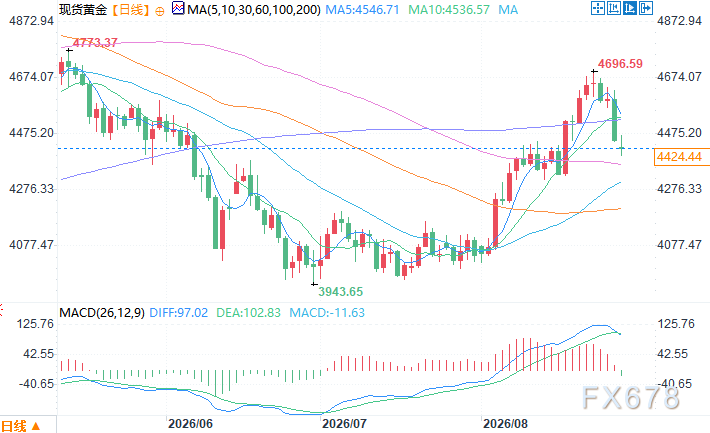
Spot Gold Daily Chart Source: Easy Huitong
GMT+8 August 31, 11:22 Spot Gold quoted at $4,428.44/ounce
Disclaimer: The content of this article solely reflects the author's opinion and does not represent the platform in any capacity. This article is not intended to serve as a reference for making investment decisions.
You may also like
SUI Price Faces Bearish Pressure Despite Account Growth

Avalanche Price Prediction November 2026: Can AVAX Break $9.03?

US CPI Exceeds Expectations Again, Waller's Warning Comes True! Wall Street Focuses on Whether December Rate Hike Will Be 25 or 50 Basis Points; "New Fed News Agency": Stop-and-Go Strategy Faces Test
The "New Federal Reserve Newsletter" pointed out that before the release of the CPI, Waller suggested the possibility of a 50-basis-point rate hike in December, and so far, no other Fed officials have publicly responded. In addition to a single 50-basis-point hike, the Fed may also choose to signal consecutive rate hikes in December and January. Wall Street generally believes that inflationary pressures remain stubborn, further strengthening the case for a rate hike in December, though a 50-basis-point increase is not a consensus. The market is concerned about whether the Fed will extend the tightening cycle.
CPI Deals a Blow to US Bonds! 2-Year Yield Surges Over 20 Basis Points Intraday, Gold and Silver Plunge
After the release of the CPI, traders began to expect a lower likelihood of a 50 basis point rate hike in December; this year’s Federal Reserve voting member Logan stated that a faster pace of rate hikes may be needed this winter, with at least two more 25 basis point hikes required before pausing. Subsequently, the rise in U.S. Treasury yields continued to widen, with the 10-year yield climbing back above 5.0% and rising more than 10 basis points intraday; spot gold once fell over 3%, while spot silver at one point dropped more than 4%.
Crypto prices
More


