
High Deficits and High Interest Rates: How Are They Reshaping Gold Price Trends?

Forex Network, August 14—— U.S. Treasury Auctions Hit 25-Year High! Surging Yields Suppress Gold Prices, Debt Crisis Underpins Long-term Bulls
On Friday (August 14), during the Asian and European sessions, spot gold experienced a dip and subsequent rebound. The worst U.S. Treasury auction in recent years pushed up benchmark yields and weighed on gold prices, but as market concerns over U.S. debt servicing grew, the U.S. Dollar Index declined, triggering a rebound in gold.
With U.S. Treasury issuance yields reaching a 25-year high and the latest released Producer Price Index (PPI) showing slower growth, global capital markets are currently at the intersection of a possible Federal Reserve policy pivot and the risks of U.S. fiscal expansion.
As a core asset with characteristics of inflation hedging, safe-haven, and non-yield (no interest), gold is being pulled and supported by multiple forces in this complex macroeconomic symphony.
U.S. Treasury Costs Hit 25-Year High: High Yields’ Short-Term Pressure on Gold Prices
Mid-August, the yield on the 30-year U.S. Treasury issued by the Treasury Department surged to 5.22% (5.216%), the highest since 2001.
Real Interest Rate and Carrying Cost: Because gold does not pay interest, its holding cost is closely related to long-term U.S. Treasury yields and real rates. A risk-free long-term yield as high as 5% or above will attract some capital seeking fixed returns in the short term, creating cyclical pressure on gold prices.
Premium Repricing: As the bid-to-cover ratio declined (to 2.39x), the market demanded higher risk premiums to absorb U.S. Treasuries, reflecting concerns over long-term debt safety and indirectly hitting risk appetite.
Fiscal Deficit and Fed Balance Sheet Reduction: Debt Credit Risk Becomes Gold’s Underlying Mid-to-Long Term Support
Though high yields have boosted the attractiveness of U.S. Treasuries in the short term, the fiscal imbalance exposed behind the scenes provides an exceptionally solid medium-to-long-term bullish logic for gold.
Debt Doom Loop: With the Federal Reserve’s balance sheet maintained at about $6.76 trillion and the Fed no longer acting as the “buyer of last resort,” the ever-expanding fiscal deficit is forcing the U.S. government to issue debt at higher costs.
The soaring borrowing cost further increases the government’s interest expenses, leading to a vicious cycle of “deficit expansion—more debt issuance—rising yields—increased interest cost.”
Fiat Credit Erosion and Safe-Haven Demand: The unrestrained expansion of sovereign debt will inevitably undermine the dollar’s credit in the long run. The U.S. Dollar Index fell intraday, forming a divergence between rising Treasury yields and a declining dollar.
Global central banks and institutional investors continue to accelerate their strategic allocation to gold to mitigate single-sovereign credit risk.
PPI Inflation Cools, Employment Pressure Rises: Catalyst for the Expected Policy Shift by the Fed
The latest July 2026 PPI data shows final demand PPI was flat month-on-month (up 4.7% year-on-year), with energy PPI falling by 3.1%, and goods PPI dropping for two consecutive months. Combined with a softening job market (with unemployment surfacing), these data points create a key backdrop for the Fed's decision-making:
Slower Inflation and Expectations for Rate Cuts: The stabilization and slowdown in upstream production costs suggest that inflationary pressure at the consumer level will gradually ease. Although core PPI remains relatively high at 4.2%, the downward inflation trend is now emerging.
Opportunity for Policy Pivot: The cooling PPI reduces the need for further Fed tightening, while potential risks in the job market are raising expectations that the future monetary policy will shift toward easing (or hold rates before possible rate cuts).
Once nominal interest rates peak or start to decline, the easing of inflationary pressure will lead real interest rates down, unlocking gold’s upward price elasticity.
Summary & Outlook: Structural Support for Gold Prices Remains Solid
To sum up, the current gold market displays a pattern of “short-term restraint from high borrowing costs, medium- and long-term benefit from credit risk and rate cut expectations”:
Short-Term View: The 5.22% high U.S. Treasury yield diverts capital away from gold, causing potential price volatility at elevated levels or periodic corrections;
Medium- to Long-Term View: The unsustainable U.S. fiscal deficit, debt servicing crisis, and the Fed’s eventual policy pivot all provide core anchors for gold’s long-term upside.
Once the squeeze from high yields is felt by the real economy and financial system, gold’s role as the “ultimate safe haven” will be further amplified by the market.
Technical Analysis: After reaching the top of its range, gold prices pulled back—as noted previously. Watch to see if gold can reclaim the 5-day moving average, monitor the coordination of price action and headlines, and observe whether and when the second wave of rebound begins. Support is near 4,289, with resistance at 4,394 (the top of the box range).
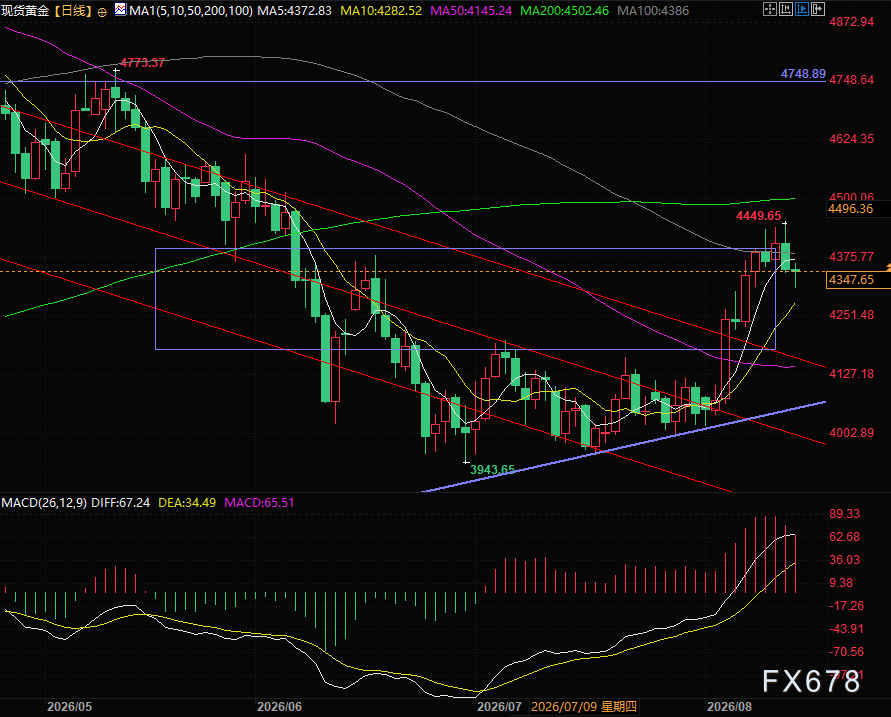
(Spot Gold Daily Chart, Source: Easytong)
At 17:04 GMT+8, spot gold was quoted at $3,437.61/oz.
Disclaimer: The content of this article solely reflects the author's opinion and does not represent the platform in any capacity. This article is not intended to serve as a reference for making investment decisions.
You may also like
AI investment enters the "Trough of Disillusionment", the next 18 months will be a life-or-death test!
Goldman Sachs believes that the AI investment cycle is currently in the "trough of disillusionment," but this is not the first time. The core contradiction lies in the fact that the business models of new cloud computing providers are highly dependent on end-user returns from AI spending, while currently "there are basically zero companies that can attribute profits to AI." Social Capital founder Palihapitiya has clearly defined an 18-month key window, during which the market will decide which AI business models are sustainable and which are not.

Anthropic's Core Concern: Revenue Can Be Withdrawn at Any Time, but Computing Power Costs Are Locked in for up to 20 Years
Zheshang Securities believes that Anthropic's revenue is mainly based on usage-based billing, with remaining performance obligations covering only about 5.1 months of annualized revenue, while compute power costs are already locked in with $895.4 billion in irrevocable commitments, some extending as far as 2045. Revenues can be reduced at any time, but costs are non-exitable, creating a highly asymmetric maturity gap between the two—this is the company's real core constraint.

Triple Pressure from the Federal Reserve, Treasury, and Congress; Goldman Sachs: Liquidity Crisis May Occur in 2027
Goldman Sachs warns that the reserve ratio of bank assets has dropped to around 11%, only slightly above the crisis trough of 2019. In the second half of 2027, a deadlock in debt ceiling negotiations will force the Treasury to rebuild the TGA, triggering a "perfect storm" of a sharp drop in reserves and a surge in T-bill supply; combined with stalled money market fund buying, this will create a huge liquidity black hole. The Federal Reserve could be forced into the awkward position of lowering interest rates and launching large-scale bond purchases to rescue the market.

Crypto prices
More


