
CRWV Beats Expectations, Shares Rise After Hours! Q3 Revenue Surges 168% to $3.661 Billion, Adjusted Operating Margin Hits 10%, Full-Year Guidance Raised to $13.0–13.3 Billion
 2026/11/11 03:39
CoreWeave’s (CRWV) third-quarter results temporarily eased market concerns about a slowdown in AI infrastructure demand. Revenue jumped 168% year over year, margins came in ahead of expectations, and the company raised full-year revenue and adjusted operating income guidance. Shares rose roughly 5% after the earnings call (and had been up about 10% in after-hours trading at one point). At the same time, the debt bill continued to grow rapidly: debt reached about $46.9 billion at quarter-end, and Q4 interest expense is still expected to exceed adjusted operating income. The growth story continues — and so does the financial leverage pressure.
Key Takeaways
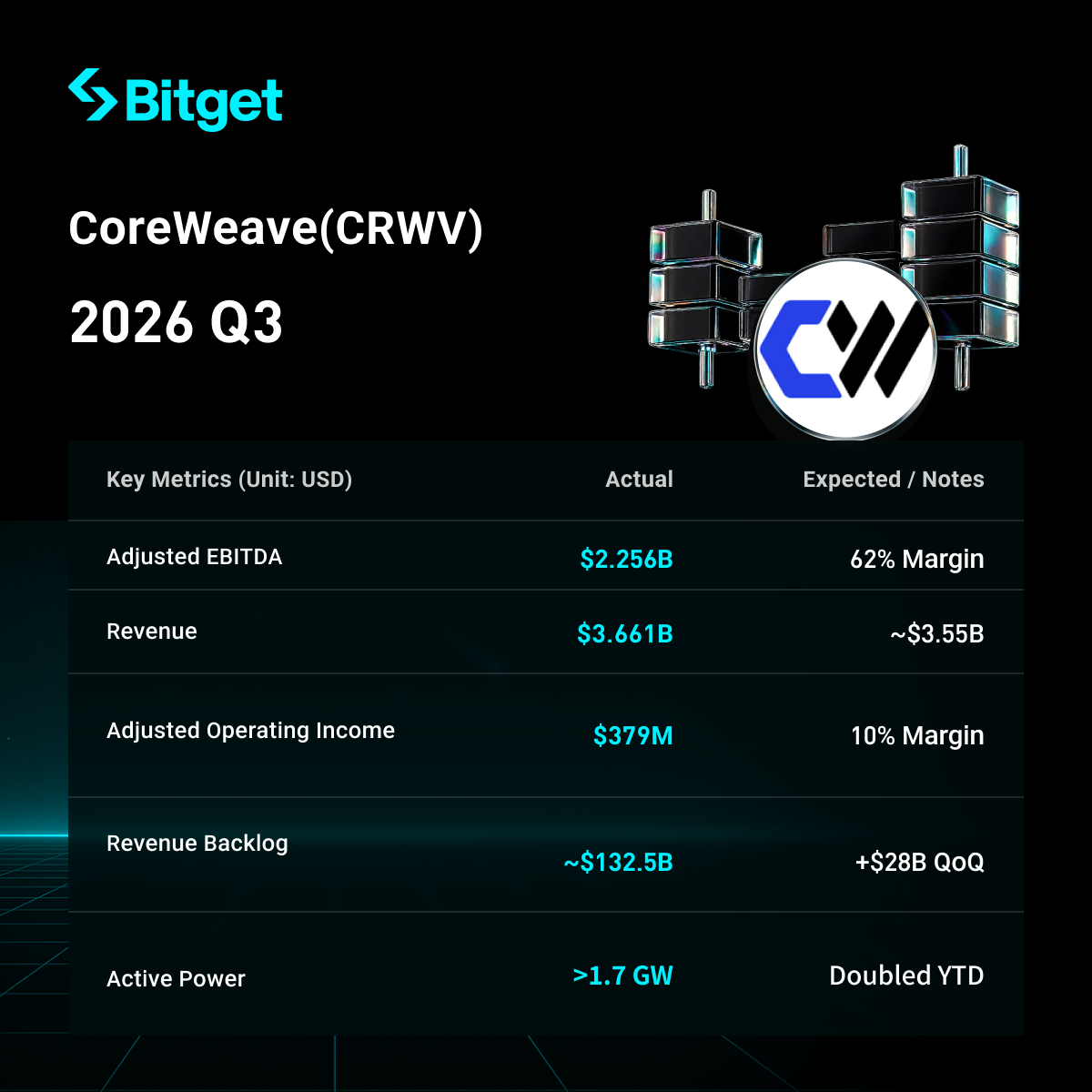
- Q3 revenue was $3.661 billion, up 168% year over year and 42% sequentially, beating consensus of roughly $3.55–3.56 billion and topping the high end of the company’s own prior guidance. Sequential revenue growth exceeded $1 billion for the first time.
- Adjusted EBITDA reached $2.256 billion at a 62% margin. Adjusted operating income was $379 million, lifting the adjusted operating margin to 10% (up from 5% in Q2 and 1% in Q1), achieving double-digit margins one quarter ahead of plan.
- Revenue backlog stood at approximately $132.5 billion (up about $28 billion from the end of Q2). Total contracted power exceeded 4.6 GW, and active power surpassed 1.7 GW (roughly doubling year-to-date).
- Full-year 2026 revenue guidance was raised to $13.0–13.3 billion (from $12.4–13.2 billion). Adjusted operating income guidance was increased to $1.275–1.375 billion (midpoint up ~26%). Year-end annualized revenue run-rate target was raised to $20–21 billion.
- Debt increased by about $11.8 billion in the quarter to ~$46.9 billion. Q3 net interest expense was $846 million. Q4 interest expense is guided to $1.05–1.15 billion, still roughly 1.4× expected adjusted operating income. The CEO said the company will not issue unsecured parent-level debt at current high yields and will primarily rely on contract-matched asset financing, customer prepayments, and operating cash flow.
1. Overall Revenue and Profit Performance
| Revenue | $3.661B | +168% | Beat ~$3.55–3.56B consensus; above high end of prior company guidance |
| Adjusted EBITDA | $2.256B | Sharp increase | 62% margin; above 57.6% expected |
| Adjusted Operating Income | $379M | Strong improvement | 10% margin (5% in Q2) |
| Net Loss | $709M | Wider | $1.27 per share; better than expected loss |
| Net Interest Expense | $846M | Significant rise | ~23% of revenue |
Sequential revenue growth topped $1 billion for the first time, driven by faster capacity delivery and a favorable pricing environment. Depreciation was $1.89 billion (~52% of revenue). Operating cash flow was about $1.98 billion, while cash spent on property and equipment reached $9.44 billion, resulting in substantial net cash consumption. Unrestricted cash stood at roughly $410 million.
2. Backlog, Capacity, and Demand
- Revenue backlog was ~$132.5 billion (up ~$28 billion from $104.2 billion at the end of June, and up ~138% year over year). The company expects to collect approximately $9 billion in customer prepayments and deposits over the next three months.
- More than 200 MW of active power was added in the quarter, bringing total active power above 1.7 GW (roughly doubled year-to-date). Total contracted power exceeded 4.6 GW (more than 900 MW added in Q3). International contracted power (including India, Indonesia, Spain, and others) surpassed 1.3 GW.
- Only about 37% of contracted power was active at quarter-end. The company maintained its year-end active power target of more than 1.85 GW.
- CEO Michael Intrator said the company is essentially sold out through 2027, with qualified demand roughly 10× available capacity; 2028 demand is also strong. Pricing on older GPUs (Ampere, Hopper, etc.) rose 30–50% sequentially in the quarter. Renewals of GPUs coming off contract in 2027–2028 could generate close to $10 billion in incremental annualized revenue with no additional capital expenditure.
Management reiterated that “customer contracts come first, and investment follows.” Spending is tied to committed demand, and customer prepayments help fund the buildout.
3. Full-Year Guidance and Capital Expenditures
- Full-year 2026 revenue guidance was raised to $13.0–13.3 billion (implying Q4 revenue of roughly $4.7–5.0 billion).
- Adjusted operating income guidance was increased to $1.275–1.375 billion, with the midpoint up ~26% from prior guidance. This implies Q4 adjusted operating income of about $800 million (more than double the Q3 level).
- Year-end annualized revenue run-rate target was raised to $20–21 billion.
- Full-year capital expenditure guidance low end was raised, with the range now $37–39 billion (previously $35–39 billion). Q3 capital spending was about $14.5 billion, above the high end of the company’s prior internal range. Remaining Q4 headroom is relatively limited, suggesting some spending may have been pulled forward.
- Financing approach: primarily delayed-draw term loans (DDTLs) matched to specific customer contracts, customer prepayments, and operating cash flow, with limited incremental parent-level capital. The CEO stated the company will not issue unsecured parent debt at current high yields.
4. Debt and Financial Pressure
Debt at quarter-end reached approximately $46.9 billion (up from ~$35.1 billion at the end of June and ~$21.4 billion at the start of the year), an increase of about $11.8 billion in the quarter. Total liabilities are higher once operating leases are included. Stockholders’ equity is only about $4 billion, leaving leverage extremely high. Q3 net interest expense of $846 million already exceeded adjusted operating income; Q4 interest expense (midpoint ~$1.1 billion) is expected to be roughly 1.4× adjusted operating income.
Net cash consumption has been substantial year-to-date. The company has already paid down some debt through the contract-matched financing structure and noted that “paid-off infrastructure will become a meaningful source of cash flow in its own right.” Analysts continue to highlight structural challenges: elevated interest costs, ongoing capital needs that require additional financing, and policy uncertainty around data-center development in some U.S. jurisdictions.
5. Market Reaction and Outlook
After the release, shares rose as much as ~10% in after-hours trading to around $54 before settling up roughly 5% following the earnings call. The stock is still down about 32% year-to-date and has fallen sharply from its June 2025 high near $183, with prior earnings reports often met with pressure. This quarter’s results temporarily pushed back the “AI buildout is slowing” narrative, but debt levels, interest burden, and the pace of capital spending remain the main points of debate.
The CEO framed the quarter as a “turning point,” saying the company is executing in the right way and continuing to win customer preference. Demand indicators (backlog, pricing, and sold-out status) are strong, and supply-side progress (capacity delivery and international expansion) continues, but financing costs and execution risks under a high-leverage model will need ongoing monitoring.
Risk Disclaimer: The above content is for reference only and does not constitute investment advice. Stock futures and leveraged trading carry high risk. Please make decisions carefully based on your own circumstances.
Disclaimer: The content of this article solely reflects the author's opinion and does not represent the platform in any capacity. This article is not intended to serve as a reference for making investment decisions.
You may also like
U.S. Stock IPO Preview | From Losses to Net Profit of 5.46 Million: The "Three-Dimensional" Platform Business Strategy with a Taste for Golf
Crossing the break-even line, the growth inflection point has arrived.
Core CPI Exceeds Expectations Again, Fed Hawks Loud! 2027 FOMC Voting Member Directly Calls Inflation Hot
Austan Goolsbee, President of the Chicago Federal Reserve, stated that officials must address the issue of high inflation, and described the October consumer price report as worrisome.
Weight-loss drug receives FDA warning for rare eye disease; Novo Nordisk (NVO.US) and Eli Lilly (LLY.US): No evidence of causality
The FDA requires all GLP-1 drugs to include a warning about the rare eye disease NAION. Novo Nordisk and Eli Lilly deny any causality, while Citi states that the impact on adoption is limited.

Crypto prices
More


