
Applied Materials (AMAT) Fiscal Q3 2026 Earnings Highlights: Record Revenue and Profits, 13th Consecutive Quarter of Gross Margin Expansion, Strong Q4 Guidance Beats Expectations — Yet Stock Falls on “Sell the News” Reaction
 Bitget2026/08/14 03:49
Core Viewpoint
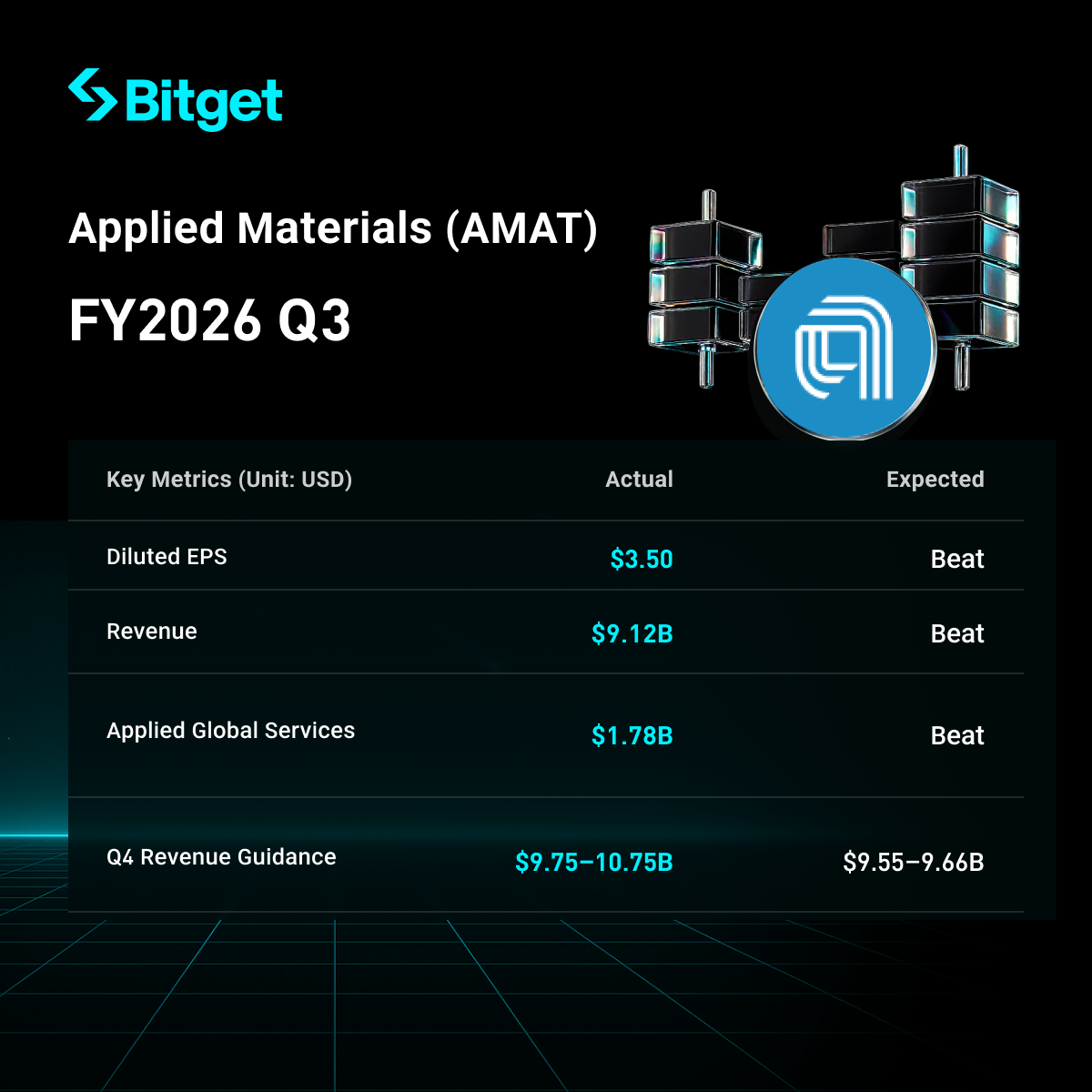
Applied Materials delivered a comprehensively better-than-expected Q3 report: revenue of $9.12 billion hit a company record (up 25% year-over-year), adjusted EPS of $3.50 also set a record (up 41% YoY), and GAAP gross margin reached 50.3% (up 1.5 percentage points YoY, the 13th consecutive quarter of year-over-year improvement). Semiconductor Systems was the primary growth engine, with AI-driven long-term demand visibility extending to 2030. The company raised its calendar 2026 packaging revenue growth outlook to more than 70%. Despite the strong beat on both results and Q4 guidance, the stock fell approximately 3–5% after hours, reflecting that after a more-than-doubling rally over the past year, the market’s appetite for “beats” has been stretched to the limit — turning “good numbers, bad stock reaction” into the new normal for AI equipment names.
Specific Breakdown
1. Overall Revenue and Profit Performance
- Revenue of $9.12 billion exceeded analyst expectations of roughly $9.0 billion (FactSet consensus around $8.99–9.0 billion), setting a company record and rising 25% year-over-year.
- Adjusted EPS of $3.50 also set a record, up 41% year-over-year; GAAP EPS was $3.17, up 43%.
- GAAP gross margin of 50.3%, up 1.5 percentage points year-over-year; non-GAAP gross margin of 50.4%.
- Record operating income (GAAP approximately $3.08 billion at 33.7% margin; non-GAAP approximately $3.10 billion at 34.0% margin), with continued margin expansion.
- Record cash from operations of about $3.04 billion; returned approximately $860 million to shareholders ($440 million in share repurchases + $420 million in dividends).
2. Semiconductor Systems Performance
- Revenue of $7.04 billion, up approximately 30% year-over-year (from about $5.56 billion in the prior-year period), serving as the quarter’s core growth engine.
- Mix: Foundry/Logic and other ~67%, DRAM ~26%, Flash ~7%.
- Gross margin of 55.3%, up 1.9 percentage points year-over-year; operating margin improved from 33.0% to 37.7%.
- Key drivers: “Unprecedented” demand for materials engineering solutions fueled by rapid global AI adoption; customers urging faster equipment delivery and capacity increases; strong demand in leading-edge logic, foundry, and DRAM.
3. Other Business Segment Performance
- Applied Global Services revenue of $1.78 billion, up 11% year-over-year.
- Growth supported by higher fab utilization rates and an expanding installed base, with customers selecting more advanced services to boost output and yield.
4. Future Plans and Growth Outlook
- The company now expects its semiconductor equipment business to grow more than 30% in calendar 2026, and packaging revenue growth of more than 70% (raised from the prior outlook of more than 50%).
- CEO Gary Dickerson stated that customer demand visibility continues to increase and that Applied Materials expects another strong growth year in 2027. Customers are requesting higher capacity and accelerated tool deliveries; some conversations already extend to 2030. Major customers are providing rolling eight-quarter demand forecasts.
- CFO Brice Hill noted that second-half revenue growth is expected to remain strong, particularly in DRAM, advanced logic/foundry, and advanced packaging.
5. Next-Quarter Guidance (Fiscal Q4 2026)
- Revenue midpoint of approximately $10.25 billion (range $9.75–10.75 billion), roughly 7% above analyst consensus (around $9.55–9.66 billion) and implying about 51% year-over-year growth at the midpoint.
- Adjusted EPS midpoint of $4.02 (range $3.82–4.22), also above market expectations.
- Non-GAAP gross margin expected at about 50.4%, flat with Q3.
- Semiconductor Systems expected at roughly $7.9 billion; Applied Global Services at about $1.84 billion.
6. Market Backdrop and Investor Concerns
- Core tension: Consecutive beats have become the base case rather than a positive surprise. Applied Materials shares are up about 108% year-to-date and roughly 194% over the past year — approaching the best annual performance since 1999. After such gains, the market now requires “substantial” beats to drive the stock higher.
- Sector rotation and profit-taking: The semiconductor equipment group has recently pulled back amid questions about the sustainability of AI capital spending. Applied Materials has been consolidating for about six weeks since its June 30 all-time high. Peer KLA’s earlier “in-line” results also led to a stock decline, raising the bar for the entire group.
- Investor reaction: The roughly 3–5% after-hours decline reflects that while fundamentals remain solid and growth momentum is intact, the results were not enough to immediately impress Wall Street. Analysts note that if the strong trajectory continues, 2027 consensus estimates still have room to move higher. This is not a deterioration in fundamentals, but rather an inflation of expectations — market patience is being tested by ever-rising bars.
Stock Limited-time Offer:August new user gift: Buy U.S. stocks and get free NVIDIA stock.Trade Now for Better Deals
Disclaimer: The content of this article is for reference only and does not constitute any investment advice.
Disclaimer: The content of this article solely reflects the author's opinion and does not represent the platform in any capacity. This article is not intended to serve as a reference for making investment decisions.
You may also like
AI investment enters the "Trough of Disillusionment", the next 18 months will be a life-or-death test!
Goldman Sachs believes that the AI investment cycle is currently in the "trough of disillusionment," but this is not the first time. The core contradiction lies in the fact that the business models of new cloud computing providers are highly dependent on end-user returns from AI spending, while currently "there are basically zero companies that can attribute profits to AI." Social Capital founder Palihapitiya has clearly defined an 18-month key window, during which the market will decide which AI business models are sustainable and which are not.

Anthropic's Core Concern: Revenue Can Be Withdrawn at Any Time, but Computing Power Costs Are Locked in for up to 20 Years
Zheshang Securities believes that Anthropic's revenue is mainly based on usage-based billing, with remaining performance obligations covering only about 5.1 months of annualized revenue, while compute power costs are already locked in with $895.4 billion in irrevocable commitments, some extending as far as 2045. Revenues can be reduced at any time, but costs are non-exitable, creating a highly asymmetric maturity gap between the two—this is the company's real core constraint.

Triple Pressure from the Federal Reserve, Treasury, and Congress; Goldman Sachs: Liquidity Crisis May Occur in 2027
Goldman Sachs warns that the reserve ratio of bank assets has dropped to around 11%, only slightly above the crisis trough of 2019. In the second half of 2027, a deadlock in debt ceiling negotiations will force the Treasury to rebuild the TGA, triggering a "perfect storm" of a sharp drop in reserves and a surge in T-bill supply; combined with stalled money market fund buying, this will create a huge liquidity black hole. The Federal Reserve could be forced into the awkward position of lowering interest rates and launching large-scale bond purchases to rescue the market.

Crypto prices
More


