
Banking giant warns: Global stock markets are in the most "bubble-like" state since the 2008 financial crisis

U.S. multinational investment bank Citi has warned that global stock markets are currently in the most “bubble-like” state since the 2008 financial crisis.
In an investor report released on June 5, Citi analyst Beata Manthey pointed out that Citi’s proprietary “Bear Market Checklist” currently has 10 out of 18 indicators triggered worldwide.
Specifically, the U.S. market scores 11.5/18, while the European market scores 5/18. Manthey said that historically, when this indicator exceeds 10, it tends to accelerate. For comparison, during the dot-com bubble in 2000, this indicator reached as high as 17.5 warning signals.
Manthey wrote: “However, we note that once the number of warning signals hits double digits, historically they often increase faster, meaning risk may be accumulating at an accelerating pace. If more indicators are triggered in the future, whether it's worth buying the dip when the market falls will become more and more questionable.”
Nevertheless, Manthey also acknowledged that the current market conditions have not yet reached an “overexuberant” level. Therefore, while the indicator does reflect rising risks, Citi as a whole still maintains a relatively positive outlook on the market.
The stock market is in the most bubble-like phase since 2008
There are numerous factors driving stock markets to the most “bubble-like” state of the past two decades. The main reasons include:
Key sector valuations have become significantly overextended;
The artificial intelligence (AI) boom has led to increasingly optimistic investor sentiment;
A surge in the number of large initial public offerings (IPOs).

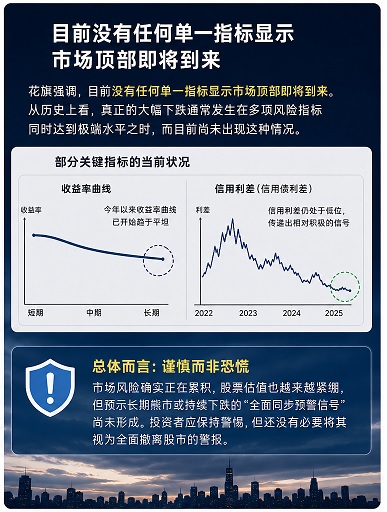
Citi emphasized that currently, no single indicator suggests the market top is imminent. Historically, significant downturns tend to occur when multiple risk indicators reach extreme levels simultaneously—a scenario not present at this time.
The Citi report stated: “Although the yield curve has started to flatten since the start of this year, some more responsive indicators, such as credit spreads, remain at low levels, sending relatively positive signals.”
Overall, Citi’s message leans more toward caution than panic.
In other words, market risks are indeed accumulating and stock valuations are becoming increasingly stretched, but the “broadly synchronized warning signal” that would foreshadow a prolonged bear market or sustained downturn has yet to materialize. At this stage, investors should remain vigilant but do not yet need to view this as a call for a full-scale exit from the stock market.
Disclaimer: The content of this article solely reflects the author's opinion and does not represent the platform in any capacity. This article is not intended to serve as a reference for making investment decisions.
You may also like
NVIDIA (NVDA.US) management changes may affect Anthropic's IPO plans; the market is watching whether the multi-billion-dollar investment will change
With the sudden departure of Nvidia CEO Jensen Huang, the record-breaking initial public offering plan of AI giant Anthropic is being reconsidered by the market.
Nebius Q3 results exceed expectations, capital expenditure rises to $27 billion, ARR target postponed, stock falls over 14% pre-market | Earnings Report Insights
Nebius reported Q3 revenue of $981 million (a year-on-year increase of 571%) and adjusted EBITDA of $466 million, both exceeding expectations. However, the company delayed and lowered its guidance for annual recurring revenue (ARR), stating that it is no longer applicable. Additionally, it significantly raised its 2026 capital expenditure target to $27 billion, with projections to further increase to $40 billion to $45 billion in 2027. The stock price plummeted more than 14% in pre-market trading.
AUD/USD Price Forecast: Breakdown of H&S pattern keeps the pair under pressure
U.S. Stock Market Preview | Major Index Futures Mixed; Nvidia Plunges Pre-market; Fed Officials' Speeches Incoming
Before the U.S. stock market opens on Thursday, November 12, the three major U.S. stock index futures showed mixed movements.
Crypto prices
More


