
Breaking News from the Middle East! Reuters Exclusive: In a Rush to Sell Oil, UAE Secretly Sends Oil Tankers Through the Strait of Hormuz

Reuters UK published an exclusive report on Thursday (May 7), stating that according to industry sources and shipping data, in order to avoid attacks from Iran, the UAE and its buyers have recently turned off location trackers and transported several crude oil-loaded tankers through the Strait of Hormuz, attempting to ship out oil that had been stranded in the Gulf due to the Middle East conflict.
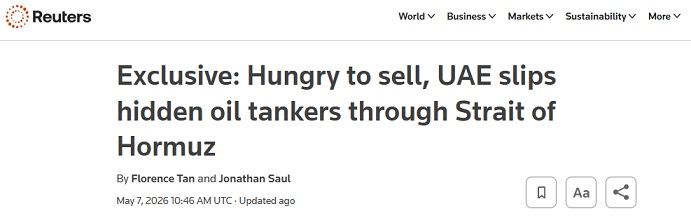
(Screenshot source: Reuters)
Reuters noted that these shipments account for only a small fraction of the UAE’s regular exports prior to the outbreak of war between the U.S. and Israel against Iran, but it demonstrates the willingness of the oil-producing country and its buyers to take risks in order to release oil sales.
Other Gulf oil-producing countries—Iraq, Kuwait, and Qatar—have either stopped sales or significantly reduced prices to attract uninterested buyers, while Saudi Arabia exports oil only via the Red Sea.
According to three sources, ship tracking data from Kpler, and satellite data analytics from SynMax, in April this year, the Abu Dhabi National Oil Company (ADNOC) of the UAE successfully exported at least 4 million barrels of Upper Zakum crude oil and 2 million barrels of Das crude oil from Gulf terminals using four tankers.
According to three sources—one with direct knowledge and two familiar with Abu Dhabi National Oil Company operations—as well as data from Kpler and SynMax, these shipments were either transferred via ship-to-ship (STS) operations to another vessel that subsequently delivered the crude to refineries in Southeast Asia, offloaded into storage facilities in Oman, or delivered directly to refineries in South Korea.
This export method was first reported by Reuters.
Abu Dhabi National Oil Company declined to comment on this crude oil shipment operation.
Tehran responded to the U.S.-Israel attacks that began on February 28 by effectively closing the Strait of Hormuz, blocking exports from all nations except itself, leaving one-fifth of the world’s oil and natural gas supplies stranded.
The closure of the strait and the U.S. blockade of Iran in recent weeks have pushed global oil prices above $100 per barrel.
Kpler data shows that since the start of the war, Abu Dhabi National Oil Company’s exports have had to be reduced by more than 1 million barrels per day, down from last year’s daily exports of 3.1 million barrels. Most of its exports are Murban crude, delivered via pipeline from onshore oilfields to Fujairah.
Disclaimer: The content of this article solely reflects the author's opinion and does not represent the platform in any capacity. This article is not intended to serve as a reference for making investment decisions.
You may also like
NVIDIA (NVDA.US) management changes may affect Anthropic's IPO plans; the market is watching whether the multi-billion-dollar investment will change
With the sudden departure of Nvidia CEO Jensen Huang, the record-breaking initial public offering plan of AI giant Anthropic is being reconsidered by the market.
Nebius Q3 results exceed expectations, capital expenditure rises to $27 billion, ARR target postponed, stock falls over 14% pre-market | Earnings Report Insights
Nebius reported Q3 revenue of $981 million (a year-on-year increase of 571%) and adjusted EBITDA of $466 million, both exceeding expectations. However, the company delayed and lowered its guidance for annual recurring revenue (ARR), stating that it is no longer applicable. Additionally, it significantly raised its 2026 capital expenditure target to $27 billion, with projections to further increase to $40 billion to $45 billion in 2027. The stock price plummeted more than 14% in pre-market trading.
AUD/USD Price Forecast: Breakdown of H&S pattern keeps the pair under pressure
U.S. Stock Market Preview | Major Index Futures Mixed; Nvidia Plunges Pre-market; Fed Officials' Speeches Incoming
Before the U.S. stock market opens on Thursday, November 12, the three major U.S. stock index futures showed mixed movements.
Crypto prices
More


