
Bank of Korea governor warns of ‘currency chaos’ from non-bank issuance of KRW stablecoins

Quick Take Bank of Korea Governor Lee said that allowing non-banks to issue their stablecoins could lead to currency chaos and disruptions in the local banking sector. South Korea’s recently elected President Lee Jae-myung seeks to promote the issuance and use of local currency-backed stablecoins.
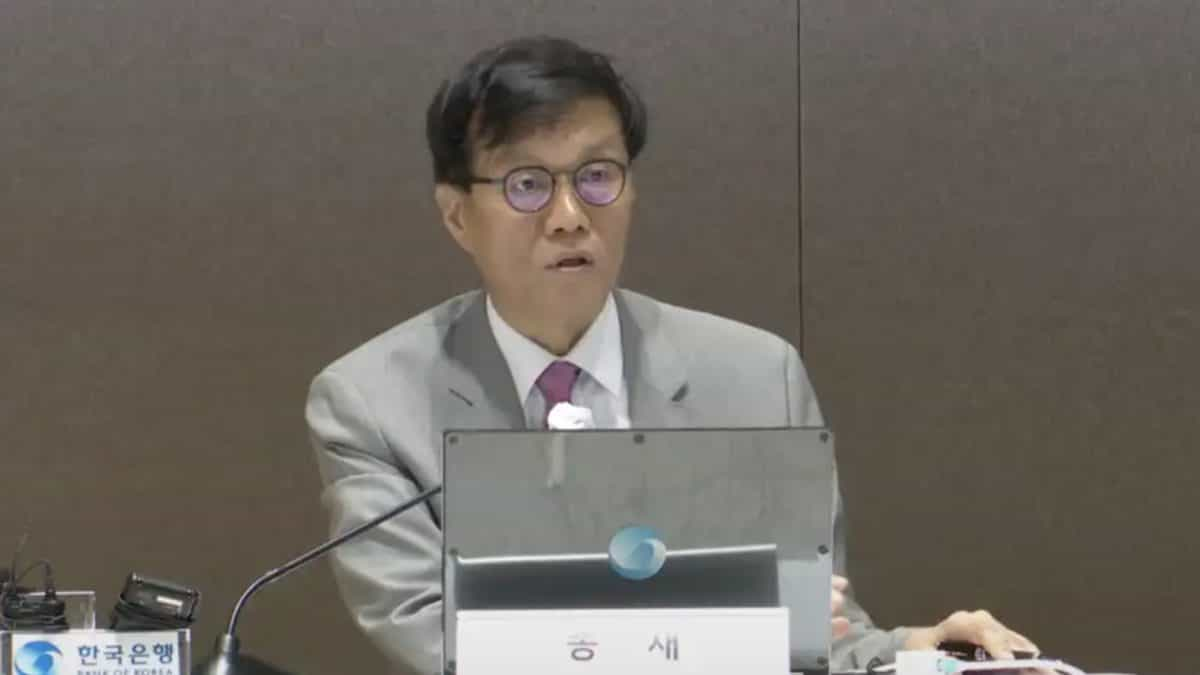
Bank of Korea Governor Lee Chang-yong said on Thursday that allowing multiple non-banking institutions to issue local stablecoins could lead to currency chaos reminiscent of the 19th century, according to local news reports.
Lee's comment comes amid South Korea's ongoing efforts to promote the issuance and usage of Korean won-based stablecoins, which is one of President Lee Jae Myung's election promises.
While Lee's latest comment at a press briefing did not specify the exact event that occurred during the 19th century, it likely refers to the Free Banking Era in the U.S. that started in 1837.
The Free Banking Era began when various states in the U.S. started allowing individuals with minimal capital to establish banks, resulting in the circulation of thousands of different banknotes, traded at varying discounts, according to the Federal Deposit Insurance Corporation (FDIC). This caused confusion and economic instability until the National Bank Act established a unified banking system.
"Allowing won stablecoins irresponsibly could conflict with foreign currency exchange policies, and delegating payment and settlement services to non-banks will disrupt the profit model of existing banks," Lee said , according to Yonhap News Agency.
Lee added that the central bank cannot determine the policies around KRW stablecoins, and said it will discuss and establish a direction once it becomes clear which relevant government departments will participate.
Stablecoin push
Meanwhile, President Lee's promise to endorse KRW stablecoins has triggered multiple major payment services firms and banking institutions to submit trademark applications for stablecoin ticker symbols. Ruling Party lawmaker Min Byeong-deok has already submitted a bill setting the overall regulatory framework for KRW stablecoins.
KakaoPay , one of the country's largest payment service providers, is expected to benefit most from South Korea's stablecoin push. The company's stock rose over 120% since early June, when the country elected Lee as its new president.
Last month, the BOK announced that it is halting its trial project on CBDCs , which it has been exploring since 2018. The BOK informed trial participants that it will monitor the development of legislation surrounding stablecoins, as the coexistence of CBDCs, stablecoins, and bank deposit tokens remains unclear.
According to Edaily News, BOK's Lee stated during Thursday's press conference that its latest CBDC utility trial was designed with KRW stablecoins in mind from the outset.
Disclaimer: The content of this article solely reflects the author's opinion and does not represent the platform in any capacity. This article is not intended to serve as a reference for making investment decisions.
You may also like
AI investment enters the "Trough of Disillusionment", the next 18 months will be a life-or-death test!
Goldman Sachs believes that the AI investment cycle is currently in the "trough of disillusionment," but this is not the first time. The core contradiction lies in the fact that the business models of new cloud computing providers are highly dependent on end-user returns from AI spending, while currently "there are basically zero companies that can attribute profits to AI." Social Capital founder Palihapitiya has clearly defined an 18-month key window, during which the market will decide which AI business models are sustainable and which are not.

Anthropic's Core Concern: Revenue Can Be Withdrawn at Any Time, but Computing Power Costs Are Locked in for up to 20 Years
Zheshang Securities believes that Anthropic's revenue is mainly based on usage-based billing, with remaining performance obligations covering only about 5.1 months of annualized revenue, while compute power costs are already locked in with $895.4 billion in irrevocable commitments, some extending as far as 2045. Revenues can be reduced at any time, but costs are non-exitable, creating a highly asymmetric maturity gap between the two—this is the company's real core constraint.

Triple Pressure from the Federal Reserve, Treasury, and Congress; Goldman Sachs: Liquidity Crisis May Occur in 2027
Goldman Sachs warns that the reserve ratio of bank assets has dropped to around 11%, only slightly above the crisis trough of 2019. In the second half of 2027, a deadlock in debt ceiling negotiations will force the Treasury to rebuild the TGA, triggering a "perfect storm" of a sharp drop in reserves and a surge in T-bill supply; combined with stalled money market fund buying, this will create a huge liquidity black hole. The Federal Reserve could be forced into the awkward position of lowering interest rates and launching large-scale bond purchases to rescue the market.

Crypto prices
More


