
Bitcoin eyes gains as dollar index sinks to 21-year lows — Can BTC surge past all-time high?

A weakening U.S. dollar is opening the door for a possible new surge in Bitcoin, stirring questions about whether one of finance’s most familiar patterns is about to play out again.
That’s the view in a July 9 analysis shared by CryptoQuant contributor Darkfost, who points out that the U.S. Dollar Index has dropped to a historically weak level. It’s now sitting 6.5 points under its 200-day moving average, the largest gap seen in more than 21 years.
Some traditional markets may be concerned about this, but history shows that a declining dollar often creates an environment that is favorable for risky assets like Bitcoin ( BTC ). As traders move their money to assets that might hold value better during currency stress, Bitcoin has frequently increased in value.
For instance, when the DXY surged to a 20-year high of 114 in 2022, Bitcoin fell to roughly $16,000, but it bounced back above $40,000 when the dollar fell in late 2023. This trend has repeatedly occurred since 2015, with Bitcoin’s correlation to the dollar index typically ranging from -0.4 to -0.8.
Despite this backdrop, Bitcoin’s price hasn’t broken out just yet. At the time of writing, Bitcoin trades at $108,712, a small increase of 0.2% in the past 24 hours. It’s still only about 2.7% below its all-time high of $111,814 set on May 22. With volume dropping 18% in a single day to about $21.5 billion, trading activity has cooled off.
The derivatives markets have also seen a slowdown in activity, as per data from Coinglass. Open interest has dipped slightly to $73.41 billion, while derivatives trading volume has decreased by roughly 12% to $55.3 billion. This implies that despite the dollar’s decline, traders are still being cautious for the time being.
On the technical side, Bitcoin’s signals are mixed. The market is neither significantly overbought nor oversold, according to the relative strength index, which is neutral at 56. Although the momentum indicator itself has entered negative territory, suggesting short-term hesitation, the MACD has turned positive, indicating some upward momentum is building.
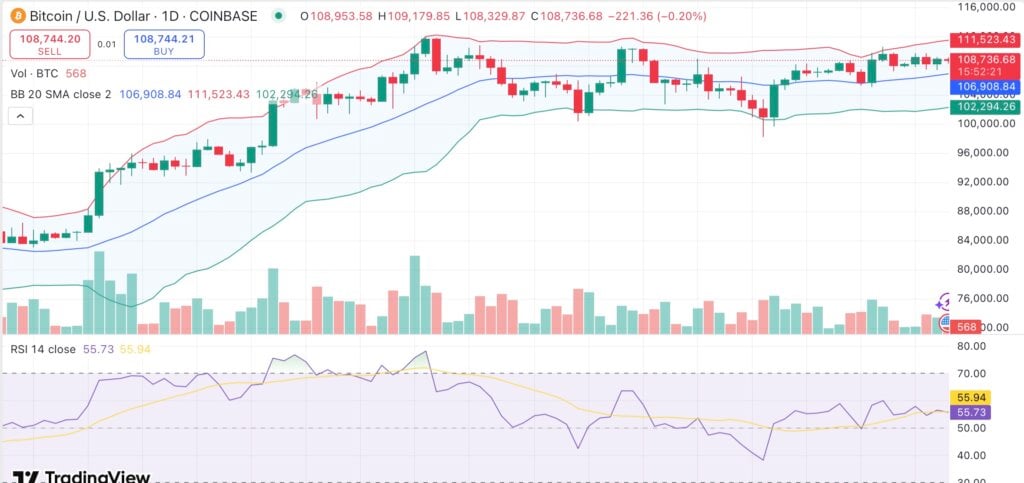 Bitcoin price analysis. Credit: crypto.news
Bitcoin is currently trading above all of its major moving averages, which typically denotes an overall upward trend and implies that any declines may quickly find support. A slight widening of the Bollinger Bands suggests that price volatility may increase soon.
Traders are keeping an eye on whether Bitcoin can break through resistance at $110,300 or if it will drop below support at $107,100. For the time being, the declining dollar creates favorable conditions for a possible Bitcoin rally. However, the speed at which traders take action may determine whether history repeats itself.
Disclaimer: The content of this article solely reflects the author's opinion and does not represent the platform in any capacity. This article is not intended to serve as a reference for making investment decisions.
You may also like
AI investment enters the "Trough of Disillusionment", the next 18 months will be a life-or-death test!
Goldman Sachs believes that the AI investment cycle is currently in the "trough of disillusionment," but this is not the first time. The core contradiction lies in the fact that the business models of new cloud computing providers are highly dependent on end-user returns from AI spending, while currently "there are basically zero companies that can attribute profits to AI." Social Capital founder Palihapitiya has clearly defined an 18-month key window, during which the market will decide which AI business models are sustainable and which are not.

Anthropic's Core Concern: Revenue Can Be Withdrawn at Any Time, but Computing Power Costs Are Locked in for up to 20 Years
Zheshang Securities believes that Anthropic's revenue is mainly based on usage-based billing, with remaining performance obligations covering only about 5.1 months of annualized revenue, while compute power costs are already locked in with $895.4 billion in irrevocable commitments, some extending as far as 2045. Revenues can be reduced at any time, but costs are non-exitable, creating a highly asymmetric maturity gap between the two—this is the company's real core constraint.

Triple Pressure from the Federal Reserve, Treasury, and Congress; Goldman Sachs: Liquidity Crisis May Occur in 2027
Goldman Sachs warns that the reserve ratio of bank assets has dropped to around 11%, only slightly above the crisis trough of 2019. In the second half of 2027, a deadlock in debt ceiling negotiations will force the Treasury to rebuild the TGA, triggering a "perfect storm" of a sharp drop in reserves and a surge in T-bill supply; combined with stalled money market fund buying, this will create a huge liquidity black hole. The Federal Reserve could be forced into the awkward position of lowering interest rates and launching large-scale bond purchases to rescue the market.

Crypto prices
More


