

The U.S. Securities and Exchange Commission (SEC) has acknowledged the Truth Social Bitcoin and Ethereum ETF application, officially starting the regulatory review process.
The ETF proposal was filed by Trump Media & Technology Group on June 16, 2025.
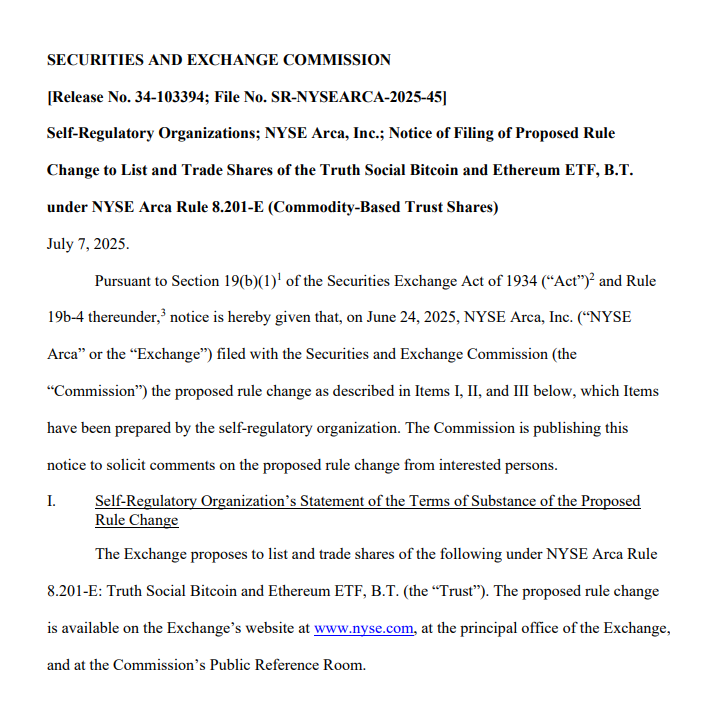 Truth Social Bitcoin and Ethereum ETF Filing. Source: SEC.gov
The Truth Social ETF filing aims to list a spot exchange-traded fund that allocates 75% to Bitcoin and 25% to Ethereum.
The shares would trade on NYSE Arca. According to the SEC’s standard process, the review timeline can stretch up to 240 days, unless a new rule framework reduces the review period.
The filing enters the review stage alongside several other applications for crypto ETFs, as the SEC considers streamlining approval procedures through a unified listing framework.
Crypto.com to Custody Assets, Yorkville to Sponsor ETF
The Truth Social Bitcoin and Ethereum ETF names Crypto.com, operating under Foris DAX Trust Company, as the custodian.
It will store the fund’s Bitcoin and Ethereum in separate cold storage wallets. The firm will keep private keys in offline storage and segregate assets from customer holdings.
Yorkville America Digital is listed as the sponsor of the ETF. It will manage daily operations, regulatory compliance, and fund structure.
The Truth Social ETF filing specifies that the fund’s Net Asset Value (NAV) will be calculated daily. For Bitcoin, it will use the CME CF Bitcoin Reference Rate.
For Ethereum, it will rely on the CME CF Ether-Dollar Reference Rate, unless the sponsor decides to use another method.
The ETF filing also confirms that each asset will be held in separate accounts to prevent mixing with other client assets. These measures are detailed in the filing to ensure security and transparency.
Fidelity Solana ETF Faces New Delay
The SEC has delayed its decision on the Fidelity Solana ETF, extending the comment period.
The Cboe BZX Exchange filed the original request to list the Solana ETF on March 25, 2025.
On July 8, the SEC opened a new window for public feedback. The public has 21 days to submit comments and 35 days for rebuttals. This extension is part of the review process and does not represent approval or rejection.
Bloomberg ETF analyst James Seyffart posted on X that the delay was expected. He confirmed that the SEC has not signaled any final stance yet.
The decision is pending further engagement and document updates from the exchange and issuer.
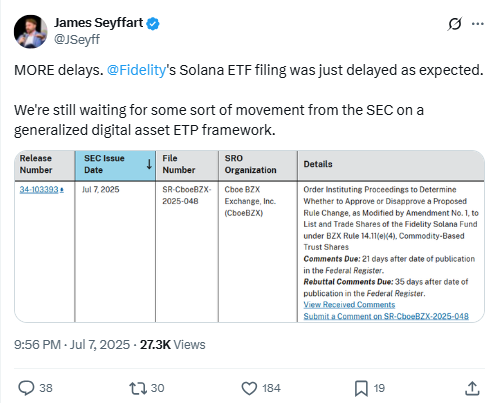 Fidelity Solana ETF Delay Update. Source: James Seyffart via X
SEC Works on Unified Framework for Digital Asset ETPs
In parallel, the SEC is reportedly developing a generalized digital asset ETP framework. This framework could simplify how spot crypto ETFs like the Truth Social Bitcoin and Ethereum ETF are reviewed and listed.
Currently, most ETF applications go through the 19b-4 exemption process, which can take months. The new structure could shorten that review window to around 75 days, based on existing reports.
According to Seyffart, the SEC has also asked Solana ETF issuers to amend and refile their applications. He clarified on X that this step is procedural and not a sign of approval.
“Pretty much any sort of interactions between SEC and issuers/exchanges should be viewed positively,” he posted, emphasizing the role of documentation and feedback in the ETF review cycle.
The Truth Social ETF filing, along with other applications, will now be reviewed under these evolving processes, with further updates expected in the coming weeks.





