
Mexican hotel chain Murano adopts Bitcoin treasury and considers accepting BTC payments

Nasdaq-listed hotel franchise Murano decides to add Bitcoin to its balance sheet, joining a global trend of companies inching towards BTC. The company is also considering accepting payments in BTC.
According to a recent press release , the Mexican real estate and hotel chain has already made a starting purchase of 21 BTC prior to the announcement being made. At press time, the company’s BTC ( BTC ) holdings is worth $2.27 million.
In order to carry out this new strategy, the firm plans to execute a standby equity purchase agreement of up to $500 million with Yorkville. Most of the funds raised from the sale of shares will be used primarily to stock up on BTC for its treasury.
The company also claimed to be reviewing and exploring operational initiatives, including accepting BTC payments and the deployment of BTC reward programs in the future, especially with regards to its hotel operations.
In addition, the Nasdaq -listed firm also plans to pursue sale and leaseback transactions to “unlock” the funds necessary for a long-term goal of Bitcoin accumulation. It claimed that it will not abandon its real estate and hotel management strategy, instead it will run both alongside its BTC strategy.
Murano’s business model is similar to that of Metaplanet, Asia’s largest corporate BTC holder. Metaplanet started off as a Tokyo-based hotel management firm but is now mostly known for its Bitcoin-focused operations.
In fact, Metaplanet still owns and runs a hotel in Tokyo that it plans to reopen under the name “The Bitcoin Hotel.” According to the company’s “ manifesto “, the hotel will be open to the public by the first quarter of 2026.
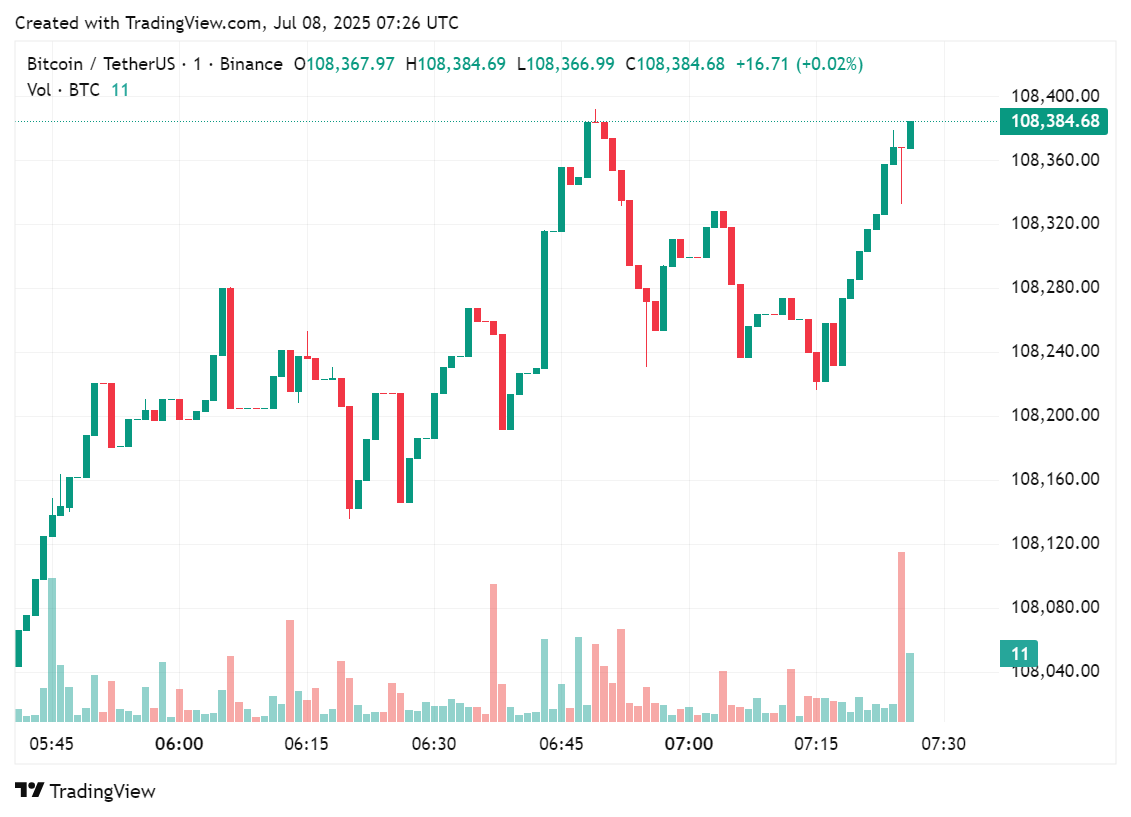 Price chart for Bitcoin in the past few hours, July 8, 2025 | Source: crypto.news
Among its capital-raising strategies, Murano plans to prioritize the development of real estate properties to drive better capital efficiency, unlock balance sheet liquidity , as well as generate improved yield for company shareholders.
One of the real estate development projects mentioned include residential condominiums planned for the next phase of then firm’s ongoing Grand Island Cancun project.
Chairman and CEO of Murano, Elias Sacal, said that the new Bitcoin treasury strategy will complement the firm’s core business model built upon the real estate and hospitality sectors. He hopes that the adoption of BTC investments would serve to enhance the value of the company’s holdings.
“We see Bitcoin as a transformative asset that not only offers long-term growth potential but also strengthens our balance sheet against inflation and systemic risk,” said Sacal.
Earlier this month, Murano joined an alliance of companies led by BTC Inc & Michael Saylor’s Strategy dubbed “Bitcoin for Corporations.” The aim of the alliance is to drive corporate adoption of Bitcoin among its members, led by the largest corporate BTC holder in the world.
Disclaimer: The content of this article solely reflects the author's opinion and does not represent the platform in any capacity. This article is not intended to serve as a reference for making investment decisions.
You may also like
AI investment enters the "Trough of Disillusionment", the next 18 months will be a life-or-death test!
Goldman Sachs believes that the AI investment cycle is currently in the "trough of disillusionment," but this is not the first time. The core contradiction lies in the fact that the business models of new cloud computing providers are highly dependent on end-user returns from AI spending, while currently "there are basically zero companies that can attribute profits to AI." Social Capital founder Palihapitiya has clearly defined an 18-month key window, during which the market will decide which AI business models are sustainable and which are not.

Anthropic's Core Concern: Revenue Can Be Withdrawn at Any Time, but Computing Power Costs Are Locked in for up to 20 Years
Zheshang Securities believes that Anthropic's revenue is mainly based on usage-based billing, with remaining performance obligations covering only about 5.1 months of annualized revenue, while compute power costs are already locked in with $895.4 billion in irrevocable commitments, some extending as far as 2045. Revenues can be reduced at any time, but costs are non-exitable, creating a highly asymmetric maturity gap between the two—this is the company's real core constraint.

Triple Pressure from the Federal Reserve, Treasury, and Congress; Goldman Sachs: Liquidity Crisis May Occur in 2027
Goldman Sachs warns that the reserve ratio of bank assets has dropped to around 11%, only slightly above the crisis trough of 2019. In the second half of 2027, a deadlock in debt ceiling negotiations will force the Treasury to rebuild the TGA, triggering a "perfect storm" of a sharp drop in reserves and a surge in T-bill supply; combined with stalled money market fund buying, this will create a huge liquidity black hole. The Federal Reserve could be forced into the awkward position of lowering interest rates and launching large-scale bond purchases to rescue the market.
Crypto prices
More


