
Calamos unveils ‘Protected Bitcoin’ strategy for institutional investors

Investment firm Calamos has unveiled a new investment strategy aimed at limiting Bitcoin’s downside potential.
Bitcoin (BTC) is becoming increasingly attractive to institutions, but many still view it as too risky. In response, on June 7, global investment firm Calamos introduced its “protected Bitcoin” strategy , designed to limit both the downside and the upside of Bitcoin exposure.
The firm noted that although Bitcoin has reached a $2 trillion valuation, institutional investors remain concerned about its volatility. As a result, most allocate just 1–2% of their portfolios to BTC to avoid outsized risk exposure.
Calamos has structured its strategy to offer some upside participation while managing risk by combining Bitcoin futures with U.S. Treasuries. Specifically, the firm purchases zero-coupon U.S. Treasury bonds maturing at the end of the year.
Calamos pairs treasuries with Bitcoin
These Treasuries act as a protective floor in predefined worst-case scenarios, limiting losses to 0%, 10%, or 20%, depending on the risk tier. Simultaneously, Calamos buys call options on the Bitcoin Index to capture potential gains. To fund these, the firm also sells out-of-the-money call options, effectively capping the upside between 25% and 60%.
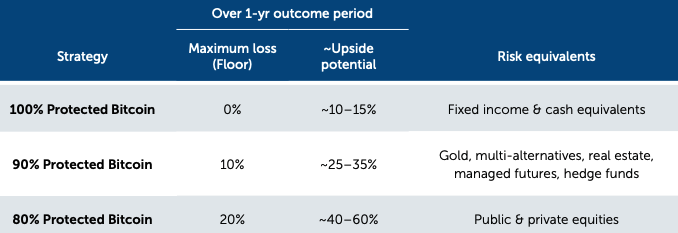 Calamos risk-reward tiers | Source: Calamos
Each risk-return tier is benchmarked to familiar asset classes. The 100% protected Bitcoin tier mirrors the risk profile of Treasuries, offering capital preservation with virtually no downside risk. The second tier is comparable to gold or alternative assets, while the third tier aligns with equities in terms of expected returns and volatility.
Calamos believes this structured approach could enhance Bitcoin’s appeal relative to traditional assets. However, timing remains critical. Traders must hold positions to maturity to benefit from the downside protection; early exits could result in loss of principal. While rare, another risk includes potential sovereign debt default, which the firm notes is highly unlikely.
Disclaimer: The content of this article solely reflects the author's opinion and does not represent the platform in any capacity. This article is not intended to serve as a reference for making investment decisions.
You may also like
AI investment enters the "Trough of Disillusionment", the next 18 months will be a life-or-death test!
Goldman Sachs believes that the AI investment cycle is currently in the "trough of disillusionment," but this is not the first time. The core contradiction lies in the fact that the business models of new cloud computing providers are highly dependent on end-user returns from AI spending, while currently "there are basically zero companies that can attribute profits to AI." Social Capital founder Palihapitiya has clearly defined an 18-month key window, during which the market will decide which AI business models are sustainable and which are not.

Anthropic's Core Concern: Revenue Can Be Withdrawn at Any Time, but Computing Power Costs Are Locked in for up to 20 Years
Zheshang Securities believes that Anthropic's revenue is mainly based on usage-based billing, with remaining performance obligations covering only about 5.1 months of annualized revenue, while compute power costs are already locked in with $895.4 billion in irrevocable commitments, some extending as far as 2045. Revenues can be reduced at any time, but costs are non-exitable, creating a highly asymmetric maturity gap between the two—this is the company's real core constraint.

Triple Pressure from the Federal Reserve, Treasury, and Congress; Goldman Sachs: Liquidity Crisis May Occur in 2027
Goldman Sachs warns that the reserve ratio of bank assets has dropped to around 11%, only slightly above the crisis trough of 2019. In the second half of 2027, a deadlock in debt ceiling negotiations will force the Treasury to rebuild the TGA, triggering a "perfect storm" of a sharp drop in reserves and a surge in T-bill supply; combined with stalled money market fund buying, this will create a huge liquidity black hole. The Federal Reserve could be forced into the awkward position of lowering interest rates and launching large-scale bond purchases to rescue the market.

Crypto prices
More


