
Ethereum's Next Level: Vitalik Buterin Unveils a 10X Scalability Plan

Ethereum is a machine of promises. With each update, the crypto world holds its breath. Yet, the gap between ambition and reality fuels criticism. Some see it as an eternal “almost ready.” But Vitalik Buterin, true to his rhythm, is picking up pace again. He wants to make a big impact. The coming year promises to be decisive. Because according to him, the time has come: Ethereum will finally transform for good.

In Brief
- Vitalik Buterin announces a 10x scaling of Ethereum Layer 1 in a year and a half.
- Increasing the gas limit and integrating stateless clients form the core of the plan.
- Censorship resistance and decentralization are priorities in this overhaul.
- High costs on Layer 2 push for strengthening Ethereum at its main layer.
Ethereum Scalability Overhaul: Buterin Goes on the Offensive
From Prague, during ETHGlobal, Vitalik Buterin did not just speak. He set a milestone. He announced a tenfold scaling of Ethereum Layer 1. And this, in just over a year. This announcement comes after a dull period for ETH. But it revives hopes and provokes skeptics.
The challenge is clear: Ethereum must not only exist, it must accelerate. Calls for scaling up Layer 1 are multiplying. Vitalik prefers caution over sensationalism. “It will be the right time to take a little breather“, he says, adding that the network must preserve its decentralization.
This timeline does not seek buzz, but a serious rebuild. Vitalik is preparing Ethereum to meet tomorrow’s challenges while avoiding disrupting the current balance.
Scalability Designed to Last: Tools and Limits
To achieve this goal, Ethereum relies on several technical levers. First, the increase in the gas limit, already raised from 30 to 36 million. But this is just the beginning. The core of the plan rests on stateless clients, an overhaul of the EVM, and deep optimizations.
The idea is not just to go faster. It is about preserving censorship resistance, ensuring decentralization, and making the network more resilient. These improvements are slow to deploy. And for good reason: they must withstand the real pressure of the network.
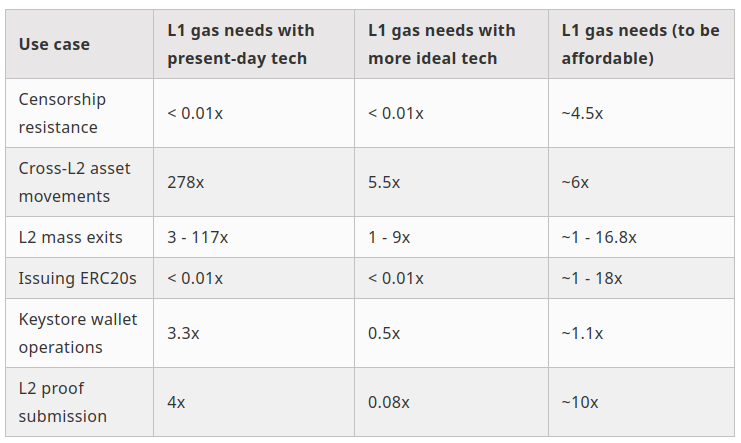 Vitalik Buterin details in his L1 gas limits table the current constraints and development prospects for the Ethereum network.
Buterin reminds that some costs, like inter-L2 transfers or mass exits, skyrocket in case of congestion. He wants to anticipate this without betraying fundamental values.
It will be a good occasion to check that we are on track in terms of decentralization.
Vitalik Buterin
The technical means are there. But the road is winding, and every technical choice is an ideological trade-off.
What Future for Ethereum and Its Native Crypto?
With such an ambitious goal, Ethereum hopes to reshape its trajectory. The ETH crypto, often battered during stagnation periods, could benefit. As scalability improves, institutional interest rises.
SharpLink Gaming envisions $2 billion in ETH purchases. This is a strong signal. But the future remains contingent on the network’s ability to deliver. Criticism mounts: empty promises, chronic slowness, unclear roadmap. Yet, something is moving. The network’s architecture is changing to adapt to a multi-layer reality.
Some key figures:
- The gas limit rose from 30M to 36M in May 2025;
- The average cost of a Layer 2 bypass reaches $4.50;
- A cross-L2 asset transfer costs nearly $14;
- The goal is to reduce these fees to $0.28 with 6x scaling;
- In crisis situations, Layer 2 exits would cover up to 32M users.
These figures show the magnitude of the challenge. But they also outline a direction. If results follow, Ethereum could dominate the next decade of decentralized finance (DeFi).
Making Ethereum a simpler, more robust, and more universal network : that is Buterin’s ultimate goal. While patience is still required, the machine is underway. The task is colossal, but the plan is set. Ethereum moves forward, slowly but surely, toward a new era.
Disclaimer: The content of this article solely reflects the author's opinion and does not represent the platform in any capacity. This article is not intended to serve as a reference for making investment decisions.
You may also like
SUI Price Faces Bearish Pressure Despite Account Growth

Avalanche Price Prediction November 2026: Can AVAX Break $9.03?

US CPI Exceeds Expectations Again, Waller's Warning Comes True! Wall Street Focuses on Whether December Rate Hike Will Be 25 or 50 Basis Points; "New Fed News Agency": Stop-and-Go Strategy Faces Test
The "New Federal Reserve Newsletter" pointed out that before the release of the CPI, Waller suggested the possibility of a 50-basis-point rate hike in December, and so far, no other Fed officials have publicly responded. In addition to a single 50-basis-point hike, the Fed may also choose to signal consecutive rate hikes in December and January. Wall Street generally believes that inflationary pressures remain stubborn, further strengthening the case for a rate hike in December, though a 50-basis-point increase is not a consensus. The market is concerned about whether the Fed will extend the tightening cycle.
CPI Deals a Blow to US Bonds! 2-Year Yield Surges Over 20 Basis Points Intraday, Gold and Silver Plunge
After the release of the CPI, traders began to expect a lower likelihood of a 50 basis point rate hike in December; this year’s Federal Reserve voting member Logan stated that a faster pace of rate hikes may be needed this winter, with at least two more 25 basis point hikes required before pausing. Subsequently, the rise in U.S. Treasury yields continued to widen, with the 10-year yield climbing back above 5.0% and rising more than 10 basis points intraday; spot gold once fell over 3%, while spot silver at one point dropped more than 4%.
Crypto prices
More


