
Dogecoin (DOGE) Active Addresses Soar to Record High, Yet $1 Still Out of Reach

Dogecoin's active addresses have soared, but declining volume and bearish trends hint at challenges ahead. Can DOGE defy the odds and rally?
Active addresses on the Dogecoin (DOGE) network have reached a new all-time high following the meme coin’s significant price increase in the last 30 days. This milestone has, once again, sparked speculation that DOGE could hit $1 in the short term.
While the coin has the potential to reach that value this cycle, this on-chain analysis explains why it might not be as quick as expected.
Dogecoin Sees Rising Adoption, Decline Elsewhere
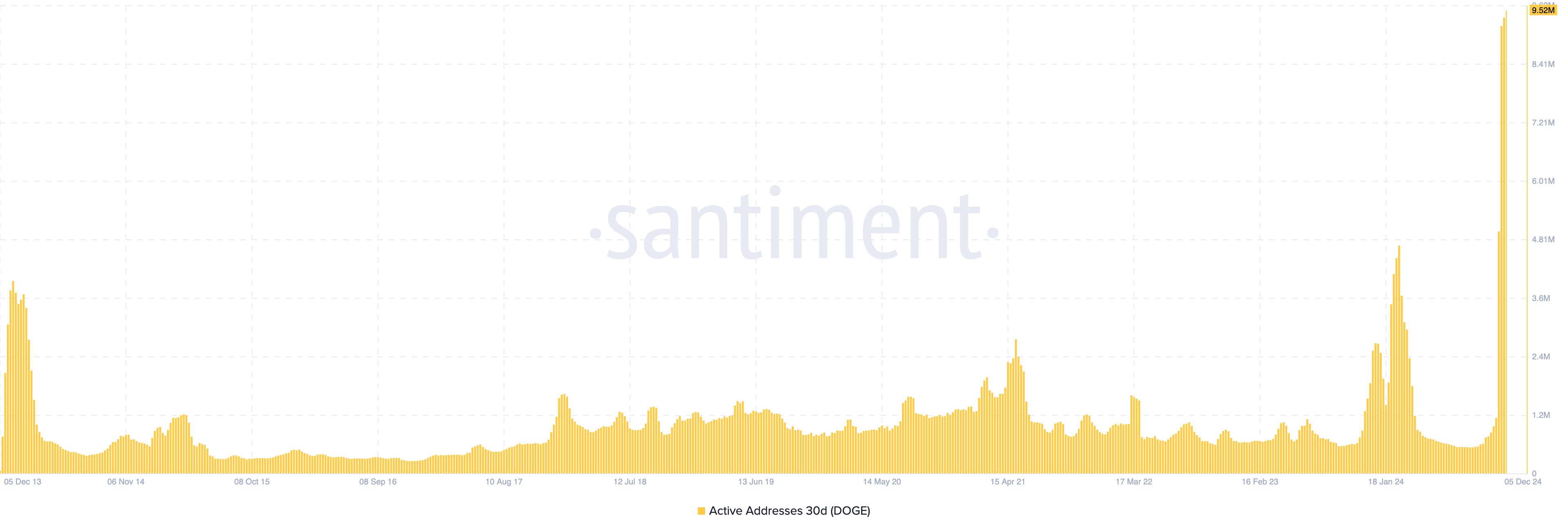
Data from Santiment shows that Dogecoin’s active addresses were less than 1 million on October 31. As of this writing, that has changed, and the metric has hit a new all-time high of 9.52 million.
Active addresses are widely used to estimate the number of users interacting on a network. It offers valuable insights into the network’s overall activity and user engagement, serving as a key indicator of blockchain adoption and interaction with a cryptocurrency.
When the reading increases, it means that many users interact with the crypto. On the other hand, a decrease indicates less traction. However, unlike November, when this metric climbed to a record high, and the signal was bullish, this notable rise might not drive a higher value for DOGE.
 Dogecoin Active Addresses. Source:
Santiment
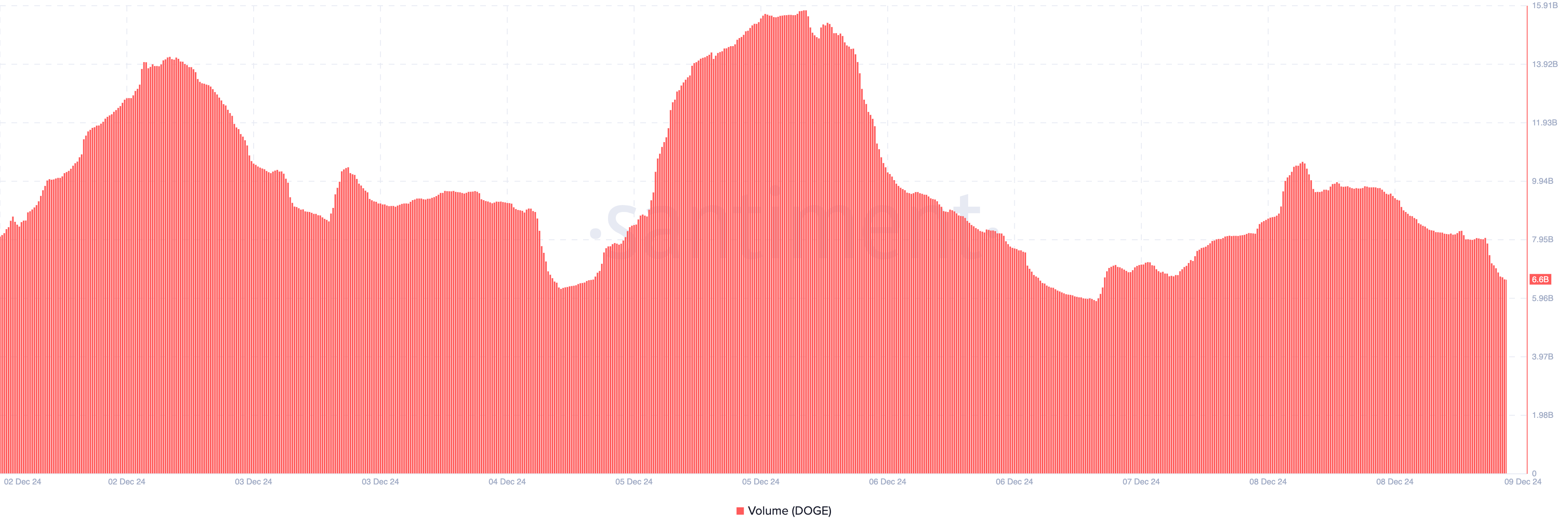
One reason for this assertion is Dogecoin’s volume. On December 5, the coin’s volume surpassed $15 billion, indicating that there was a lot of buying and selling.
Typically, when the volume increases alongside the price, it indicates further strength for the uptrend. As a result, DOGE’s price climbed to $0.48. However, as of this writing, the volume has dropped to $6.60 billion, indicating that broader interest in the meme coin has decreased.
Should this remain the case, Dogecoin’s value might find it challenging to rise quickly toward the $1 mark. Instead, it could face a decline below $0.45.
 Dogecoin Volume. Source:
Santiment
DOGE Price Prediction: Time to Cool Off
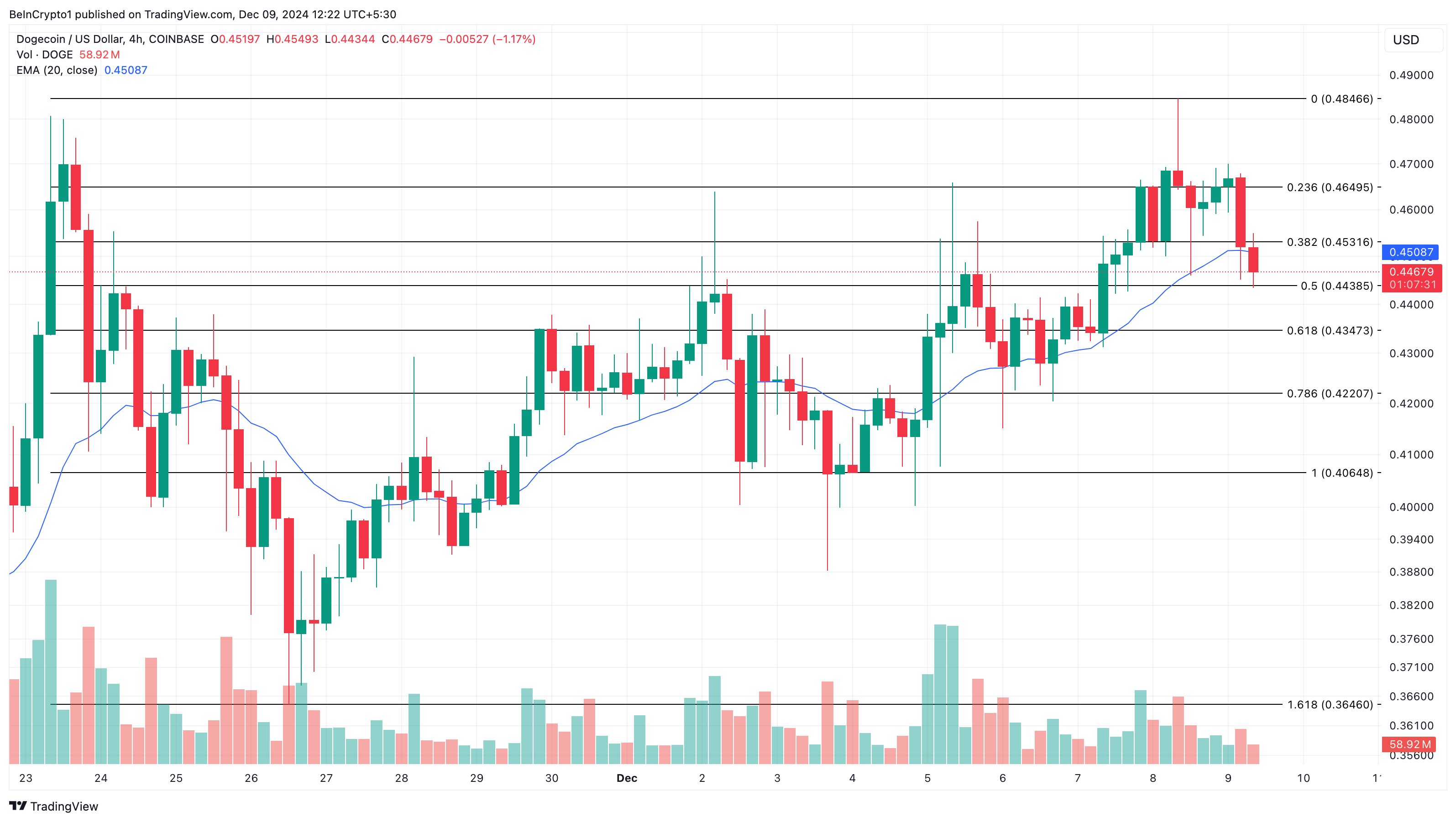
From a technical perspective, the 4-hour DOGE/USD chart shows that the coin’s price has dropped below the 20-period Exponential Moving Average (EMA).
The EMA detects a cryptocurrency’s trend by analyzing its price changes. When the price rises but is below the EMA, the trend is bullish. On the flip side, if the price drops below the indicators, the price is bearish, and the downtrend can accelerate.
According to the image below, Dogecoin’s price, at $0.45, is below the 20 EMA (blue). Considering this condition, then the coin’s price could go lower, with the Fibonacci retracement indicator suggesting that it could decline to $0.42.
 Dogecoin 4-Hour Analysis. Source:
TradingView
However, if DOGE rises above the EMA, the trend might change. In that scenario, the price might surpass $0.48 and move closer to $1.
Disclaimer: The content of this article solely reflects the author's opinion and does not represent the platform in any capacity. This article is not intended to serve as a reference for making investment decisions.
You may also like
Assessing if Avalanche’s growing network activity can spur AVAX’s price recovery

Berkshire's stock hits a new high amid tech plunge as return to yen bonds sparks heated "increase positions in Japan" discussion
Berkshire Hathaway has hired banks to prepare for its first yen bond issuance since April, aiming to raise more funds in Japan. According to sources familiar with the matter, Berkshire has mandated Mizuho Securities and Bank of America Securities for a potential benchmark yen bond issuance, which is expected to take place in the near future, though the exact timing will depend on market conditions.
Nomura's monopoly is being challenged! Mizuho (MFG.US) is reshaping Japan's underwriting landscape with global IPOs
Mizuho is establishing a solid foothold in Japan's equity capital market by leveraging a unique and highly profitable track: on one hand, it is tapping into the strong demand for AI financing from the US market, and on the other, connecting with the vast domestic household savings in Japan.

Crypto prices
More


