
Bitcoin investment overview: long-term correlation with gold and Nasdaq, liquidity remains the key driving force
Original author: ECOINOMETRICS
Original translation: TechFlow
If you zoom out from the day-to-day fluctuations in major asset classes, you’ll find a big trend.
This trend ties together Bitcoin, gold, and leading companies that hold a significant position in the stock market, and it is affecting everything downstream.
This is the big picture we should focus on.
Key Points
This week we look beyond short-term correlations and take a longer-term view. When we look at the big picture, here’s what we learned:
Bitcoin’s price trends are closely correlated with gold and Nasdaq in the long term, driven primarily by global liquidity conditions.
Many crypto assets, miners, and related stocks follow the trend of Bitcoin. Investing in these assets is actually betting on the direction of Bitcoin.
Financial conditions in the United States are easing, creating a favorable environment for Bitcoin and related assets.
Current liquidity supports Bitcoin, but a potential U.S. recession remains a key risk to watch.
Understanding these long-term trends and macro correlations is critical to effectively navigating the crypto markets.
Looking at macro correlations
Since we started this correlation report, I have typically focused on shorter time frames. For us, short means monthly scale, so we typically look at changes in correlations over a 1-month rolling window.
This approach helps identify potential turning points, but also introduces relatively high noise (so some guesswork is required in the analysis).
Sometimes its worth taking a longer-term view to better understand long-term trends.
When I first got into the quantitative business about 15 years ago, it was still possible to find information advantages in short time frames. But as time has gone on, those advantages have become harder to capture, and I believe having a deep understanding of the bigger picture of long-term trading is where the real advantage lies.
So today, I decided to tweak some parameters and study the evolution of Bitcoin’s trend similarity score with several “macro” assets over a 1-year rolling window.
This approach helps ensure we don’t miss the forest for the trees and gives us a clearer overall picture.
Here are the results. As a reminder, a trend similarity score close to 1 means that both assets are trending in the same direction, while a score close to -1 suggests that they are trending in opposite directions.
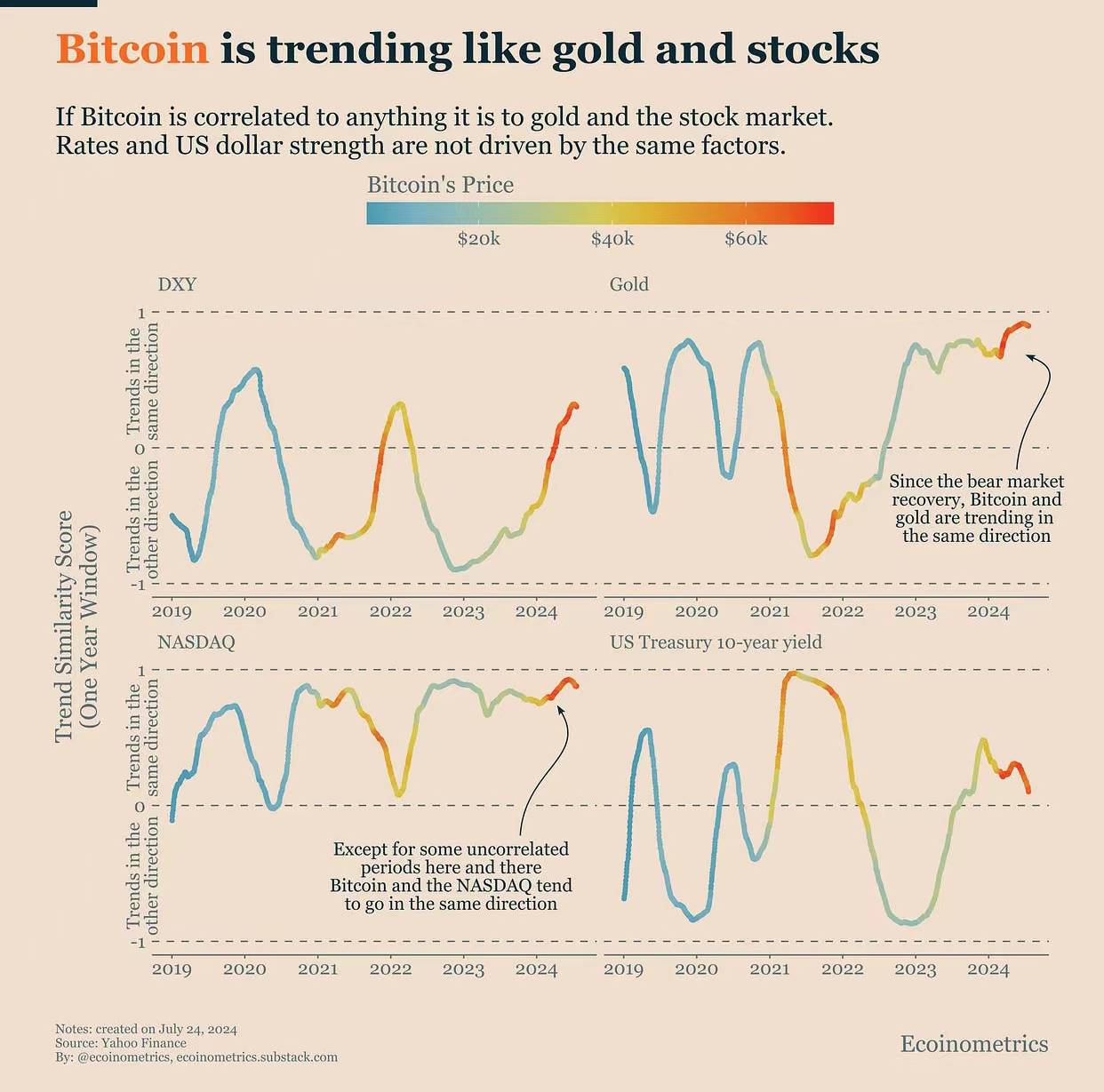
Is Bitcoin greatly affected by the strength and weakness of the US dollar (DXY)? No. The trend similarity score only fluctuates between positive and negative values.
Is Bitcoin correlated with interest rate movements? Again, not much. The trend correlation we see is similar to the pattern seen with DXY.
However, when you look at gold and the Nasdaq, you see a more consistent relationship. Especially since we’ve been through the recent bear market, the correlation between Bitcoin, gold, and the Nasdaq has been very strong.
This is no coincidence. There is a common factor that ties all three together: global liquidity.
Global liquidity drives these assets by influencing risk appetite and investment flows. Loose monetary policy not only boosts risk assets such as Bitcoin and tech-focused Nasdaq stocks, but also gold as a hedge against potential inflation. As liquidity fluctuates, these assets tend to move in sync, reflecting broader economic conditions and investor sentiment.
This has downstream effects.
Downstream effects of Bitcoin
Here we are talking about correlation, not potential causation.
However, it is fair to say that we can divide the world into leaders and followers.
For example, Global Liquidity is the leader and Bitcoin is the follower. Or Bitcoin is the leader and MicroStrategy is the follower.
When it comes to Bitcoin followers, we can identify several natural categories:
Crypto assets (such as Ethereum)
Assets that derive value from Bitcoin (e.g., miners, MicroStrategy)
Assets that indirectly profit from the growth in Bitcoin value (such as Coinbase)
By looking at the trend similarity scores of these assets over a 1-year period, we can see some typical behavior patterns. Let’s look at a few examples:
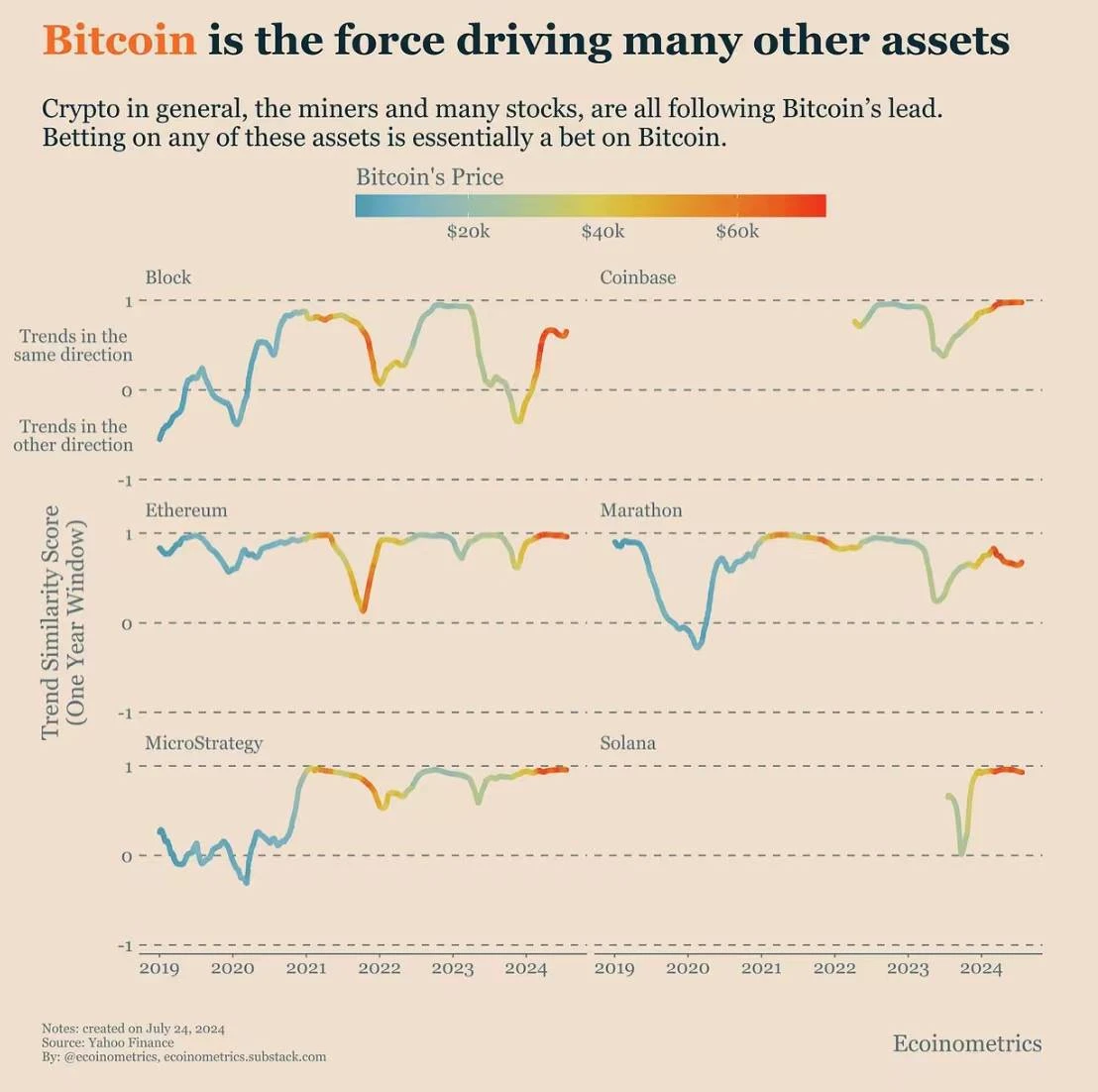
The rule basically goes like this: Over a long enough timeframe (like a year), the trend correlation between Bitcoin and all directly or indirectly related assets is very high.
Actually, very high isnt quite the right word. I should say these trends are very strongly correlated.
Betting on any of these assets is essentially the same as making a directional bet on Bitcoin. Yes, some of these assets will grow faster than others. But they will all boom or bust together.
The good news is that current conditions appear favorable for these assets to thrive.
Liquidity tailwind
A few months ago, we discussed that the financial situation in the United States is at a critical juncture.
There are two possible scenarios:
If inflation worsens, we face the risk of “higher rates for longer” and more rate hikes. Even the threat of this would lead to a tightening of financial conditions and a reduction in the liquidity of financial assets.
If the inflation situation improves, the Fed may start to cut interest rates. This will probably lead to looser financial conditions than at that time. In the end, the loose scenario prevailed. This is already evident from the trend of the National Financial Conditions Index.
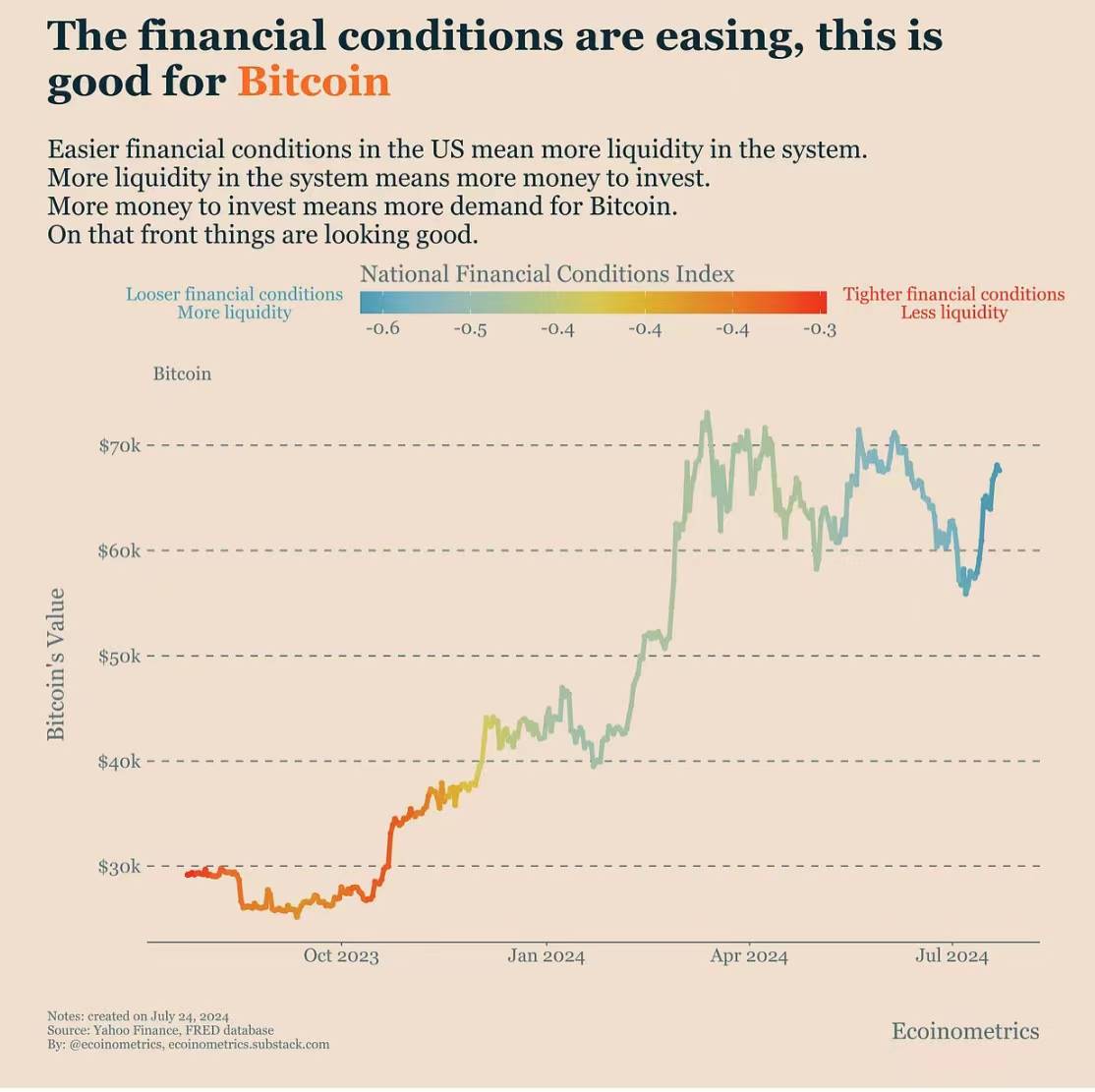
It is very dangerous to fight against liquidity. After the 2008 financial crisis, liquidity became the driving force of everything.
As financial conditions ease in anticipation of rate cuts, Bitcoin (and its related assets) will see a tailwind.
The only thing that could break that trend is a recession in the U.S. So Im watching the pace of change in the job market closely.
Disclaimer: The content of this article solely reflects the author's opinion and does not represent the platform in any capacity. This article is not intended to serve as a reference for making investment decisions.
You may also like
U.S. non-farm payrolls surge by 165,000 in October, far exceeding expectations! Unemployment rate unexpectedly drops to 4.1%, December rate hike expectations intensify
In October, US non-farm payrolls increased by 165,000, which is 2.5 times the Wall Street median forecast of 65,000 and represents an exceptionally strong deviation of about 5 standard deviations, exceeding the upper limit of all institutional forecast ranges. The unemployment rate unexpectedly fell from 4.2% to 4.1%, while the market had expected it to remain unchanged; average hourly wages also accelerated year-on-year growth to 3.1%. Meanwhile, the previous two months' non-farm payrolls were revised upwards by a total of 84,000. Following the release of the data, the yield on 2-year US Treasury bonds rose by 7 basis points, and the pricing of the probability of a Fed rate hike in December climbed to 70%.
AI Sell-off Hits Anthropic IPO, Potential Valuation Expected to Drop to $1.2–1.3 Trillion
The valuation range discussed by potential investors has been lowered from the previous high of $2 trillion to between $1.2 trillion and $1.3 trillion, and some strategists have even suggested going below $1 trillion to ensure safety. In the face of significant market volatility and financial concerns such as quarterly losses, Anthropic is facing tough decisions, including a discounted valuation, reducing the size of the offering, or postponing the listing.

Moderna Q3 revenue up 29% year-on-year, far exceeding expectations, raises full-year revenue growth guidance to 15%-25% | Earnings Report Insight
Moderna's Q3 revenue increased by 29% year-on-year to $1.31 billion, with profits significantly exceeding expectations. The company raised its 2026 revenue growth guidance to 15%-25%. The ramp-up of next-generation COVID-19 and flu vaccines, along with international market expansion, has driven performance improvement. Phase III data for the personalized cancer vaccine has also shown positive progress. The company is simultaneously advancing cost reduction and pipeline R&D, with year-end cash expectations significantly raised.
Crypto prices
More


