
Waller sends strong rate hike signal, gold price surges then retreats

Huitong Network, November 10th—— Easing US-Iran tensions support gold prices, Waller hints at possible 50BP rate hike, gold surges then comes under pressure
During Tuesday (November 10th) Asia-Europe session, international gold prices experienced a volatile surge and pullback, dominated by two main themes: on one hand, weakened White House control over Congress and easing Middle East tensions have lowered the inflation ceiling, prompting a staged rebound in gold; on the other hand, hawkish comments from Federal Reserve officials have revived rate hike expectations, capping the gold price rebound and intensifying the tug-of-war between bulls and bears.
Geopolitical easing boosts gold rebound, hawkish Fed remarks cause immediate price retracement
Recently, gold initially rallied, primarily driven by the US White House losing control of both chambers of Congress.
The Trump administration’s foreign policy faced limitations, leading markets to price in a lower probability of full-scale US-Iran conflict escalation and large-scale tariff disputes. The inflation ceiling driven by Middle East geopolitics was thus lowered, attracting safe-haven capital into gold.
However, the rally failed to last as Fed Governor Waller sent a clear hawkish signal, directly dampening bullish sentiment and causing gold prices to fall. In his London speech, Waller stated that even if October inflation data shows cooling compared to September, he still supports a 25-basis-point rate hike in December;
Currently, interest rate futures pricing shows about an 85% chance of a December hike to the 4.00%-4.25% range, with odds of another rate increase by next March surpassing 50%.
As a non-interest-bearing asset, rising rate hike expectations and higher real yields are the most immediate short-term drags on gold.
Houthi militants continue to harass Saudi facilities; although shipping in the Strait of Hormuz has partially recovered, security risks along the waterway persist. Geopolitical risks currently exhibit a “long-term unresolved, but short-term probability of escalation decreasing” pattern.
Falling oil prices reduce pressure for continuous global rate hikes
Easing US-Iran prospects have led oil prices into a period of weakness. Rapid oil price corrections have directly eased the inflation pressure propagated from energy to consumer goods, reducing the necessity for aggressive central bank rate hikes globally.
Although Goldman Sachs warns that Hormuz shipping remains fragile until a formal agreement is reached and maintains a high medium- and long-term oil price target, short-term geopolitical premiums are unwinding quickly, and the inflation threat from the energy side is temporarily cooling.
In terms of shipping, Saudi oil tankers now transit regularly with US coordination, October’s Hormuz LNG volume hit a new high since the outbreak of this round of conflict, and restored supply is further dampening any impulsive rise in oil prices.
Warning: Falling inflation amid high energy prices could signal recession
There is a key dialectical risk: if inflation continues to fall despite previous surges in energy prices, it does not necessarily indicate a victory in the war against inflation. It is more likely a sign of rapidly contracting end demand, a precursor to economic recession.
RBC Capital previously pointed out that rising commodity costs and high energy prices present a latent risk of inflation spillover, but the current market theme is shifting from “energy price hikes forcing rate increases” to “high energy costs eroding demand and fueling recession expectations.”
Waller also noted that US GDP momentum has weakened this quarter, consumer spending has slowed, and although the labor market remains broadly stable, high inflation remains the core policy focus.
As the inflation cycle ends, easing expectations can open up upside for gold
Once this round of anti-inflation measures nears an end, stabilizing growth and issuing economic stimulus packages are likely to become priorities for many countries’ policies.
Summary and technical analysis
First, Waller actually turned hawkish in May; sticking to his stance didn’t exceed market expectations much, and much of gold’s fallback can be attributed to profit-taking.
Second, the US October CPI is about to be released, with Deutsche Bank forecasting a significant month-on-month inflation drop. The mainstream market expects core CPI to rise 0.2% month-on-month, making this the last key inflation reference before the next Fed meeting. Due to last year’s US government shutdown, this CPI will not release a year-on-year figure, which makes interpretation harder and is a key basis for Waller’s judgment on the December rate hike. Additionally, the previous significant US stock market correction, stricter approvals for AI companies, and heavy capital expenditures could cause US GDP to decline, which would limit the Fed’s appetite for aggressive hikes.
KBC Bank also noted that falling energy prices and improved risk appetite led to a slightly weaker dollar, while US Treasury yields are oscillating as the market awaits CPI guidance.
Finally, in the Middle East, any diplomatic statement from the US and Iran, Strait transit news, or Houthi attacks could disrupt oil prices and inflation expectations—causing sharp gold volatility.
Technically: Although gold recently retreated after a breakout, it remains in a bullish pattern. Watch for support at the 5-day moving average and the breakout at 4060, which are important supports for this round of gold price action.
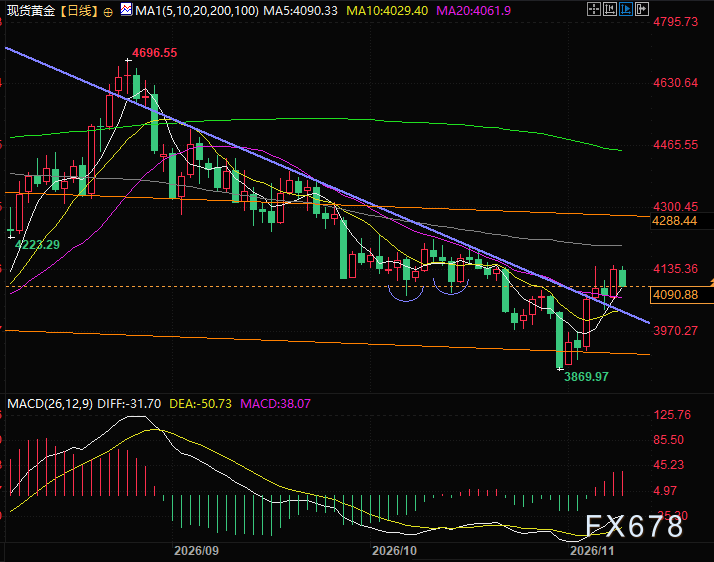
(Spot gold daily chart, source: Yihuitong)
At 17:32 (GMT+8), spot gold was trading at $4,089/ounce.
Disclaimer: The content of this article solely reflects the author's opinion and does not represent the platform in any capacity. This article is not intended to serve as a reference for making investment decisions.
You may also like
Ternos pressures Siri chief, Apple AI can't wait any longer

BlackRock Bitcoin ETF outflows hit $1.66 billion after seven-day streak
If Jensen Huang resigns, who could take over Nvidia? AMD's Lisa Su included in media candidates
AMD CEO Lisa Su, who holds a Ph.D. from MIT and led AMD back to growth while rebuilding customer trust during a crisis, is seen as a potential candidate. However, the competitive relationship between AMD and NVIDIA adds complexity to the succession process. Arm CEO Rene Haas, who worked at NVIDIA for seven years, is considered a smoother option for succession.
SoftBank reports first quarterly loss in two years! $3.7 billion impairment in US data center project, AI investments face pressure
SoftBank Group reported a net loss of 1.12 trillion yen in its second fiscal quarter, marking its first quarterly loss in nearly two years. The main reasons are the write-off of nearly $3.7 billion in advance payments due to adjustments in the procurement of power supply equipment for its AI data center in Ohio, USA, a shift of the Vision Fund from profit to loss, and a surge in the cost of high-debt financing. Since the June peak, SoftBank's share price has fallen more than 50%.
Crypto prices
More


