
Gold Trading Reminder: After a Turbulent Week, US CPI Takes Center Stage! Bulls and Bears Enter a Fierce Showdown

Huitong Network, Nov 9 — Last Friday, strong non-farm payrolls pushed down gold prices more than 1% intraday, but gold still rose 5% last week, marking the best weekly performance since late August. The dollar and US Treasury yields climbed, raising the probability of a December Fed rate hike back to 80%, creating short-term pressure; meanwhile, geopolitical risks and Indian physical demand provided support. This week, focus turns to US CPI, PPI, and several speeches from Fed officials— inflation data may be key to gold’s direction.
On last Friday (November 6), the gold market played out a roller coaster session that quickened the pulses of both bulls and bears. An unexpectedly robust US non-farm jobs report struck like a bolt from the blue, undermining the rebound in gold prices, with spot gold plunging over 1% intraday to a low of $4,028.43/oz, but recouped some losses by the close to end down 0.43% at $4,071.
Despite a "Black Friday"-style selloff, gold still posted a 5.2% gain over the week— its best weekly performance since late August. This contrast of “daily gloom, weekly brilliance” highlights the complex tug-of-war in the gold market: on one side, strong jobs data reinforced Fed hike expectations, boosting both the dollar and Treasury yields to pressure gold; on the other, geopolitical risks, physical demand, and safe-haven buying due to broader uncertainty lent support.
This week, with US October CPI and PPI and multiple Fed official speeches ahead, gold faces a real test of direction. In Asia’s early session on Monday (November 9), spot gold edged down, now trading near $4,060/oz. 
1. Non-Farm “Black Swan” Strikes: Gold Plunges, Dollar and Treasuries Surge
The immediate trigger for Friday’s gold decline was a strong US jobs report. Data from the Bureau of Labor Statistics showed non-farm payrolls increased by 165,000 in October—more than double economists’ expectations—while revised September job gains were 60,000 and the unemployment rate edged down to 4.1%. This suggests ongoing resilience in the US labor market, leaving the Fed more room to focus on inflation risks driven by Middle East tensions. Independent metals trader Tai Wong said, “After the broadly strong jobs report, gold gapped lower, but is now trying to rebound. This is a test of the recent rally.”
After the data, the dollar index surged 0.77% to 102.26, its biggest one-day gain in nearly five months. A stronger dollar makes gold—priced in dollars—more expensive for holders of other currencies, pressuring prices. At the same time, US Treasury yields also moved higher: the 10-year yield up 1.6 basis points to 4.85%, and the 2-year yield up 4.1 basis points to 4.52%. With both the dollar and yields—traditional “enemies” of gold—rising together, gold came under pressure. Spot gold fell over 1% intraday, hitting $4,028.43; December US gold futures settled down 0.9% at $4,074.90.
2. Weekly Chart Hit Best Since August: Physical Buying Shows Resilience
Even though gold retreated on Friday, the week’s overall performance was impressive. Spot gold was up 5% for the week—the best since late August—while silver, platinum, and palladium also posted weekly gains. Several factors contributed to these robust weekly gains. First, for most of last week, gold exhibited strong safe-haven qualities, rebounding from a cash market low of $3,870 to nearly $4,147, before pulling back under pressure from jobs data and higher oil prices. Marc Chandler, managing director of Bannockburn Global Forex, noted that gold mainly performed as a safe-haven last week but isn’t convinced a bottom is in; a break below $3,975 would confirm his concerns, with mild support at $3,935.
Second, strong physical demand also underpinned gold. The drop in prices spurred Indian retail demand ahead of the important Diwali festival. On October 30, gold dipped to $3,869.85/oz—a one-year low—sparking enthusiasm among Indian buyers. Diwali is a key period for gold consumption in India, and pre-festival physical buying often forms a price floor. Additionally, after Democrats won the US midterms, market worries over Middle East tensions eased, oil prices tumbled over 12%, slashing Fed rate hike pressures for December and prompting dip-buyers to enter the gold market, fueling a rebound.
But investors must keep watching geopolitical risks. After months of maritime blockades on Iran, the US is building the “Iron Gate Task Force” to tighten restrictions on Iran’s transport of advanced weapons and sanctioned goods via land and the Caspian Sea. In Saudi Arabia, there was a limited attack on the Riyadh Saudi Aramco building; over the weekend, the third “violating” oil tanker in the Strait of Hormuz exploded and caught fire. Although President Trump said another strike on Iran is “highly unlikely” if talks make progress, he also stressed US forces are prepared, with three carriers on full alert. This “neither make nor break” tense situation leaves markets nervous about the geopolitical outlook.
3. Fed Hike Expectations Reignite: December Chances Rise to 80%
After the jobs report, market expectations for Fed policy shifted significantly. According to CME’s FedWatch tool, traders now put December’s Fed rate hike odds at 80%—up from 72.8% before the jobs report, and about 67% last Thursday. Traders also predict the next, and likely final, rate hike will come as soon as next April—earlier than the previous forecast of June. This shift is direct pressure on gold: higher rates mean greater opportunity costs for holding non-yielding gold.
Fed official speeches further strengthened hike expectations. San Francisco Fed President Mary Daly said in an interview, “I expect we will have to tighten policy further.” She noted the strong labor market gives the Fed space to complete its inflation-cutting mission. Daly isn’t an FOMC voting member this year but is often aligned with the committee’s mainstream opinion.
St. Louis Fed President Musalem also said that in communications with local businesses, inflation is still their top concern. He advocates further hikes, saying, “The best thing we can do for growth and jobs is to bring inflation down promptly.”
New York Fed President John Williams said Friday that despite ongoing shocks, US growth remains remarkably resilient but inflation is too high and must return to 2%.
Fitch Ratings analyst Olu Sonola wrote after the jobs report that following strong GDP and consumer data the prior week, the jobs numbers again confirmed a very strong labor market, reinforcing that economic momentum is solid. Labor market resilience enables the Fed to keep its focus on inflation, driving policy discussions further toward a December hike.
4. The AI Cloud
The market turmoil caused by the AI boom shouldn’t be ignored. Last Thursday, the Nasdaq logged its biggest one-day drop in 19 months and S&P 500 lost about $3 trillion in value, as markets feared that, after the midterms, the US government would clamp down on AI development, slowing economic growth.
Democrats regained control of Congress in Tuesday’s midterms and won several governorships. Multiple winning Democratic governors promised to restrict data center construction, while Democratic congressional leadership is planning a new batch of AI regulation bills.
Worries over the AI outlook briefly drove traders to cut previously huge bets on a Fed rate hike next month,
However, the latest jobs report brought rate hike talks back to the fore. Daly commented that though tech stocks have rebounded, last week marked their fourth weekly drop—this doesn’t mean the market is dismissing the importance of data centers and cloud computing; stepping back from short-term swings, the rebalancing as investors reassess AI-driven growth is exactly what’s needed for orderly adjustment.
Musalem noted that the AI industry is driving up inflation via higher demand for commodities like copper. Even if these investments will eventually boost profits and productivity, monetary policy should focus on the present economy, not what might happen five years out.
5. Wall Street Split Widens: Retail Bullish, Analysts Cautious
Amidst such strongly opposing forces, Wall Street’s short-term outlook for gold is increasingly divided. Last week, 13 analysts took part in a Kitco News gold survey: four (31%) expect gold to rise this week; five (38%) see it falling; the other four (31%) are neutral or see sideways movement. At the same time, among 212 votes in Kitco’s online poll, after gold’s post-midterm rebound, retail sentiment soared again: 143 retail traders (68%) expect gold to rise this week. This contrast— expert caution, retail optimism— reveals market indecision at current levels.
Looking close up, analyst views vary. Adam Button, currency strategy director at investingLive, is bullish, saying price action held up well amid volatility and that seasonal tailwinds are starting. Adrian Day, CEO of Adrian Day Asset Management, cautions that while gold’s post-midterm rally has a logical basis, there may be over-optimism about easing Iran tensions and falling oil prices lowering inflation and Fed pressure; he foresees a likely short-term pullback this week.
Phoenix Futures and Options President Kevin Grady takes a broader view: if Democrats push a high-spending agenda in Congress, this may eventually weaken the dollar and benefit gold. He also notes jobs data reinforce future rate hikes, but focuses more on long-term trends than single reports; on Iran, he thinks Trump may have more room for negotiation or could keep the pressure up.
John Weyer, co-director of commercial hedging at Walsh Trading, stresses that the Fed and President still have the keys to the dollar and gold. While the election did remove some uncertainty, it has little impact on the Fed. He expects $3,900 and $4,000 are likely to hold, serving as re-entry zones for forced sellers, and thinks “returning to former prices” is easier than setting new highs; long-term, policy uncertainty from Trump itself forms the basis for gold’s safe-haven appeal.
6. This Week’s Outlook: Inflation Data and Fed Speak Will Set the Tone
Looking ahead, US inflation data and multiple central bank speeches are expected to dominate market sentiment this week, while the latest in US-Iran tensions and tech stock volatility may keep traders cautious. The US will release October CPI and PPI, crucial for December’s Fed decision, as well as weekly initial jobless claims. Cisco and Applied Materials will report earnings. Fed officials Barkin, Goolsbee, Logan, Schmid, Williams, Harker, and Daly will deliver speeches. US Treasury markets are closed Wednesday for Veterans Day. For gold, if inflation proves stubborn, December hike expectations will be reinforced, keeping gold under short-term pressure; but if inflation cools or geopolitics escalate, gold’s safe-haven traits could come to the fore again.
Overall, the gold market is now in a “short-term pressure, medium-term range, long-term support” phase. Friday’s strong non-farm data boosted both the dollar and yields and hiked December Fed odds to 80%—the core short-term headwind for gold. Still, last week’s 5% gain signals that safe-haven demand, physical buying, and fears over US politics and geopolitics are providing resilient support.
Wall Street analyst splits and continued retail optimism show the market has no clear direction yet. This week’s inflation data and Fed speeches are likely to provide the key clues. For investors, rather than chasing daily moves, it’s better to watch inflation trends, Fed policy signals, and US-Iran developments— seeking gold’s real anchor value amid volatility. After all, in a world where dollar credibility is eroded by deficits, geopolitics remain tense, and the AI revolution is reshaping the economy, gold’s long-term status as the ultimate safe asset is hardly shaken by just one jobs report.
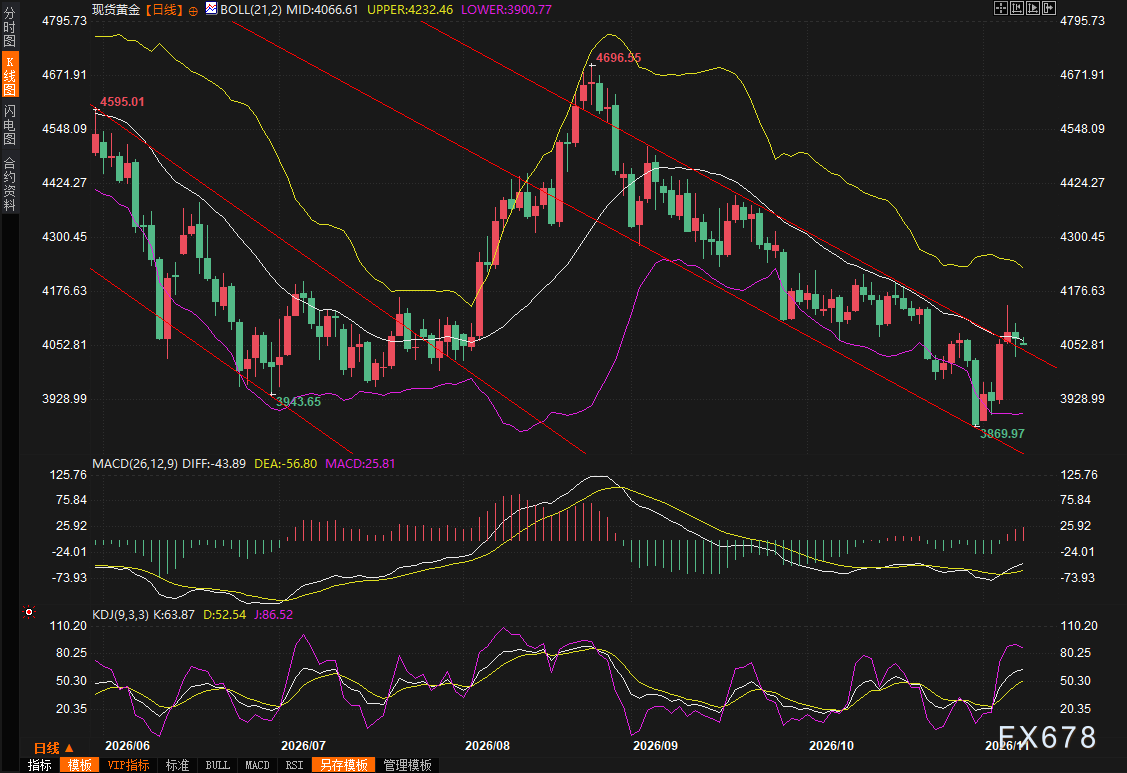
(Spot gold daily chart, source: Sounds Good Too)
East 8th Zone 07:52, spot gold now at $4,059.59/oz.
Disclaimer: The content of this article solely reflects the author's opinion and does not represent the platform in any capacity. This article is not intended to serve as a reference for making investment decisions.
You may also like
Morgan Stanley reviews the AI crash: It's the valuation that's being slashed, not the profits! But don't rush to bottom-fish.
Morgan Stanley stated that the AI pullback is driven by valuation contraction, while profit expectations continue to rise. It advises against indiscriminate bottom-fishing upstream sectors, recommending selective allocation to application players, with priority given to those in the US and Europe with safety cushions.

SpaceX (SPCX.US) Under the $500 Billion Growth Vision: Morgan Stanley Bets on AI Computing Power Explosion, "Big Bears" Warn of a Bubble
Morgan Stanley remains optimistic that the company's stock price could reach $300, while "Big Short" Michael Burry questions whether its high valuation can be sustained. The real disagreement between the two sides centers on whether SpaceX can leverage the synergistic advantages of rockets, satellite communications, and AI computing power to generate sustained cash flow sufficient to support a $1 trillion valuation.

AI Trading "Weather Vane": Meta's Bond Issuance Faces Multiple Twists and Turns
Meta's $46 billion Election Day bond issuance faced multiple challenges: a credit rating downgrade by S&P, Microsoft gaining market share, and political upheaval. The CFO personally presented to 500 investors, ultimately paying a real financial cost—the spread on the longest-term bonds widened by 90 basis points compared to April. The Democratic "blue wave" has sharply increased regulatory risks for AI data centers, tech bond spreads continued to widen last week, and whether AI capital expenditures can translate into returns remains the biggest question for the market.
CICC: Accelerated Employment Expansion, Fed Maintains Gradual Rate Hikes
China International Capital Corporation (CICC) released a research report stating that the baseline scenario remains that the Federal Reserve will raise interest rates once more in December and then shift to a wait-and-see approach.

Crypto prices
More


