
U.S. Stock Market Sell-off Storm! Quantitative and Leveraged ETFs Sold $70 Billion in One Day, Another $50 Billion in Sell Orders Coming

The sharp decline in US stocks triggered by the technology sector is causing a chain reaction of systematic strategy funds deleveraging. The scale and speed of selling are so significant that market pressure is unlikely to dissipate in the short term.
According to Pursuit Trading Desk, in a report released by the JP Morgan equity derivatives strategy team on November 5, US stocks experienced their worst single-day performance since "Tariff Day," with the S&P 500 index plunging 4.4% and the Nasdaq 100 index collapsing 6.4%. Quantitative strategy funds played a key accelerating role in this downturn—CTA trend-following strategies and leveraged ETFs collectively sold over $70 billion in equity exposure that day.
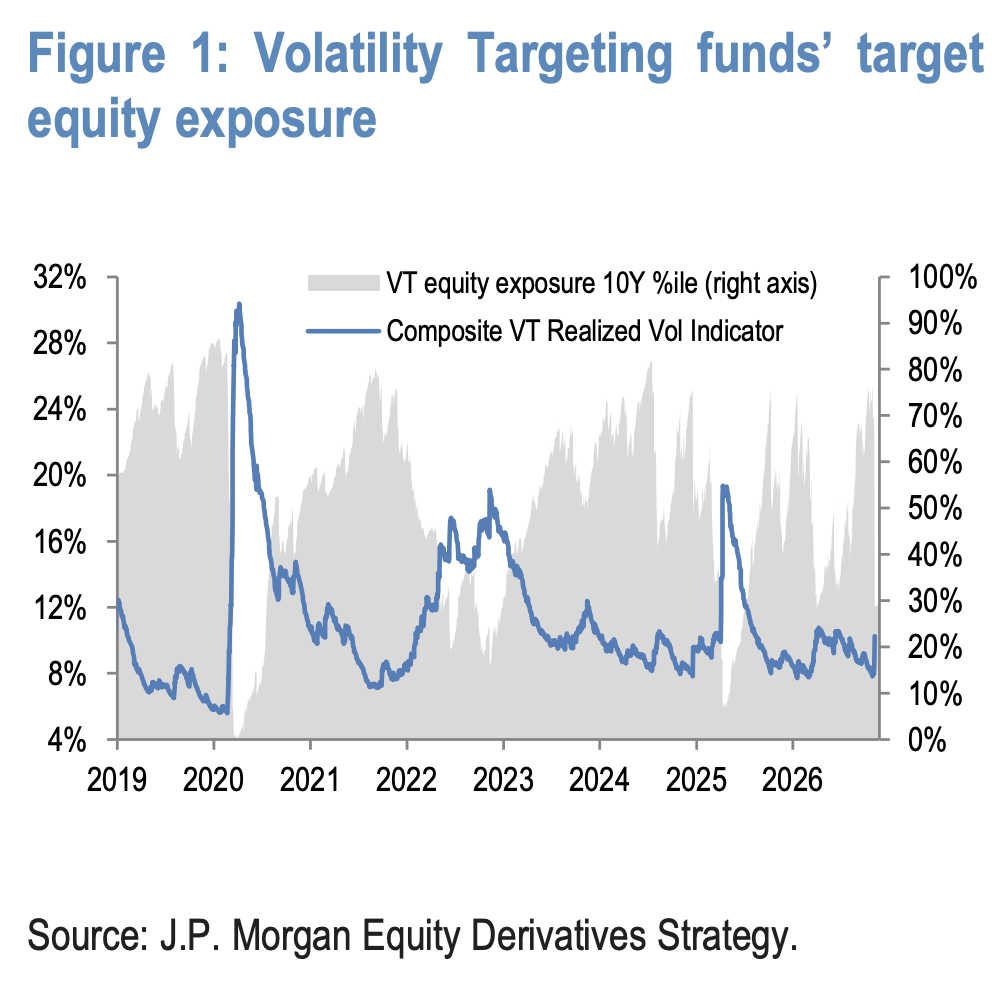
Even more concerning is that the selling pressure has not yet been exhausted. JP Morgan’s models estimate that Volatility Targeting funds still have about $50 billion of equity exposure to sell in the coming days, to reduce their target leverage from around the 67th percentile down to the 30th percentile. This means that if the market continues to decline, mechanical downsizing will add persistent downward pressure.
CTA Turns Net Short, $11 Billion Sold in First 90 Minutes
The direct trigger for this downturn was the mass breach of momentum signals in CTA trend-following strategies. JP Morgan’s report noted that the early trading session broke several key momentum signals across major US stock indices, triggering programmatic CTA selling that further accelerated the market drop.
Specific data show that within approximately 1.5 hours after the spot market opened, net sales of S&P 500 futures already reached about $11 billion. From the momentum signals, CTA positions in the S&P 500, Nasdaq 100, and Russell 2000 have all turned net short.
JP Morgan’s CTA momentum signal tracking chart shows that the S&P 500 current price is around 7383 points, the 1-month momentum signal is negative, and the CTA signal is now "short." The Nasdaq 100 is in the same situation. Although the 12-month momentum remains positive for major indices and the S&P 500 price hovers near its 200-day moving average—meaning further deleveraging depends on whether the market breaks lower— the report also notes that since most signals have turned bearish, the risk direction is skewed to the upside.
Leveraged ETFs Deleverage Sharply for Second Time in a Week, Tech Stocks Make Up 90%
Leveraged ETFs are another major force behind the recent selling. JP Morgan estimates that leveraged ETFs sold over $60 billion in equity exposure before the market closed, about 90% of which was concentrated in technology products including semiconductors (Semis), Nasdaq 100 (NDX), and technology ETFs (XLK).
This marks the second sharp deleveraging by leveraged ETFs within a week, highlighting the recent market trait of tech stocks dominating the decline. However, the report also notes that in past sell-offs, buying on dips by investors has partially offset the rebalancing sell pressure from ETFs.
After this round of deleveraging, the implied short gamma exposure of leveraged ETFs dropped from about $7.5 billion per 1% volatility to around $6.5 billion, meaning subsequent passive sell-offs triggered by rebalancing will be somewhat reduced in scale.
$50 Billion Looms Overhead, Volatility Targeting Funds Become the Next Focus
The largest source of potential selling pressure currently comes from Volatility Targeting funds. JP Morgan’s models show that as market volatility surges, these funds will need to cut about $50 billion of equity exposure over the coming days to reduce their target leverage from around the 67th percentile down to the 30th percentile.
The logic of volatility targeting strategies is as follows: when market volatility rises, they mechanically reduce risk asset exposure to stabilize portfolio volatility. This mechanism often forms a negative feedback loop of "the more it drops, the more it sells" during market turbulence.
JP Morgan had already warned in its Monday report that macro systematic strategies face risks of bidirectional flows, and in scenarios of sharp declines and soaring volatility, there exists a substantial potential for deleveraging. The day’s market action confirmed this judgment, and the adjustment process may last several days. For investors, the market’s pressured pattern is unlikely to fundamentally change in the short term until the full $50 billion in passive selling is released.
Disclaimer: The content of this article solely reflects the author's opinion and does not represent the platform in any capacity. This article is not intended to serve as a reference for making investment decisions.
You may also like
Overnight US stock market crash: A reflexivity storm triggered by a $100 billion “early exit”
A wave of $100 billion in mechanical selling pressure triggered a "head start" on Wall Street, but these early moves by smart money instead accelerated the sell-off: the Nasdaq fell 6.4% in a single day, semiconductors plunged 12%, and the “best of the year” AI and energy barbell trades collapsed within 48 hours. Even more dangerously, lagging selling pressure is still on its way. This reflexive storm demonstrates that when everyone knows the same script and acts on it simultaneously, the script itself stops working.
U.S. stocks plunge amid midterm election turbulence! Wall Street's bullish expectations dashed, short-term selling pressure may be hard to ease
For weeks, major Wall Street trading institutions have been saying that stock market gains would resume after the US midterm elections. However, Thursday's market performance brought a dramatic reversal to this prediction.
Bernstein Comments on Datadog (DDOG.US) Q3 Financial Report: Strong Performance but Guidance "Not Surprising", Lowers AI Business Revenue Expectations
Bernstein lowered Datadog's target price from $350 to $273, but maintained its "outperform" rating.
S&P evaporates 2.8 trillion in a single day, BTIG warns: This is not the bottom, the real sell-off has just begun
BTIG Chief Technical Strategist Krinsky warns that yesterday's sharp decline in the US stock market is not the bottom, but just the beginning. Nearly 70% of S&P 500 components are still trading above their 200-day moving average, and elevated breadth indicators suggest that the sell-off is far from over. If "defensive sectors" such as healthcare and consumer staples start to fall as well, the real "generals and soldiers falling together" will occur, and the S&P may head straight for 7000 points.
Crypto prices
More


