
Apple Q4 Earnings Preview: iPhone 18 Volume-Down Price-Up + Duo Foldable, Goldman Sachs Raises PT to $390
 2026/11/01 12:44
🔥 US Stock Hotspot Radar is Live! Content: 3 major themes + 6 selected stocks + 7 key events. Where are this week’s opportunities? Click the link to see all 22 trading directions in one chart →
1. Investment Highlights
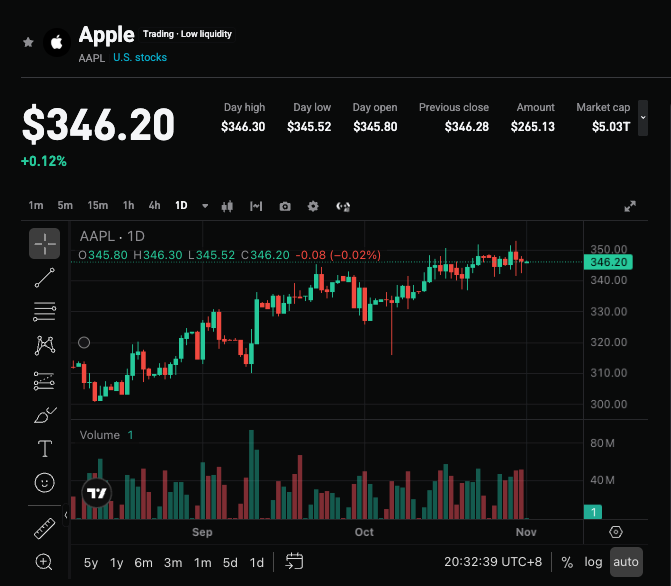
Apple (AAPL.US) will report fiscal 2026 Q4 results after the market close on November 2, 2026 (U.S. Eastern Time). Wall Street consensus expects revenue of approximately $113.322 billion (+10.6% YoY) and EPS of $1.979 (+7.0% YoY). Goldman Sachs forecasts revenue of $113.598 billion (+11% YoY), slightly above consensus and at the high end of the company’s 9%–11% guidance range, with EPS of $2.01. It maintains a Buy rating and raises its 12-month price target from $360 to $390. Key focus areas are whether the iPhone 18 series “volume down, price up” dynamic materializes, early demand signals for the Duo foldable, services resilience, and guidance under ongoing supply constraints.
2. Four Key Focus Areas
Focus 1: Validation of iPhone 18 Series Volume-Down, Price-Up Logic
iPhone remains the core driver. Goldman Sachs expects Q4 iPhone revenue of $56.561 billion (+15% YoY), in line with consensus and management’s “mid-teens” guidance. Shipments are projected to decline roughly 4% YoY (to about 57.3 million units), while average selling price (ASP) rises about 20% YoY, delivering the “volume down, price up” outcome. The volume decline stems from the split launch cycle (base model absent), industry-wide memory and component constraints, and broad price increases pressuring demand; this is partially offset by residual iPhone 17 demand and a strong iPhone 18 Pro series launch (especially in China and India). Against global smartphone shipments falling ~20–22%, Apple’s share rose from 18.2% to 22.4%, showing relative resilience. Investors will watch whether the mix continues shifting toward Pro/Pro Max models and the near-term gross-margin pressure from only partial price-hike realization this quarter.
Focus 2: Supply Constraints, Lead Times, and Early Duo Demand Signals
Supply constraints are a critical variable this quarter. Tight capacity on advanced nodes for Apple’s own SoCs, potential DRAM delays affecting A20 Pro assembly, and still-suboptimal Duo yields have led management to warn that constraints will intensify sequentially. Goldman Sachs’ lead-time tracker shows the iPhone 18 Pro series averaging 24 days in the first 42 days—slightly shorter than the prior generation and declining faster—while Pro Max holds up better. The Duo saw roughly 100-day average wait times in its first week of pre-orders across regions. Early demand appears solid: China first-week 18 Pro series sales +12% YoY and ~33% of that week’s China smartphone sales; India first-day estimates +15% to +28%. Supply-chain feedback indicates Pro Max orders up 10–15% and Duo orders up 30%, with 18 Pro orders down 10–15%, keeping total Pro volume flat but shifting mix higher. Lead times are heavily influenced by channel inventory and supply; the earnings call commentary will be important for assessing true demand.
Focus 3: Services Resilience and Mac/iPad Price Offsets
Services are expected to grow ~10% YoY, in line with consensus and company guidance (the company previously guided ~9.5% after roughly 2.5 percentage points of sequential FX headwind). Goldman Sachs sees services revenue around $31.521 billion, with App Store growth slowing to ~+2%, TAC (Google traffic acquisition cost) ~+11%, and subscriptions ~+22%. Mac is the largest divergence: Goldman expects revenue of about $8.683 billion (flat YoY) versus consensus +12%, with volumes down ~12% offset by the average ~18% price increases implemented in June. iPad is the opposite—Goldman sees ~$7.398 billion (+6% YoY) versus consensus +1%, also benefiting from June’s >20% average price hikes. High-margin services and installed-base growth remain the long-term narrative; this print will be watched for further pressure on App Store and subscription growth.
Focus 4: Gross Margin, Next-Quarter Guidance, and Valuation Re-rating Potential
Goldman expects gross margin of 47.8%, above consensus 47.5% and near the midpoint of the company’s 47–48% guidance (or 46–47% excluding tariff refunds). Operating expenses are expected to fall within the $19.1–19.4 billion range. More important is the outlook: Goldman is more cautious on F1Q27 (EPS $2.88, revenue $151.2 billion, gross margin 46.8%)—all below consensus—and anticipates company guidance of low- to mid-single-digit year-over-year growth. The price-target increase primarily reflects higher confidence in the iPhone replacement cycle after the Duo launch (multiple expanding from 37x to 40x NTM+1Y EPS) rather than upward EPS revisions. Management’s commentary on December-quarter guidance and the pace of supply-constraint relief will heavily influence near-term sentiment and valuation digestion.
3. Risks and Opportunities
Upside catalysts:
- iPhone revenue growth meaningfully above 15%, with stronger-than-expected Pro/Pro Max and Duo mix validating the volume-down, price-up thesis.
- Services maintaining double-digit growth, gross margin near the high end of guidance, and relatively constructive next-quarter commentary.
- Strong early Duo demand signals (lead times and regional sales) reinforcing expectations for a new form-factor-driven replacement cycle.
Downside risks:
- Larger-than-expected shipment declines or clear demand suppression from price increases, causing iPhone revenue to miss mid-teens growth.
- Persistent or worsening supply constraints, or only cautious low-single-digit growth guidance, raising concerns about the holiday quarter.
- Further App Store deceleration, plus FX and cost pressures exceeding expectations, weighing on gross margin and earnings quality.
4. Trading Strategy
Bull case: Clear beats on iPhone and total revenue, stable gross margin, and constructive management commentary on Duo demand and December-quarter guidance could reinforce the “hardware cycle + services resilience” narrative and support valuation recovery consistent with the higher price target.
Bear case: In-line or slightly soft results, pessimistic supply-constraint language, or weak next-quarter guidance could trigger profit-taking, particularly with the stock already at elevated levels.
Key metrics to watch:
- Total revenue and YoY growth; iPhone revenue, shipment, and ASP mix
- Services growth and App Store/subscription sub-segments
- Gross margin and operating-expense execution
- F1Q27 revenue guidance and supply-constraint outlook
Positioning notes: Strong results and constructive guidance may present pullback-entry opportunities; muted results or cautious guidance warrant caution on short-term volatility and chasing. Position sizing and risk management should be adjusted to individual risk tolerance.
Disclaimer: The above is for reference only and does not constitute investment advice.
Disclaimer: The content of this article solely reflects the author's opinion and does not represent the platform in any capacity. This article is not intended to serve as a reference for making investment decisions.
You may also like
Bitcoin’s MA200 at $73,200 — Inverse H&S Neckline Is the Only Level Left

Bitcoin Supply Velocity Hits 10-Year Low as ETH Supply Diverges

Just bet on AI and already faced a market blow! Berkshire reports earnings tonight, Abel faces a major test in his transformation
Greg Abel has been leading Berkshire Hathaway for less than a year, yet he has already made a bet of over $10.9 billion on the AI sector, marking a complete break from Buffett’s traditional avoidance of tech stocks. However, Alphabet’s stock price has fallen below their initial purchase cost, and Bending Spoons continues to decline, putting this bold AI gamble to the test. At the same time, third-quarter earnings per share are expected to drop 6% year-over-year, and the share repurchase program is likely to plummet from $4.5 billion to $1.6 billion. How to deploy $358 billion in cash will be a major challenge for the new leader’s capital allocation skills.
Has the AI bubble burst? Goldman Sachs: It's more like 1998 than 2000 right now
The Goldman Sachs trading desk stated that the current wave of sell-offs resembles the 1998 liquidity crisis more than the bursting of the 2000 bubble. It is a forced deleveraging rather than a refutation of business fundamentals. The market is drastically repricing construction financing and timeline expectations, rather than underlying demand. Moreover, the issues currently drawing the most attention from the market—electricity and licensing—are actually the least important, as limited supply does not equate to disappearing demand. The real question that needs to be answered is whether long-term revenues can ultimately justify the capital invested.

Crypto prices
More


