
Intel Q3 2026 Earnings Highlights: Revenue Up 21% YoY in Line with Expectations, Data Center Surges 78%, but Q4 Guidance Falls Far Short of Expectations Amid Israel Factory Explosion, Stock Plunges Over 20% After Hours
 2026/10/30 03:25
Core View
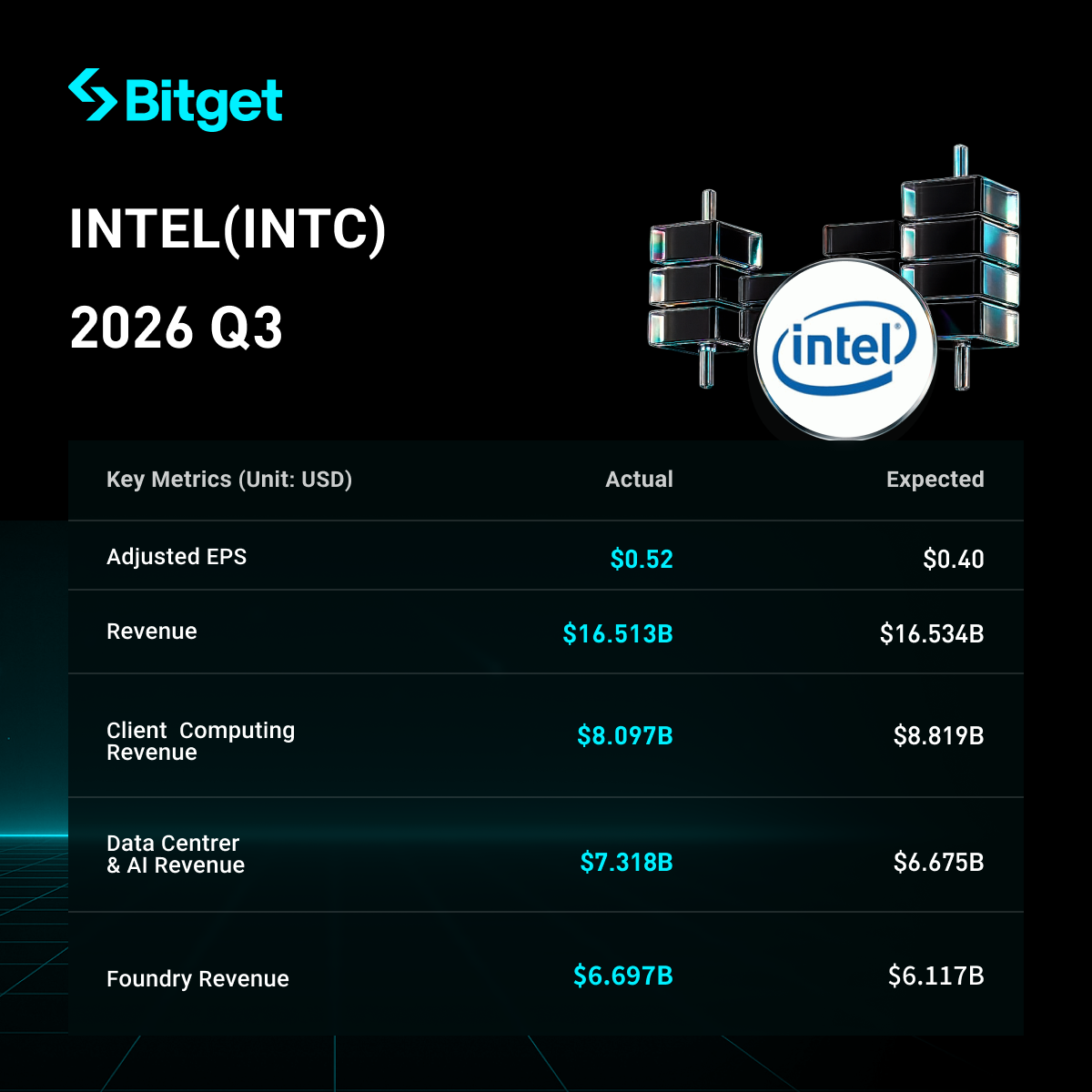
Intel’s third-quarter 2026 revenue reached $16.5 billion, up 21% year-over-year and in line with market expectations. Adjusted EPS was $0.52, beating analysts’ estimate of $0.41. Data Center and AI business performed strongly, while Client (PC) business declined. The company’s fourth-quarter guidance came in significantly below expectations, mainly due to weak PC demand, rising memory prices, and the impact of an explosion at its Israel factory. The stock fell more than 20% in after-hours trading following the guidance, with intraday declines exceeding 23%. Management remains optimistic about long-term capacity expansion and the foundry business, but near-term challenges are pronounced.
Detailed Breakdown
-
Overall Revenue and Profit Performance
- Third-quarter revenue: $16.5 billion, up 21% year-over-year, broadly in line with market expectations.
- Adjusted earnings per share (EPS): $0.52, beating the analyst consensus of $0.41.
- Overall gross margin: approximately 43% (expected to narrow further in Q4 due to the factory incident).
- Comparison to expectations: Revenue met expectations and earnings beat; weak guidance drove the market reaction.
- Free cash flow and operating cash flow details were not fully disclosed in the source; profit performance mainly reflected the earnings beat.
-
Data Center and AI Business Performance
- Revenue: $7.3 billion, up 78% year-over-year, one of the strongest growth rates in recent years.
- Key drivers: Expanding AI server demand and increased demand for general-purpose processors.
- Challenges: Supply shortages limited further growth, including the Israel factory shutdown and raw material issues. CEO Lip-Bu Tan said: “I am somewhat disappointed that we are unable to meet customer demand.”
- Profitability: Specific segment operating profit figures were not provided in the source, but this business was the primary growth engine.
-
Other Business Segment Performance
- Client Computing (PC chips): Revenue $8.1 billion, down 5% year-over-year, below the analyst expectation of $8.98 billion. Mainly driven by rising memory prices (caused by DRAM shortages from Samsung, SK Hynix, and Micron due to surging AI server demand), which raised notebook and desktop costs and suppressed end-user demand and processor shipments.
- Foundry services: Revenue $6.7 billion, up 58% year-over-year. The CEO expressed growing confidence in attracting external chip vendors to use Intel’s factories.
- Overall: Performance was mixed, with strong data center results offsetting PC weakness, but PC market softness is expected to persist.
-
Capital Expenditure Plans
- 2026 CapEx: Raised to $20 billion from the $18 billion forecast in July.
- 2027: Expected to see significant further increases for manufacturing capacity expansion.
- Funding: The company issued $23 billion in stock in August to support foundry growth.
- Main investment areas: Manufacturing capacity, especially foundry and advanced process technologies (including related 10nm facilities).
- Competitive context: The source does not provide a direct comparison table, but notes market share losses to AMD in PC and server chips and competition from NVIDIA in AI accelerators; recovery remains uncertain.
Item Amount / Description2026 CapEx $20 billion (raised from $18 billion) 2027 CapEx Expected to increase significantly further Stock issuance $23 billion issued in August Primary use Manufacturing capacity and foundry expansion -
Q4 2026 Guidance
- Revenue: $15.0–$16.0 billion (midpoint ~$15.5 billion), below the market expectation of $17.0 billion, with some optimistic forecasts exceeding $18.0 billion.
- Adjusted EPS: $0.25, well below the consensus of $0.43–$0.45.
- Gross margin: Expected to narrow to 38%, with the Israel factory incident dragging it by roughly 200 basis points.
- Year-over-year change: Guidance implies a sequential decline from Q3, reflecting ongoing PC weakness and supply disruptions.
- Other impacts: The explosion at the Kiryat Gat factory in Israel (using 10nm process for data center chips) in October caused an approximately two-week shutdown (resulting in two employee deaths) and is expected to reduce Q4 revenue by about $0.3 billion; similar effects may continue into Q1 next year. The factory is planned to resume mass-production ramp-up by the end of this weekend. CFO David Zinsner said the company is still assessing wafer usability one by one and that the impact may last longer.
-
Market Background and Investor Concerns
- Core tension: Weak PC demand (expected to last at least through the first half of 2027; 2026 market size projected to decline 12%, with a further 10% decline in 2027) coexists with strong data center AI demand, but supply constraints prevent fully meeting customer needs.
- Market challenges: Memory price inflation (AI-driven DRAM shortages) raises PC system costs and suppresses demand; the Israel factory explosion plus raw material issues limit AI chip supply; competition from AMD and NVIDIA is causing market share losses.
- Investor reaction: Stock fell more than 20% after hours, with intraday drops exceeding 23%, as the guidance miss overshadowed the Q3 earnings beat.
- Management comments: The CEO expressed disappointment at the inability to meet demand and predicted that memory issues will become a severe problem for the entire market by 2027; remains optimistic about foundry expansion and long-term product demand/capacity investments. The CFO emphasized that the PC slowdown will continue at least through the first half of next year.
Disclaimer: This content is for reference only and does not constitute any investment advice.
Disclaimer: The content of this article solely reflects the author's opinion and does not represent the platform in any capacity. This article is not intended to serve as a reference for making investment decisions.
You may also like
$33.5 billion! This Amazon number has "shocked" the market
Amazon's free cash flow in Q3 plummeted to -$33.5 billion, four times higher than the market expectation of -$7.7 billion. The sharp decline was caused by the dual impact of $77.3 billion in capital expenditures and $48.1 billion in new debt in a single quarter. Although AWS's growth rate reached a five-year high of 39.3%, it still fell short of buy-side expectations, and its profit margin declined. The Q4 operating profit guidance of $31 billion was entirely below Wall Street and buy-side forecasts. The core issue is that for every $1 earned by AWS, nearly $4 in new spending is tied to it.
Bank of Japan's "hawkish pause" implemented! Core inflation meets target, paving the way for rate hikes to return in December; amid AI selling wave, yen regains safe-haven status
The Bank of Japan has kept interest rates unchanged and, for the first time, stated that the underlying inflation rate has reached the 2% target. This milestone development paves the way for a possible further rate hike as early as December.
10% to 56%: USDC’s remarkable rise in euro-paired stablecoin trading

Hedge funds are amplifying the risks of tech stocks!
Hedge funds are quietly making a risky strategic shift—from shorting individual stocks to shorting indices. This transition is accelerating the rise in stock correlations, and the “anti-leverage” buffer that once dampened volatility is disappearing. According to Goldman Sachs data, funds’ short exposure to indices and ETFs has reached a ten-year high. The VIX faces the risk of disorderly surges, and vulnerability to deep stock price declines is quietly accumulating.

Crypto prices
More


