
Seagate Technology (STX) FY2027 Q1 Earnings Preview: Can a “Beat All” Overcome AI Spending Anxiety?
 2026/10/26 11:07
1. Investment Highlights
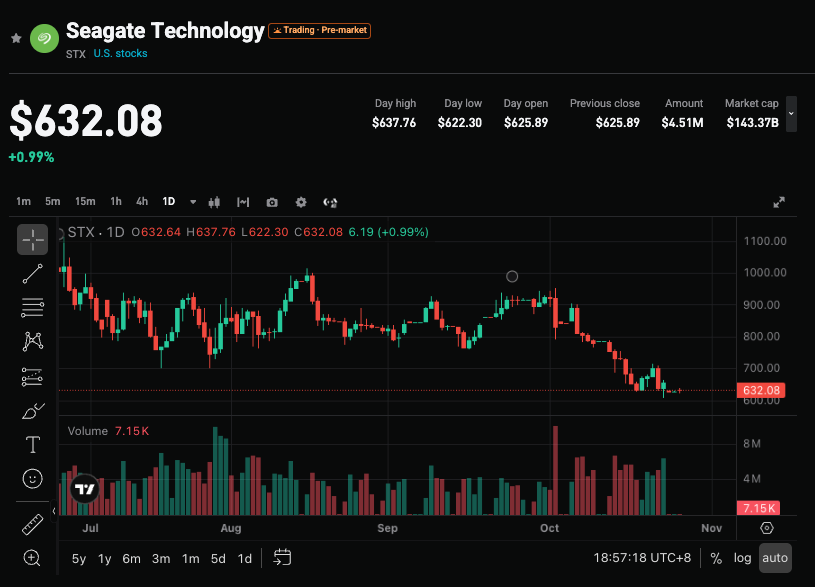
Seagate Technology (STX.US) will report fiscal first-quarter 2027 results after the U.S. market close on October 27, 2026. Company guidance calls for revenue of $4.0–$4.2 billion and non-GAAP EPS of $7.10–$7.50. Wall Street consensus expects revenue of approximately $4.14 billion (+57.5% YoY) and non-GAAP EPS of around $7.40. Over the past 90 days, the EPS consensus has risen from $5.88 to $7.40. The market is focused on whether the company’s nearline capacity already locked in through 2028 can deliver another “beat-and-raise” amid rising concerns over AI capital-expenditure sustainability, and whether margins can continue to expand.
Focus 1: Nearline Capacity Locked Through 2028, Data Center Mix ~90%
Management has stated that the vast majority of nearline EB-level capacity is locked in through full-year 2028 via long-term contracts, with data-center shipments accounting for roughly 90% of total EB-level shipments. Cloud EB-level shipments have grown quarter-over-quarter for three consecutive years with no signs of slowdown. HDD demand has accelerated over the past one to two months, driven by new buyers including neocloud providers and “physical AI” companies. Agentic AI data-retention needs exceed those of traditional chatbots, creating more rigid storage spending. This structure positions Seagate closer to contracted AI compute monetization than a traditional cyclical commodity.
Focus 2: Gross Margin Expansion and Pricing Power Validation
Last quarter (FY26 Q4) revenue reached $3.629 billion (+48.5% YoY), non-GAAP gross margin was 52.7%, and non-GAAP EPS came in at $5.71 (a beat). The market expects further margin expansion this quarter, with some estimates (e.g., Wedbush) pointing above 58%. Peer Western Digital reported FY27 Q1 non-GAAP gross margin of 58.1% (+1,420 bps YoY) and operating margin of 49.1%. If Seagate demonstrates volume-price gains and delivers higher margins, it will reinforce its pricing power in AI storage.
Focus 3: Effectiveness of a “Beat All” Amid AI Spending Concerns
Recent developments include Meta raising its 2026 capex floor and significantly increasing contracts and leases, alongside widening CDS spreads, while CoreWeave bonds yield over 15% and its stock has fallen more than 50% from highs. On October 22, the Nasdaq fell 2.60% and the semiconductor index dropped 6.7%. The market is more concerned about customers’ ability to sign contracts beyond 2028 than about the current quarter’s numbers alone. Seagate needs to show that contract visibility can be extended further and is not being undermined by funding-chain cracks.
Focus 4: HAMR Technology Ramp and Supply Constraints
Seagate’s 44TB Mozaic 4 HAMR platform is ramping at its top two cloud customers, with a target of 50% of HAMR EB shipments by the end of calendar 2026. Toshiba lacks high-capacity nearline capacity and HAMR technology, creating a technical moat. However, yield risks could affect the roughly 50% operating-margin target. Sustained supply constraints would support volume-price upside and margin expansion; a slower-than-expected ramp could limit the growth trajectory in the second half.
3. Risks and Opportunities
Upside Catalysts:
- Revenue and EPS significantly beat consensus, accompanied by an upward revision to next-quarter or full-year guidance, confirming efficient conversion of locked orders into revenue.
- Non-GAAP gross margin well above 52.7% and approaching or exceeding 58%, validating pricing power and mix improvement.
- Management explicitly extends contract visibility beyond 2028, or neocloud and physical-AI customer contributions exceed expectations.
Downside Risks:
- Results merely meet the midpoint of guidance with no upward revision, amplifying AI spending concerns and compressing valuation.
- Deteriorating customer funding environment slows contract signing or prevents extension of visibility past 2028.
- HAMR yield ramp underperforms, limiting high-capacity product shipments and progress toward the margin target.
4. Trading Strategy
Bull Case: A clear beat plus raised guidance and commentary on extending contracts beyond 2028 could reinforce Seagate’s status as a scarce AI storage name and support valuation recovery. The stock has already corrected substantially from its highs (trailing P/E around 45x), providing some buffer.
Bear Case: Results that only meet expectations, cautious guidance, or weaker customer spending signals could extend recent AI-trade concerns and trigger further profit-taking. Options put/call ratio around 1.06 reflects cautious positioning.
Key Metrics to Watch:
- Revenue and YoY growth (consensus +57.5% YoY)
- Non-GAAP EPS and gross margin
- Data-center/nearline shipment mix and contract lock-in progress
- Whether next-quarter and full-year guidance is raised
Tactical View: A strong beat with positive guidance can present a dip-buying opportunity; results that only meet expectations or weaker customer signals warrant caution on near-term volatility and chasing strength. Position sizing and stop-loss levels should be adjusted according to individual risk tolerance.
Disclaimer: The above is for reference only and does not constitute investment advice.
Disclaimer: The content of this article solely reflects the author's opinion and does not represent the platform in any capacity. This article is not intended to serve as a reference for making investment decisions.
You may also like
Bitcoin price dips under $75K as crypto markets miss tech-stock rebound

October Non-farm Payrolls Reignite December Rate Hike Expectations! Wall Street Bets Probability Over 80%, "New Fed News Agency": AI Sell-off May Become a Policy Variable
After the non-farm payroll report, traders' bets on a December rate hike surged to as high as 85%. Wall Street analysts believe the report provides room for further rate hikes, bringing renewed pressure for a hike at a time when post-election market concerns over slowing AI development might dampen expectations. Some remain cautious about a December hike, as stock market volatility and AI investment prospects could restrain the Federal Reserve. "New Fed News Agency" notes the report has not shaken the Fed's outlook on economic growth and inflation, but whether AI asset sell-offs change financial conditions could become a new variable for the December decision. Attention should be paid to whether Waller values lagging employment data or forward-looking market signals.

U.S. non-farm payrolls surge by 165,000 in October, far exceeding expectations! Unemployment rate unexpectedly drops to 4.1%, December rate hike expectations intensify
In October, US non-farm payrolls increased by 165,000, which is 2.5 times the Wall Street median forecast of 65,000 and represents an exceptionally strong deviation of about 5 standard deviations, exceeding the upper limit of all institutional forecast ranges. The unemployment rate unexpectedly fell from 4.2% to 4.1%, while the market had expected it to remain unchanged; average hourly wages also accelerated year-on-year growth to 3.1%. Meanwhile, the previous two months' non-farm payrolls were revised upwards by a total of 84,000. Following the release of the data, the yield on 2-year US Treasury bonds rose by 7 basis points, and the pricing of the probability of a Fed rate hike in December climbed to 70%.
Crypto prices
More


