
Gold prices face sell-off, key support levels test buyer confidence

Huitong Finance, October 22—— Last week, gold briefly showed upward potential; however, in this morning's session, the precious metal plummeted rapidly. As global market risk-off sentiment intensifies, price action remains volatile and repeated, with notable short-term speculative swings in gold prices. Intraday traders who expected a smooth upward trend are now likely facing losses, with those betting on a rise in gold prices under significant pressure. This move again reminds traders: short-term trading in gold is always highly susceptible to abrupt fluctuations.
Although gold showed upward potential last week, this precious metal quickly dropped in this morning’s trading. With rising global market risk aversion, the market continues to swing and remain volatile, and short-term speculative moves in gold prices are very apparent. Intraday traders hoping for a smooth rally are likely suffering losses, especially those with speculative long positions under further pressure. This round of price action serves as yet another reminder to traders: short-term gold trading is always prone to violent swings.
In recent weeks, although gold has moved higher gradually, multiple bearish factors continue to exert pressure, making it difficult for the price to break through resistance effectively. This morning’s decline has yet to show widespread market spillover, with only some Asian stock markets also moving lower. Meanwhile, fluctuations in the US dollar this morning are relatively muted, which may indicate that this round of gold selling was triggered by large funds locking in recent profits, creating speculative price moves. Support levels now warrant close attention, with the upcoming hours critical for trend direction. If gold shows solid support at these levels, some aggressive speculators may re-enter with long positions.
Gold is trading near $4,058. The price has broken below the $4,100 level, setting off alarms in institutional trading rooms as they analyze recent developments. At the start of the quick slide this morning, gold was near the $4,120 mark. The metal had already shown signs of weakness yesterday near the close, meeting strong resistance around $4,140 and then retracing.
Later last week, gold briefly tested $4,200 and flashed some bullish signals, seemingly presenting an upward opportunity, but that rally has now shifted to a selling signal. The core issue lies in the underlying cause: although rising energy prices objectively fuel inflation concerns, do persistently high US Treasury yields continue to drag gold lower? Bullish gold traders should not be overly optimistic nor anticipate an immediate and strong rebound in the gold price.
After just a few hours of swift declines, gold traders hoping for a rebound are caught in a dilemma. In theory, various risk events should be supportive for gold, yet selling pressure persists. Currently, gold is testing support near $4,050, and the temptation for dip-buying is considerable. However, at the end of July this year, gold also dipped, testing the $4,000 mark.
All assets are influenced by cyclical timing, and gold is no exception. While the market generally sees gold as a store of value, it is still occasionally hit by speculative sell-offs. Short-term bullish strategies are not inherently flawed, but those entering the market should ensure robust risk controls for quick entries and exits.
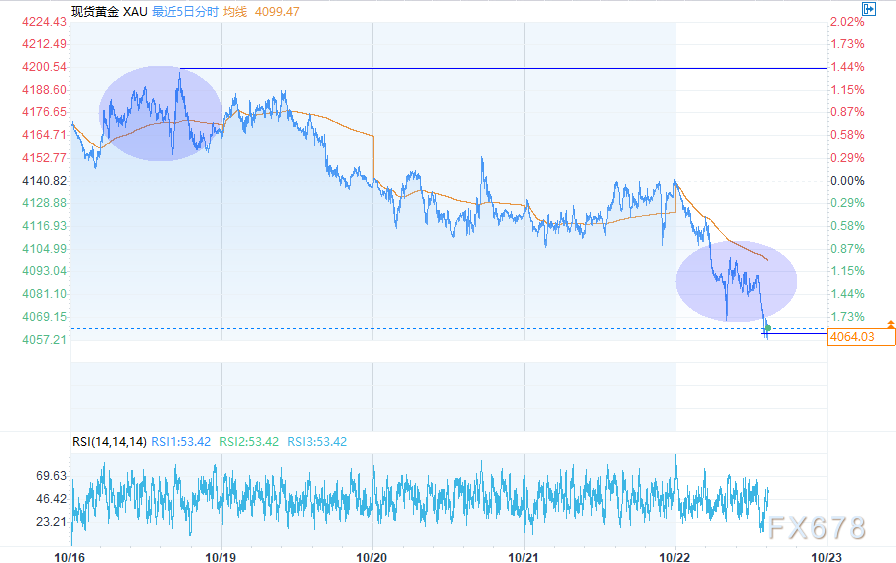
(Spot Gold 5-Day Chart Source: FXHuitong)
If US Treasury yields remain high or continue to climb, gold prices have room to fall further. The current strengthening of the US dollar has eased slightly, but should global equity markets keep weakening and intensifying the sell-off, the dollar could strengthen again. This implies that gold prices could continue downward even though many already believe the market is in 'oversold' territory.
If gold continues to decline, traders inclined to take long positions must remember: the current market price reflects the real state of the market. Blindly buying simply because prices are deemed oversold is unwise and does not guarantee a short-term upward reversal.
The rapid decline in gold on both yesterday and today underscores that the precious metals market remains in a highly volatile state. The prudent atmosphere prevalent in global markets means sentiment can shift abruptly, demanding constant attention from gold traders. While gold’s decline may appear excessive, traders looking to bet on a rebound need to recognize that short-term price movements do not necessarily reverse upward.
After falling below $4,100, gold is now trading near $4,060, with $4,050 serving as a critical support level. If gold climbs back above $4,095, short-term selling pressure will ease somewhat, creating the possibility of a rebound toward $4,135. However, elevated US Treasury yields will continue to cap gains.
If gold breaks below $4,050, the next target is $4,030, indicating buyers have yet to regain control of the market. How price reacts near support levels will determine whether this downtrend stabilizes gradually or attracts additional selling pressure.
Disclaimer: The content of this article solely reflects the author's opinion and does not represent the platform in any capacity. This article is not intended to serve as a reference for making investment decisions.
You may also like
The recovery of the automotive industry drives Germany's factory orders to rebound by 4.4% in September; ECB December rate hike expectations further strengthened
The rebound in orders provides positive signals for the outlook of subsequent industrial production. However, economists expect the upcoming September industrial production data to show a slight decline in output following strong growth in August.

Forex Today: Post-election USD weakness persists, focus shifts to BoE rate call
Can Record Earnings Put Apple on the Verge of a Breakout
Uber (UBER.US) Q3 Conference Call: Driver Shortage in Brazil and India Weighs on Mobility Business, October Supply Shows Improvement
Uber's Q3 revenue and EPS both exceeded expectations, but ride-hailing income fell by 2% and an overseas driver shortage became a focal point; the stock price rose 4.91%, and management stated that conditions had improved in October.
Crypto prices
More


