
Cryptonomist’s AI integration gives readers a chatbot for its crypto news archive

Cryptonomist is folding artificial intelligence directly into how it produces and delivers crypto news, moving AI from a background tool into something readers can actually use.
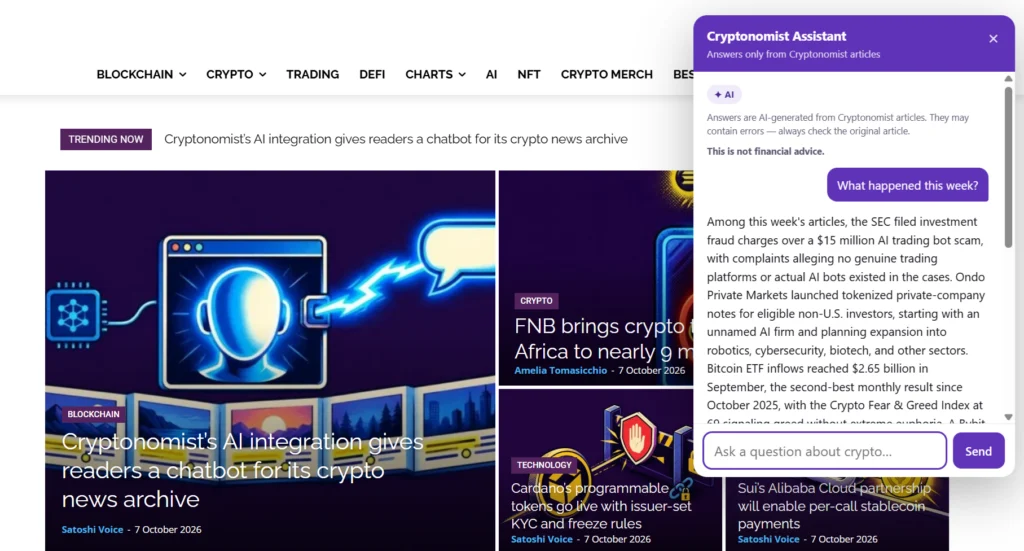
Our media outlet has introduced a new AI chatbot that lets visitors query its article archive, request summaries, and get help making sense of market trends, part of a broader shift the publication describes as becoming an AI-powered media outlet.
This Cryptonomist AI integration touches everything from how stories get written to how companies outside the newsroom can license similar tools.
Summary
Key takeaways
- Cryptonomist launched an AI chatbot that lets readers summarize articles, simplify topics, and track market trends.
- Internally, AI already handles translations, SEO work, content management, and automation tasks.
- This automation boosts output speed without a matching rise in staff or resources.
- Cryptonomist also sells AI-based automation services, including lead research, to outside companies.
- The publication frames its long-term model as a mix of human editorial judgment and AI systems.
Cryptonomist Expands Its Editorial Model With Artificial Intelligence
The core idea behind this shift is simple: information moves faster than most readers can process, especially in crypto, so Cryptonomist built tools to help filter and connect it.
This editorial AI integration is meant to make internal processes more efficient while giving readers a new way to interact with the news rather than replacing the reporting itself.
AI already supports content production and management, translations, SEO activity, and various automated operations across the newsroom. This frees staff time for work that depends on judgment, creativity, and editorial responsibility rather than repetitive tasks.
An AI Chatbot Built on Cryptonomist’s Editorial Archive
The new chatbot turns years of published articles into something readers can question directly, not just scroll through. A reader can ask it to summarize a news item, simplify a complex topic, connect related pieces of coverage, or pull a quick overview of market trends.
This is an adding a layer on top of its reporting, not a substitute for it. The chatbot can point to a summary or key points, and readers can still move to the original articles for full context.
In that sense, the AI chatbot functions as a conversational entry point into the outlet’s existing archive, turning it into what Cryptonomist calls an interactive information base.
Scaling Content Production Without Scaling the Newsroom
Automation changes what scalability means for a digital newsroom. Traditionally, publishing more content required proportionally more staff and hours.
AI tools let it handle repetitive tasks faster, work across more language markets, process larger volumes of information, and update content more often, without expanding the newsroom at the same pace.
For an outlet covering blockchain and crypto markets internationally, the publication frames this kind of editorial automation as a meaningful advantage in a sector where news cycles move quickly.
AI Services Extend From Readers to Business Clients
Cryptonomist’s use of AI is not limited to its own publishing operation. We develop and offer AI-based solutions to other companies, covering automation for content, translations, and lead research and qualification.
This reflects a broader shift the publication describes: AI has mainly functioned as an internal productivity tool, but it is increasingly becoming a product in its own right, one offered both to readers through the chatbot and to businesses through automation services.
Cryptonomist frames this as a loop in which internal use of AI generates workflows that later become client services, which in turn feed improvements back into its own operations.
A Hybrid Vision for the Future of Media
Cryptonomist does not present AI as a replacement for its newsroom.
The publication says artificial intelligence changes how a newsroom works rather than removing the need for one, pointing toward a model that combines journalists with AI systems, articles with conversational tools, and traditional search with more personalized answers.
The outlet says it wants to experiment directly with these changes rather than only report on how AI is reshaping companies and the information industry.
By its own account, AI is becoming part of its infrastructure across the full chain, from producing information to distributing it, and from research to the new services built around its content.
The chatbot is one of the first visible touchpoints of that wider transformation.
Disclaimer: The content of this article solely reflects the author's opinion and does not represent the platform in any capacity. This article is not intended to serve as a reference for making investment decisions.
You may also like
Alphabet (GOOGL.US) reportedly plans to issue its first Hong Kong dollar and Singapore dollar bonds, potentially testing investor confidence amid growing concerns over AI financing.
Alphabet has recently held discussions about the potential issuance of its first Hong Kong dollar and Singapore dollar bonds. Amid global market volatility caused by sell-offs in artificial intelligence (AI) related sectors, this deal will test Asian investors’ appetite for subscription.

The "Blue Wave" overturns chip stocks, Morgan Stanley remains bullish on Seagate (STX.US): Weak market sentiment diverges from fundamentals, listed as the top storage pick
Morgan Stanley maintains an "Overweight" rating on Seagate Technology with a target price of $1,148.

Chart - AI Stock Plunge Triggers Market Alert. Here’s What Traders Are Watching

Earnings Preview | Rocket Lab (RKLB.US) Faces Ongoing Profit Pressure Amid Revenue Surge, Neutron Delay Concerns Gradually Disappear
The market currently anticipates that Rocket Lab's revenue in the third quarter will increase by nearly 66% year-on-year to $257 million, with a GAAP net loss of $0.08 per share.
Crypto prices
More


