
Costco Q4 Earnings Preview: Membership and Capital-Return Test After a Near-Bear Pullback
 Bitget2026/09/23 04:08
🔥 US Stock Hotspot Radar is Live! Content: 3 major themes + 6 selected stocks + 7 key events. Where are this week’s opportunities? Click the link to see all 22 trading directions in one chart →
- Investment Snapshot
Costco (COST.US) will report fiscal 2026 fourth-quarter results (16-week period ended August 30) after the U.S. close on September 24, 2026. Wall Street consensus looks for total revenue of about $94.8 billion (about +10.0% YoY) and adjusted EPS of about $6.53 (about +11.2% YoY versus $5.87 a year earlier). Full-year EPS is expected near $20.5 (versus about $18.2 last year), with annual revenue potentially topping $301 billion.
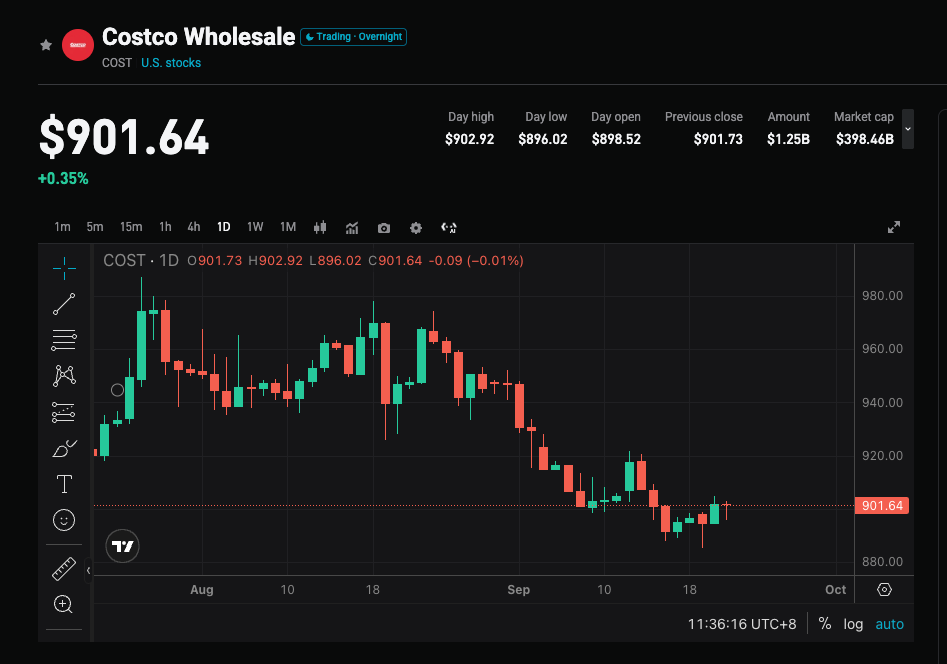
The company has already printed Q4 net sales of $93.9 billion (+11.3% YoY), with comparable sales +9.4% and +6.7% excluding gasoline and FX. The debate is therefore not whether Costco sold merchandise, but whether membership-fee quality, margins, tariff-refund reinvestment, and a possible special dividend or buyback can reset the tape. Shares have fallen about 18% from the May high of $1,096.50 to a September 22 close of $899.41. Valuation digestion and the earnings print arrive together.
- Four Things That Matter
Focus 1: Can the membership flywheel offset slower traffic?
Costco’s profit engine is membership fees, not merchandise markup. Q3 membership-fee income was $1.37 billion (+10.7% YoY, about +9.9% YoY ex-FX). Paid members reached 82.9 million (+4.1% YoY) and Executive members 41.2 million (+9.6% YoY). Renewal rates were 92.2% in the U.S. and Canada and 89.7% worldwide. Q4 needs to show that renewals are holding, Executive mix is still rising, and digital acquisition is not quietly impairing future renewal rates. Soft membership metrics would invite a re-rating from “premium retailer” to “mature retailer.”
Focus 2: Comps are already out; margins decide the beat
The top line is largely locked in: Q4 net sales $93.9 billion (+11.3% YoY), U.S. comps +10.7%, digitally enabled comps +19.5%; August net sales $23.70 billion (+9.9% YoY). Q3 traffic rose only +2.4% (about +5.2% a year earlier), so growth leaned on ticket size. What the market will price is gross margin, core merchandise margin, and expense ratio. Some on the Street argue that stripping out U.S. government tariff refunds could leave core EPS below the $6.53 consensus, making that number closer to a best case.
Focus 3: Tariff refunds, nearly $20 billion in cash, and special-dividend talk
The balance sheet is the other sentiment lever. Cash and equivalents exceed $18.9 billion, with about $1 billion in short-term investments against roughly $5.6 billion of long-term debt. Some estimates put cash near $20 billion and tariff refunds around $1.5 billion. Investors will listen for how management redeploys those refunds — lower prices, new warehouses, or shareholder returns — and whether a special dividend or larger buyback is on the table. A warehouses-only message with no capital-return signal may leave the cash pile inert for the stock.
Focus 4: After the multiple reset, guidance quality decides the bounce
Forward P/E is about 43x, a bit below the five-year average near 45x, but still rich versus high-single- to low-double-digit growth. The average Wall Street target is about $1,085–$1,092, implying roughly 20%+ upside, with a Moderate Buy tilt. Shares dropped about 4% after Q3, a reminder that “in line” is often not enough for COST. Membership, margins, and capital return need to land together.
- Risks and Opportunities
Upside catalysts:
- Membership-fee growth stays in double digits, U.S./Canada renewals hold near 92%, and Executive memberships keep outpacing the overall base.
- EPS reaches or exceeds $6.53 even after stripping one-time tariff items, with core margins better than feared.
- A clear special dividend, buyback step-up, or cash-use plan that supports a valuation repair.
Downside risks:
- Core EPS misses because of costs, tariffs, or margin pressure, confirming $6.53 as a best-case print.
- Traffic keeps slowing and renewals slip as the digital-acquisition mix ages into the renewal calculation.
- Vague cash-use commentary and cautious outlook, with high valuation leaving room toward $875 and potentially $844.
- Trading Playbook
Bull case: Net sales have already validated share gains. If membership and margins both beat, and management signals a special dividend or buyback, the roughly 18% drawdown can turn into a repair trade.
Bear case: The top line was pre-announced in monthly sales. An EPS “print-and-go,” flat membership metrics, or no capital-return signal can repeat the Q3 pattern: decent results, weaker stock.
Key numbers:
- Adjusted EPS and whether tariff refunds or other one-offs are in the figure
- Membership-fee income, renewal rates, Executive-member growth
- Gross margin / core margin ex-gasoline
- Cash, buybacks, special-dividend language; warehouse pipeline and outlook
Tactical notes (as of the September 22 close at $899.41):
- Into the print: The stock bounced four sessions off the September 16–21 $885–$896 shelf, tagged $903.40 on September 22, and closed $899.41. It remains below the 10-day MA near $901, 20-day near $919, 50-day near $936, and 200-day near $960 — short- and intermediate-term averages are still stacked bearishly. Price is pinned under the $900 round number into the event; risk/reward is only average. Options imply about a ±3.3%–3.6% move (roughly $868–$932). Keep event size light. Do not add leveraged longs below $885.
- Long structure: A close back above $910–$922, with pullbacks holding $900 / $888–$896. Upside references: $936 (50-day) / $960 (200-day). Stops can sit at $885, or below $875 depending on risk tolerance.
- Short / hedge structure: A gap that cannot reclaim $888–$896, or a failed push into $910–$922. Downside references: $885 / $875 / $844 (52-week low).
How to use it: If results and capital return both surprise and the stock closes above $910–$922, look for pullbacks toward $900 / $888–$896 rather than chasing the first spike. If the print only confirms already-released sales and margins or membership disappoint, respect the $868–$932 implied range and the $885 / $875 / $844 shelf. Size and stops should match personal risk tolerance.
Disclaimer: For information only. This is not investment advice.
Disclaimer: The content of this article solely reflects the author's opinion and does not represent the platform in any capacity. This article is not intended to serve as a reference for making investment decisions.
You may also like
Morgan Stanley Illustrates 'Blue Wave' Impact: 20% of New Data Center Projects May Be Delayed to 2029, 40% of Shipped Chips May 'Not Be Powered On' Before 2028
Morgan Stanley believes that the US midterm elections are substantially disrupting the construction pace of AI data centers—about 5GW of capacity will be postponed from 2028 to 2029, and up to 40% of chip deployments between 2026 and 2028 risk not being powered on time. The combined pressures of power shortages, political resistance, and rising costs are accelerating the shift of capital toward overseas markets such as Southeast Asia and India, potentially extending the overall AI capital expenditure cycle.
Risk is shifting! Goldman Sachs: Chipmakers' CDS spreads surpass hyperscale cloud providers for the first time, AI default swaps hit record highs
Goldman Sachs stated that AI credit risk is shifting from cloud giants to chip suppliers. For the first time in nearly three months, the chip CDS spread has surpassed that of hyperscale cloud providers, reflecting market concerns over intensified GPU depreciation and customer financing exposure. Impacted by a supply surge, bond issuance premiums for cloud providers have risen significantly, with durations shortening. As hundreds of billions of dollars in project financing flood in by 2027, pressure in the credit market is expected to continue accumulating.

Difficult to Monetize 3.57 Billion Orders? Neutron's Maiden Flight Delayed and Iridium (IRDM.US) Faces Acquisition Funding Pressure
Rocket Lab reported Q3 revenue of $268 million and outstanding orders totaling $3.57 billion. The maiden flight of the Neutron rocket has been postponed to 2027, with clients such as ICEYE having already reserved launch windows in advance. Although operating cash flow has turned positive, the planned acquisition of Iridium will require more than $3 billion in cash, with future revenue...
Crypto prices
More


