
The "devaluation trade" of the US dollar returns to Wall Street, institutions warn: further cooperation from the Federal Reserve is needed

Wall Street is once again betting on the so-called "depreciation trade." The core logic is not complicated: as the U.S. fiscal deficit continues to swell, government debt surpasses $40 trillion, and policymakers attempt to suppress long-term yields by buying back Treasuries, investors are growing concerned about the erosion of the real value of the dollar and U.S. government bonds, prompting a rotation into gold and other assets perceived as "hard assets."
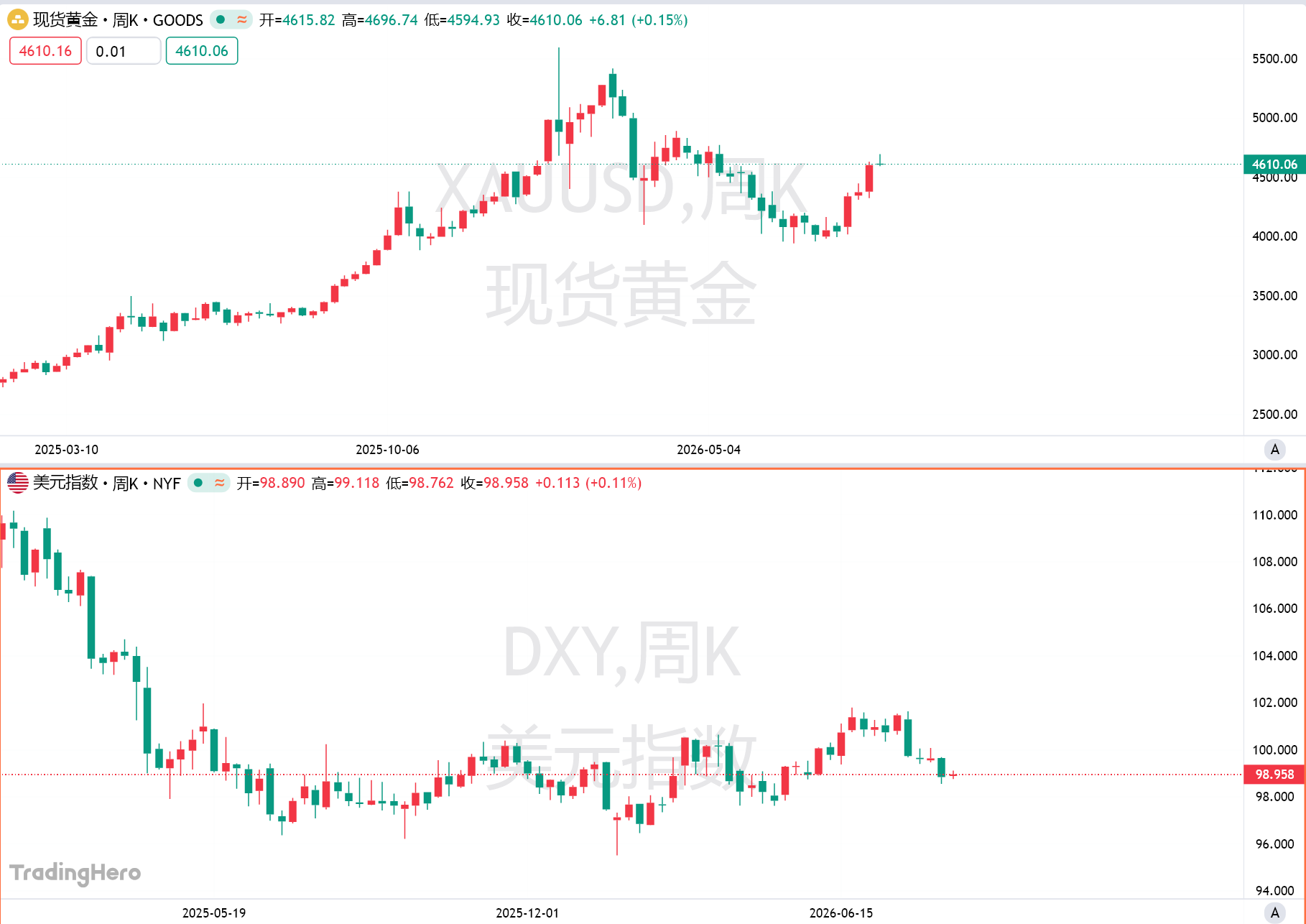
This trade has clearly heated up recently. Gold hit a three-month high on Monday, continuing its rally after gaining over 5% the previous week, marking its fifth consecutive week of gains and setting up to post its largest monthly increase since August 1999. Meanwhile, the U.S. Dollar Index fell to a three-month low last week, declining for the third week out of the past four.
However, as of Tuesday’s press time, gold fell 0.9% intraday due to profit-taking pressures, with the market waiting for this week's U.S. inflation data and comments from Federal Reserve Chair Kevin Walsh at the Jackson Hole Symposium.
Stephen Coltman, Head of Macro at 21Shares, pointed out that the fiscal deficit and debt scale may be more worth focusing on than the size of buybacks themselves. The amount of buybacks currently announced by the U.S. Treasury is still negligible compared to the overall Treasury market, but the signal sent by the policy is very strong: when the government begins to actively intervene in long-term Treasury yields, the market will naturally question what forces are compelling the Treasury to step in.
The Treasury Suppresses U.S. Treasury Yields, but Markets Bet the Dollar Will Be Under Pressure
The U.S. Treasury announced last week that it would raise the ceiling for long-term Treasury buybacks from $2 billion to at least $4 billion. On Monday, two senior Treasury officials further disclosed that the Treasury may use the roughly $1 trillion Treasury General Account (TGA) to fund the buybacks.
This flurry of activity comes as the U.S. fiscal situation further deteriorates. The U.S. monthly deficit in July hit a five-year high, and total federal debt exceeded $40 trillion for the first time. Meanwhile, the 30-year Treasury yield climbed to 5.34%, approaching its highest level in two decades, up significantly from 4.82% at the end of June.
Yet the buybacks have not truly solved the problem. Yields briefly fell after the Treasury announced its actions, but soon rose again. This means bond investors do not believe the Treasury’s measures are sufficient to change the fundamental forces driving up long-term yields.
Nohshad Shah, Citadel Securities’ Head of Fixed Income Sales for Europe, the Middle East and Africa, believes this is actually a kind of "financial repression": the Treasury can prevent further declines in Treasury prices, but cannot eliminate the pressures from fiscal deficits, inflation, and the supply of debt—it merely shifts this pressure to other markets.
If long-term yields are artificially suppressed, the dollar’s appeal may decrease, import prices and financial conditions could be affected, and ultimately this could push inflation higher. Shah warns that, the signal sent by the bond market is very clear—both fiscal and monetary policy need to tighten further.
This also means the market is once again betting on Federal Reserve rate hikes. Federal funds futures now show the probability of a rate hike at the Fed’s October meeting has risen to about 56%, up more than 7 percentage points from a week ago.
Will Gold and Emerging Market Currencies Take Over?
According to Deutsche Bank analyst Michael Hsueh on Monday, gold could even surpass its $4,800 per ounce target, as a policy shift by the Treasury further reinforces a bullish case for gold.
Billionaire investor Ray Dalio also recommends continuing to overweight gold and bitcoin, warning that the U.S. government's runaway spending could ultimately turn into a debt crisis. He believes gold can account for as much as 15% of a model investment portfolio.
However, the market does not fully agree that the "depreciation trade" has become a confirmed trend. Alexander Lis, Head of Investment at Social Discovery Ventures, believes that, unless it can be confirmed that the Federal Reserve is willing to cooperate with the Treasury, it is still too early to bet entirely on this logic.
It's worth noting that the traditional relationship between U.S. Treasuries and emerging market currencies is also undergoing changes. In the past, rising U.S. Treasury yields usually meant a stronger dollar, which suppressed emerging market assets; now, that link is unraveling. As long-term U.S. Treasuries come under pressure, emerging market currencies have actually outperformed.
The reason is that investors are increasingly worried the U.S. government will ultimately ease its debt burden through inflation and looser policies—including Treasury buybacks. If the real value of the dollar keeps falling, gold and commodities might benefit, and resource-rich emerging markets such as South Africa, Colombia, and Chile could see increased capital inflows.
Nick Rees, Head of Macro Research at Monex Europe, believes that, if concerns over a depreciating dollar continue to intensify, this will create a more favorable environment for commodity currencies.
Disclaimer: The content of this article solely reflects the author's opinion and does not represent the platform in any capacity. This article is not intended to serve as a reference for making investment decisions.
You may also like
IPO Roadshow Day Boosts Enterprise Office Market! Anthropic Launches Multiple AI Tools, Directly Challenging Microsoft Office
Anthropic has launched Claude Meetings, allowing Claude to join Google Meet video conferences in real-time and perform tasks, transforming Claude from a meeting note-taker into a real-time collaborator. AI whiteboard and spreadsheet features are now available, introducing Claude Whiteboards for team co-editing and Claude Sheets that can be created and modified by AI. The data analysis product Claude Data has officially launched, enabling seamless integration between enterprise data and third-party applications. Microsoft's stock decline has widened, at one point falling more than 3%.

Anthropic roadshow targets 35% long-term operating profit; founders plan to cash out $1.75 billion in IPO; Goldman Sachs estimates $685 billion revenue by 2030
In a roadshow video, executives at Anthropic revealed that the company believes it can achieve an adjusted operating profit margin of 35% or higher in the long term, far surpassing this year’s Q3 margin of 15%. According to the prospectus, all seven co-founders plan to sell nearly 3.38 million shares each at the IPO’s midpoint price, netting about $250 million per person, while each will still retain approximately $18 billion in shares. Goldman Sachs predicts that by 2030, Anthropic’s annual revenue will be nearly 150 times last year’s revenue, including $586 billion from enterprise clients and $100 billion from non-enterprise customers.

Texas bill seeks to let cities and counties invest up to $10 million in Bitcoin
Crypto prices
More


