
Foreign media: Strategy uses debt instruments to hedge against Bitcoin retracement

According to foreign media, Michael Saylor's latest published chart attempts to demonstrate that, despite Bitcoin's significant decline over the past 12 months, Strategy's various debt instruments have still provided investors with relatively stable returns. The article focuses on how the company packages highly volatile assets into products with more predictable yields.
Chart highlights resilience during downturns
Based on data cited in the article, “raw” Bitcoin fell by 47% over the past 12 months. In comparison, the defensive debt securities within the Strategy ecosystem absorbed most of the volatility, with the flagship instrument STRC even recording a 9% net return.
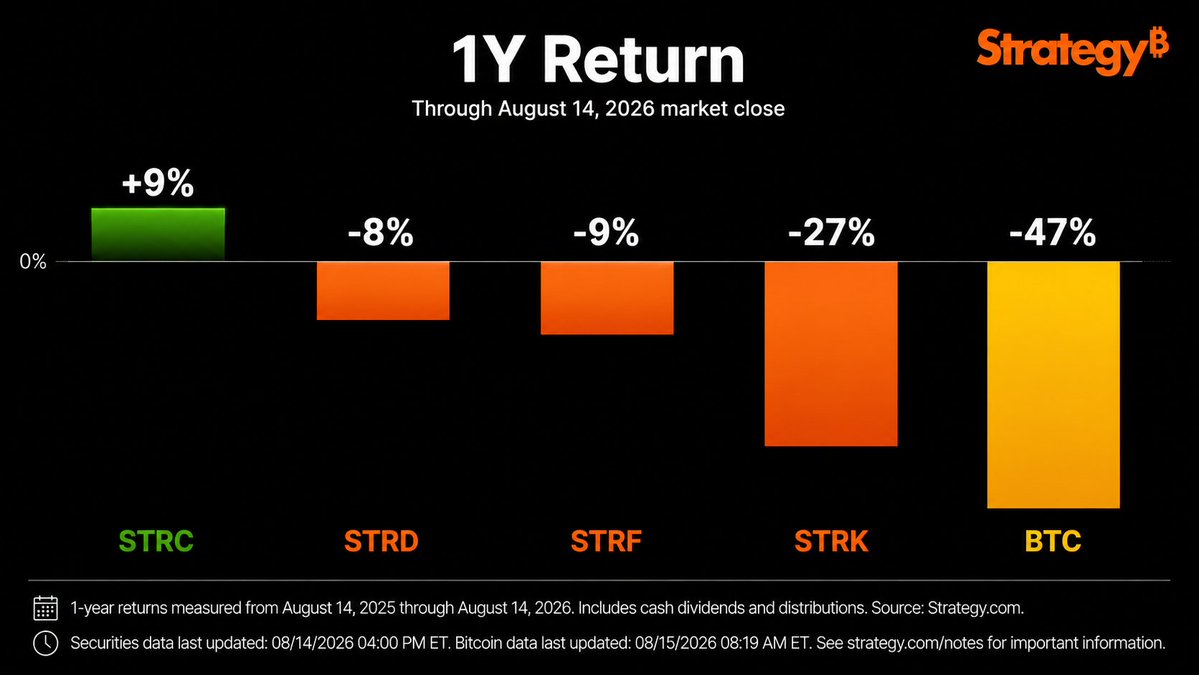
The article notes that Strategy’s product line is roughly divided into two categories: one consists of senior defensive instruments with fixed coupons, such as STRD and STRF; the other comprises hybrid instruments with convertible bond features, such as STRK. This layered design aims to distribute risk among different investors during market downturns.
- Bitcoin fell 47% over the past 12 months
- STRC’s net return in the same period was 9%
- The S&P 500 rose 22% during the same period
The price of stable returns
However, the commentary argues that this performance chart does not fully present the cost. In order to continue providing high yields to investors during a prolonged crypto market downturn, Strategy had to adjust its consistently emphasized approach of “continual accumulation.”
The article points out that this means the company may need to make concessions in capital allocation to maintain the appeal of its debt instruments. In other words, resilience at the product level does not necessarily mean the company as a whole hasn’t paid a price.
Opportunity cost questioned
The commentary also cites the views of independent analysts, saying investors should treat this kind of marketing demonstration with caution. The core concern is that while Strategy’s debt instruments reduce losses from the crypto market’s decline, they do not change the broader return comparison.
According to the article, over the same 12-month period, the S&P 500 in the United States rose 22%, with significantly lower volatility than Bitcoin and related debt products. In other words, in terms of opportunity cost, even if investors take on more complex structural products, they may not achieve a better risk–return ratio.
The overall tone of the article is that Saylor hopes to use the chart to prove Strategy can turn highly volatile digital assets into more stable investment tools, but outside commentators are more concerned about whether such stability is worthwhile and how much real cost the company bears for it.
Disclaimer: The content of this article solely reflects the author's opinion and does not represent the platform in any capacity. This article is not intended to serve as a reference for making investment decisions.
You may also like
BUZZ-IIFL Finance rallies to a two-month high, boosted by Blackstone deal
The “outlier” in the AI capital expenditure frenzy: Apple (AAPL.US) keeps spending flat, accounting for less than 5% of sales
Apple continues to stand out among major tech peers, largely avoiding the aggressive wave of capital expenditure associated with artificial intelligence (AI) infrastructure.

Youth Employment Declines for 48 Consecutive Months: Behind the Semiconductor Boom, Young South Koreans Are Being Left Behind by the Times
In South Korea, the unemployment rate in October fell to a three-year low of 2.5%. However, the number of employed people decreased by 50,000, youth employment has declined for 48 consecutive months, and domestic demand remains weak.


Crypto prices
More


