Bitget App
Trade smarter
Buy cryptoMarketsTradeFuturesStocksEarnInstitutionAI & More
Bitcoin’s 2017, 2021 macro signal returns – But this cycle has a catch

Bitcoin’s 2017, 2021 macro signal returns – But this cycle has a catch

AMBCryptoAMBCrypto2026/08/04 15:03
By:AMBCrypto

History has a way of repeating itself, and right now, that’s exactly what the market seems to be pricing in. Of course, there’s no guarantee that past events will play out the same way again.

But in trading, investors often look at historical patterns and previous cycles to guide their decisions. This sometimes creates the illusion of “history repeating itself,” when in reality, it could simply be a market coincidence.

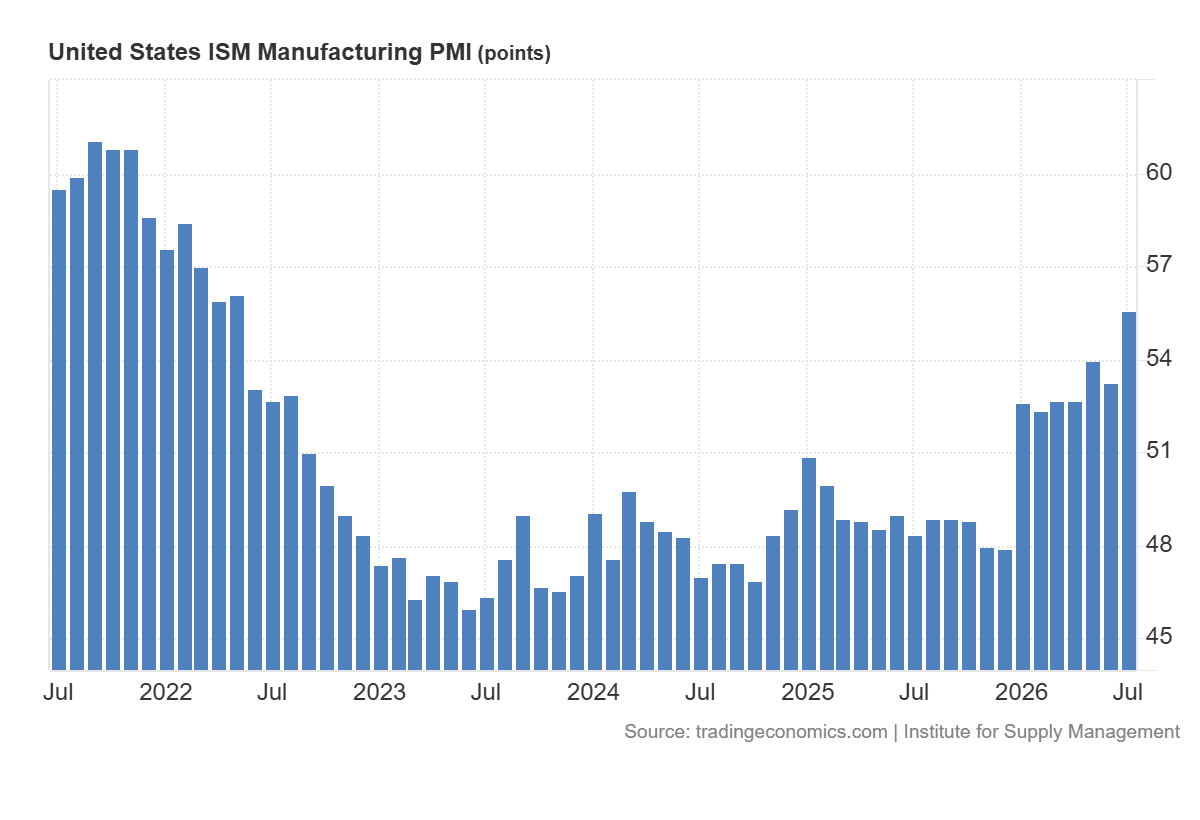
Now, with the latest PMI data, a similar setup appears to be forming. As the chart below shows, the U.S. ISM Manufacturing PMI came in at 55.6, above the expected 54. This marked its highest level since June 2022.

@media only screen and (min-width: 0px) and (min-height: 0px) { div[id^="bsa-zone_1774359638628-7_123456"] { min-height: 50px; transition: min-height 0.3s ease; } } @media only screen and (min-width: 640px) and (min-height: 0px) { div[id^="bsa-zone_1774359638628-7_123456"] { min-height: 90px; } }
AD

A stronger PMI typically points to improving manufacturing activity and a healthier economic backdrop, which could influence risk assets like Bitcoin.
Bitcoin’s 2017, 2021 macro signal returns – But this cycle has a catch image 0

Notably, this is where historical patterns start becoming interesting.

Can PMI repeat Bitcoin’s 2017 and 2021 rallies?

During those cycles, the total crypto market cap broke above $500 billion and $2 trillion, respectively, while Bitcoin rallied 1,336% and 59% in those periods.

That said, this signal alone does not guarantee that Bitcoin is about to repeat the same move, especially with BTC still stuck in a broader bearish phase and down more than 25% in 2026.

However, the timing of the stronger PMI data is notable, arriving as markets are closely watching rate expectations, with the odds of a rate hike at the next FOMC meeting currently sitting at 64%.

Meanwhile, Bitcoin’s ability to hold strong despite rising on-chain selling pressure adds another layer to the setup, suggesting that the improving macro backdrop from the PMI report could be laying the foundation for a potential shift in market momentum.

Bitcoin’s resilience meets rising selling pressure 

Calling Bitcoin’s [BTC] resilience above $60k a potential bull trap is not entirely far-fetched.

From an on-chain perspective, selling pressure is picking up across multiple cohorts.

BlackRock recently moved 1,948.07 BTC, worth around $122.03 million, into Coinbase Prime, while Bitcoin miners sold roughly 1,774 BTC, valued at around $112 million, over the past week. Adding to the bearish narrative, Jim Cramer also warned about selling his Bitcoin holdings over quantum computing concerns.

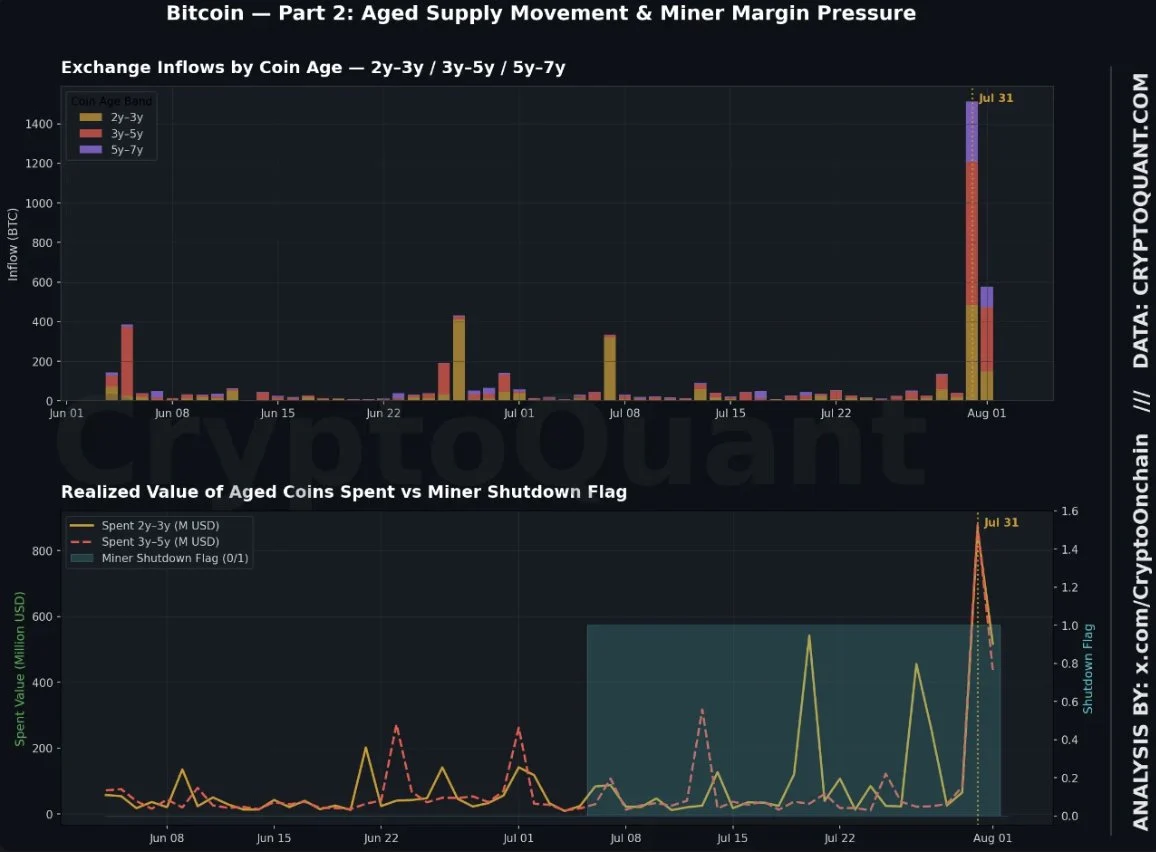
But the bigger takeaway is the sudden reactivation of dormant cohorts after years of inactivity. As the chart below shows, the long-dormant Bitcoin supply is beginning to move again.
Bitcoin’s 2017, 2021 macro signal returns – But this cycle has a catch image 1

Can PMI offset Bitcoin’s selling pressure?

Against this backdrop, the latest PMI report starts to carry more significance. 

The logic is straightforward: Key macro data releases this week could shape expectations heading into the September FOMC meeting. As mentioned earlier, rate hike odds have recently climbed above 64%.

In this environment, the stronger PMI print could be the first bullish signal, suggesting that the macro backdrop may be turning more supportive for Bitcoin and other risk assets. 

This is why BTC’s resilience despite rising selling pressure may not be just another bull trap. Instead, it could signal that improving macro conditions are helping Bitcoin absorb the pressure.

Final Summary

  • Bitcoin is holding above $60k despite heavy selling pressure.
  • A strong PMI report could give BTC a boost by improving market confidence.

 

0
0

Disclaimer: The content of this article solely reflects the author's opinion and does not represent the platform in any capacity. This article is not intended to serve as a reference for making investment decisions.

Understand the market, then trade.
Bitget offers one-stop trading for cryptocurrencies, stocks, and gold.
Trade now!

You may also like

How much CPO demand will Nvidia Rubin Ultra generate? Bernstein: Optical value per Pod will increase fivefold

Bernstein believes that the co-packaged optics (CPO) and fiber demand driven by Nvidia's Rubin Ultra architecture will surge significantly, with the optical content per Pod rising from $1 million to $5.4 million. This will propel the size of Nvidia's optical ecosystem market to $46.8 billion by 2028 (a 91% annual increase). Although the industry faces supply bottlenecks with InP substrates, the outlook remains positive. The institution reiterates its “outperform” rating for Lumentum, Coherent, and Ciena.

华尔街见闻•2026/11/11 08:47
How much CPO demand will Nvidia Rubin Ultra generate? Bernstein: Optical value per Pod will increase fivefold

UBS Q3 implements a two-way strategy with gold options, heavily invests in technology stocks, and builds positions in SK Hynix (SKHY.US)

UBS Group (UBS.US) has submitted its Q3 holdings report (13F) as of September 30, 2026.

智通财经•2026/11/11 08:22
UBS Q3 implements a two-way strategy with gold options, heavily invests in technology stocks, and builds positions in SK Hynix (SKHY.US)

SpaceX (SPCX.US) reportedly attempts “de-Nvidiaization” at the rack level: developing Kessel cabinets to bypass L6 compute boards, purchasing only chips

SemiAnalysis: SpaceX has developed its own Kessel cabinet, bypassing Nvidia's L6 cards to provide more options for manufacturing its own hardware.

智通财经•2026/11/11 08:20
SpaceX (SPCX.US) reportedly attempts “de-Nvidiaization” at the rack level: developing Kessel cabinets to bypass L6 compute boards, purchasing only chips

$3.7 billion “data center power equipment prepayments” abandoned! What did "the most active buyer of gas turbines", SoftBank, see?

In the second quarter of fiscal year 2026, SoftBank reported a net loss of $7.1 billion, primarily due to a $3.7 billion impairment charge from a $9.5 billion advance payment for power generation equipment for US data centers—of which about $2.9 billion was non-refundable and effectively lost. The CFO admitted that SoftBank placed orders before the project plan was finalized, and is now conducting a comprehensive review of its procurement strategy. "The most aggressive purchaser of gas turbines has now written off the deposit in this way."

华尔街见闻•2026/11/11 08:19

