Bitget App
Trade smarter
Buy cryptoMarketsTradeFuturesStocksEarnInstitutionAI & More
99% Liquidation Imbalance: Cardano (ADA) Price Bounce Traps $1 Million in Short Positions

99% Liquidation Imbalance: Cardano (ADA) Price Bounce Traps $1 Million in Short Positions

CryptoNewsNetCryptoNewsNet2026/08/03 21:33
By:CryptoNewsNet
Back to the list

99% Liquidation Imbalance: Cardano (ADA) Price Bounce Traps $1 Million in Short Positions

99% Liquidation Imbalance: Cardano (ADA) Price Bounce Traps $1 Million in Short Positions image 0  u.today 37 m
99% Liquidation Imbalance: Cardano (ADA) Price Bounce Traps $1 Million in Short Positions image 1

Cardano ($ADA) rarely ranks among the leading assets on exchange liquidation charts, usually giving way to BTC or ETH. However, the situation changed in early August as margin traders became overly confident that the token would fall toward $0.15 and opened one-sided bets on further downside.

As a result, a local price reversal triggered more than $1 million in short liquidations as per CoinGlass.

The hourly chart shows exactly how this trap closed. In late July, the token found a local bottom at $0.150. Bears assumed that the support level was about to break and began selling aggressively, but instead of moving lower, the price reversed and started climbing.
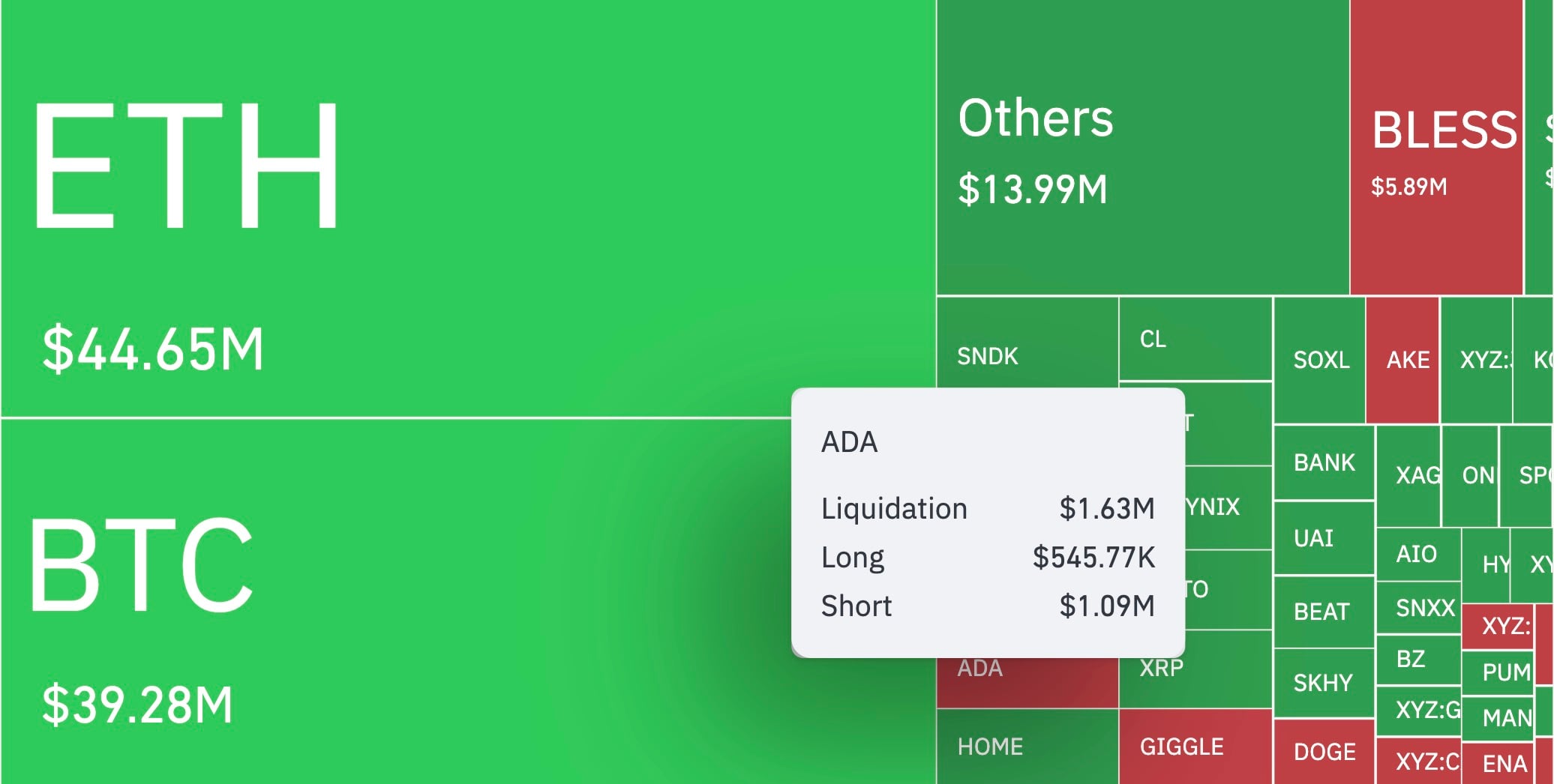
99% Liquidation Imbalance: Cardano (ADA) Price Bounce Traps $1 Million in Short Positions image 2 Crypto derivatives liquidation heatmap over the past 24 hours, Source: CoinGlass

The main action began during the attack on the $0.185 level. An impulsive breakout above this mark to a peak of $0.193 caused margin calls to begin triggering across sellers' positions.

The forced buying of $ADA to cover short sellers' losses accelerated the rally and pushed the token into the top liquidation rankings.

Why $ADA's path of least resistance leads upward

CoinGlass's liquidation heat map clearly shows the scale of the damage suffered by bears. A total of $1.63 million worth of $ADA positions was liquidated, with $1.09 million, or more than 66%, lost by short sellers.

A major imbalance emerged on the futures market, as longs suffered almost no damage while short sellers were systematically forced out one after another. Following this move, the price cooled slightly to $0.1857, turning the former heavy resistance barrier into a new support line for buyers.

Although the first wave of the squeeze has subsided and the RSI indicator has fallen to 54.22, the game is not over for sellers. The "Max Pain" map shows that the market's main liquidity magnet is located directly above the current price.

The next major pool of short liquidations, worth $1.12 million, sits at $0.19396.

To trigger a second wave of forced short closures, $ADA needs to rise by only 4.45%, or approximately $0.008. At the same time, buyers have a much larger safety margin below: the price would need to fall by more than 7% to reach their risk zone at $0.17102.

The current balance of forces shows that the liquidity pools above the price are twice as close as the support zones below. Therefore, bulls need only one brief push toward $0.194 to force sellers out again.


0
0

Disclaimer: The content of this article solely reflects the author's opinion and does not represent the platform in any capacity. This article is not intended to serve as a reference for making investment decisions.

Understand the market, then trade.
Bitget offers one-stop trading for cryptocurrencies, stocks, and gold.
Trade now!

You may also like

How much CPO demand will Nvidia Rubin Ultra generate? Bernstein: Optical value per Pod will increase fivefold

Bernstein believes that the co-packaged optics (CPO) and fiber demand driven by Nvidia's Rubin Ultra architecture will surge significantly, with the optical content per Pod rising from $1 million to $5.4 million. This will propel the size of Nvidia's optical ecosystem market to $46.8 billion by 2028 (a 91% annual increase). Although the industry faces supply bottlenecks with InP substrates, the outlook remains positive. The institution reiterates its “outperform” rating for Lumentum, Coherent, and Ciena.

华尔街见闻•2026/11/11 08:47
How much CPO demand will Nvidia Rubin Ultra generate? Bernstein: Optical value per Pod will increase fivefold

UBS Q3 implements a two-way strategy with gold options, heavily invests in technology stocks, and builds positions in SK Hynix (SKHY.US)

UBS Group (UBS.US) has submitted its Q3 holdings report (13F) as of September 30, 2026.

智通财经•2026/11/11 08:22
UBS Q3 implements a two-way strategy with gold options, heavily invests in technology stocks, and builds positions in SK Hynix (SKHY.US)

SpaceX (SPCX.US) reportedly attempts “de-Nvidiaization” at the rack level: developing Kessel cabinets to bypass L6 compute boards, purchasing only chips

SemiAnalysis: SpaceX has developed its own Kessel cabinet, bypassing Nvidia's L6 cards to provide more options for manufacturing its own hardware.

智通财经•2026/11/11 08:20
SpaceX (SPCX.US) reportedly attempts “de-Nvidiaization” at the rack level: developing Kessel cabinets to bypass L6 compute boards, purchasing only chips

$3.7 billion “data center power equipment prepayments” abandoned! What did "the most active buyer of gas turbines", SoftBank, see?

In the second quarter of fiscal year 2026, SoftBank reported a net loss of $7.1 billion, primarily due to a $3.7 billion impairment charge from a $9.5 billion advance payment for power generation equipment for US data centers—of which about $2.9 billion was non-refundable and effectively lost. The CFO admitted that SoftBank placed orders before the project plan was finalized, and is now conducting a comprehensive review of its procurement strategy. "The most aggressive purchaser of gas turbines has now written off the deposit in this way."

华尔街见闻•2026/11/11 08:19
