
Euro: Medium-term Trend Remains Weak

Since June, the US stock market has ended its unilateral upward trend, returning to a more volatile pattern, and the yield gap between US and European equity assets has narrowed. However, the euro continued its weak performance and did not gain significant upward momentum from the volatility in the equity markets.
Why is this happening, and what lies ahead for the euro? Let’s look into several dimensions:
First, from the perspective of capital flows, due to the valuation resilience of US AI leaders, dollar-denominated asset allocation remains attractive.
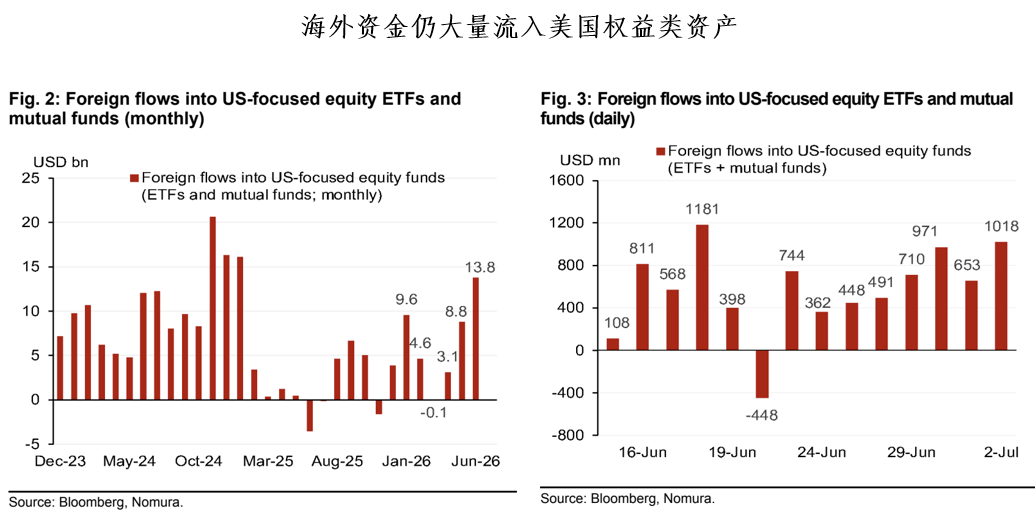
During the period from June 26 to July 2, foreign inflows into US equity ETFs and mutual funds totaled $3.8 billion, maintaining positive growth. Looking at the entire month of June, total inflows into these funds reached $13.8 billion, the highest level since $16.1 billion in January 2025.
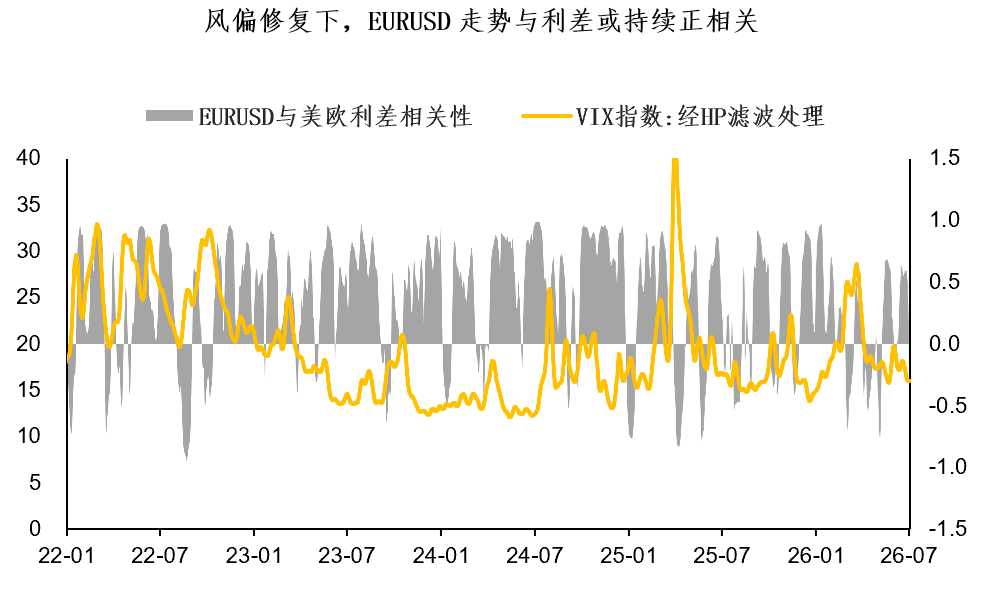
In addition, carry trades related to the US-EU interest rate spread are also an important constraint on short-term EURUSD fluctuations. The warming of market risk appetite has caused the VIX reading to continue falling. In a low-volatility environment, funds are more willing to engage in carry trades, and the interest rate spread may continue to dominate EURUSD movements for a period of time.
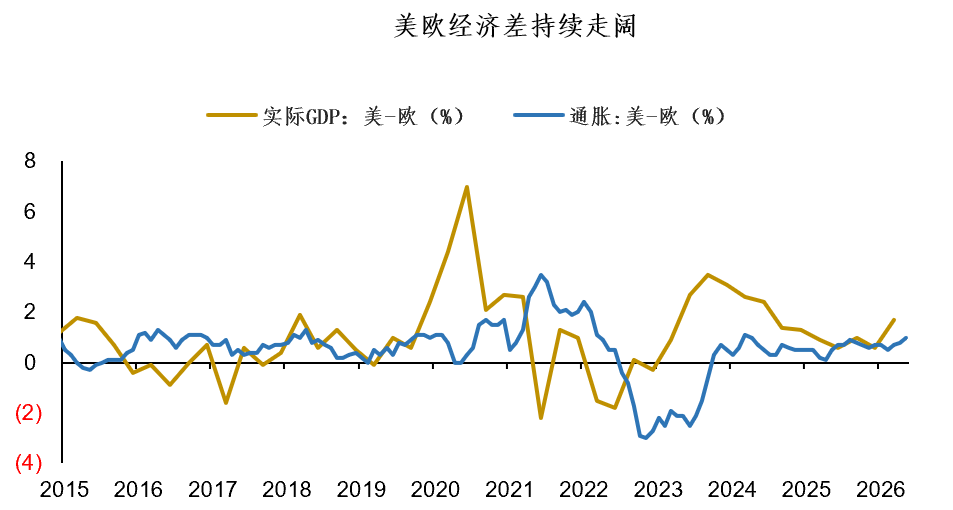
The continued divergence in economic performance provides medium- to long-term support for a “strong US, weak Europe” scenario. Major economic data show the US has both higher economic growth momentum and inflation stickiness compared to the eurozone. Up to the present day, the fundamental divergence between the US and Europe continues to widen.
Looking ahead, different paces of AI industry development in the two regions may further widen the gap in US and European economic fundamentals:
As the country at the forefront of AI advancement, the minutes of the latest Federal Reserve FOMC meeting show that officials’ concerns about future inflation trends are rising. Compared to before, more officials are now identifying the corporate investment boom driven by AI infrastructure as a new source of persistent inflation for the first time.
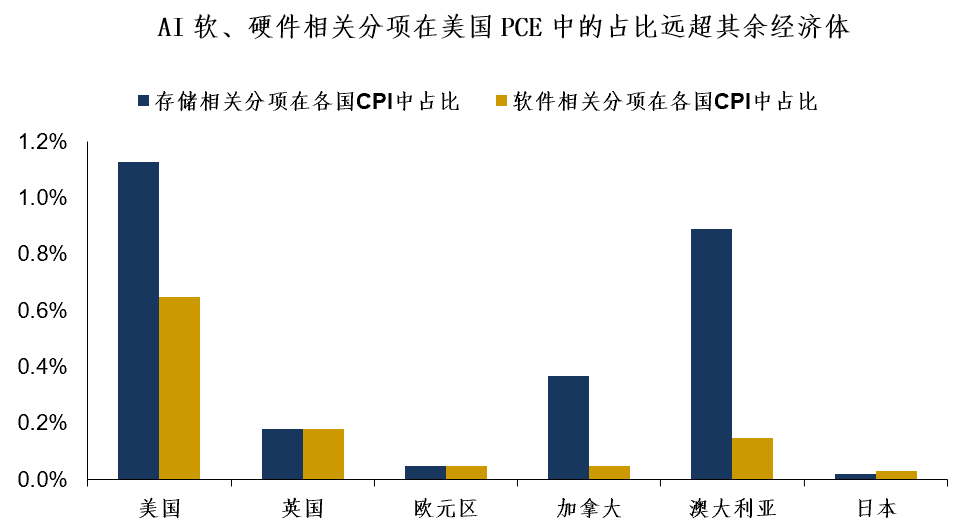
A Goldman Sachs research report delved deeper with data analysis: whether in hardware or software, America's PCE inflation metric contains many components related to this. The impact of AI development on US PCE is much greater than in other developed countries.
As for Europe, as pointed out by an ECB paper, due to the constraints of the productivity J-curve, there is a lag in reaping the growth dividend from digital investment. Europe has suffered from long-term insufficient investment in intangible assets and ICT-related sectors; this structural imbalance has continued to widen the US-Europe output gap, exerting medium- to long-term pressure on the European economy.
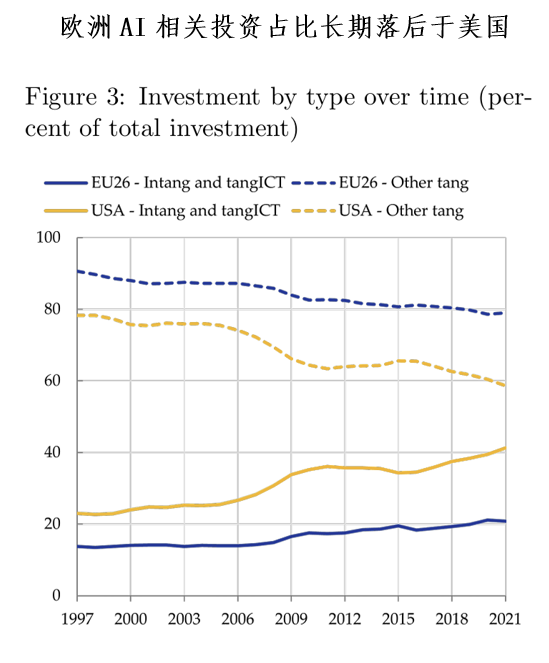
To summarize today’s discussion:
1. Although the US stock market is volatile and the US-Europe equity yield gap is narrowing, high-valuation AI-related assets remain highly attractive to foreign capital. Inflows into US equity ETFs and mutual funds remain positive, while EURUSD continues to be weak;
2. With the return of market risk appetite, the US-Europe interest rate spread is an important constraint on short-term EURUSD volatility, while the persistent divergence in economic fundamentals underpins a medium- to long-term “strong US, weak Europe” narrative;
3. Looking forward, US concerns about AI’s contribution to inflation and Europe’s continued lack of related investment will further widen the economic gap between the US and Europe for some time.
Disclaimer: The content of this article solely reflects the author's opinion and does not represent the platform in any capacity. This article is not intended to serve as a reference for making investment decisions.
You may also like
Jensen Huang's sudden resignation shrouded in suspicion: Did the White House secretly intervene? Is a return possible in the future?
Only a few days separated Jensen Huang’s strong support from the board last Sunday and his late-night resignation on Wednesday. Multiple reports of the Wednesday night Nvidia board meeting were co-authored by Washington-based journalists—who do not typically cover Nvidia—fueling rumors of "White House pressure and information leaks." Huang’s unique value lies in leveraging his personal reputation to secure the supply chain and drive the implementation of technological roadmaps, making him difficult to replace. Some analysts note that, drawing on examples such as Steve Jobs’ return to Apple, it is possible that Huang may come back in the future.

Gold recovers from YTD low, retakes $3,900; Fed hike bets and bullish USD to cap gains
Cerebras (CBRS.US) Cloud Business Soars, Masking Hardware Decline; OpenAI Supports Half of Cloud Revenue
Cerebras achieved record Q3 revenue, but hardware income dropped by nearly 30%, while cloud business accounted for two-thirds of total revenue. OpenAI contributed $72.4 million. The company raised its full-year guidance and expects Q4 to be close to breakeven.
Crypto prices
More


