
Cambridge study puts Ethereum near the lower end of PoS energy intensity

A new Cambridge study placed Ethereum near the lower end of energy intensity among major proof-of-stake (PoS) blockchains, although the network still used more electricity overall than most of the PoS networks studied.
The Cambridge Centre for Alternative Finance estimated that Ethereum consumes about 7.87 gigawatt-hours (GWh) of electricity annually. When adjusted for market value, the network used roughly 33 kilowatt-hours (kWh) per $1 million, the second-lowest figure among the proof-of-stake networks assessed, behind BNB Chain.
Solana used the most electricity among the PoS networks studied, at about 13.48 GWh per year. Its energy intensity was roughly 283 kWh per $1 million of market value, around 8.5 times Ethereum’s, while the networks in the comparison consumed about 38 GWh combined.
The report provides one of the most detailed assessments yet of Ethereum’s post-Merge footprint, giving policymakers and investors a more current basis for comparing blockchain sustainability.
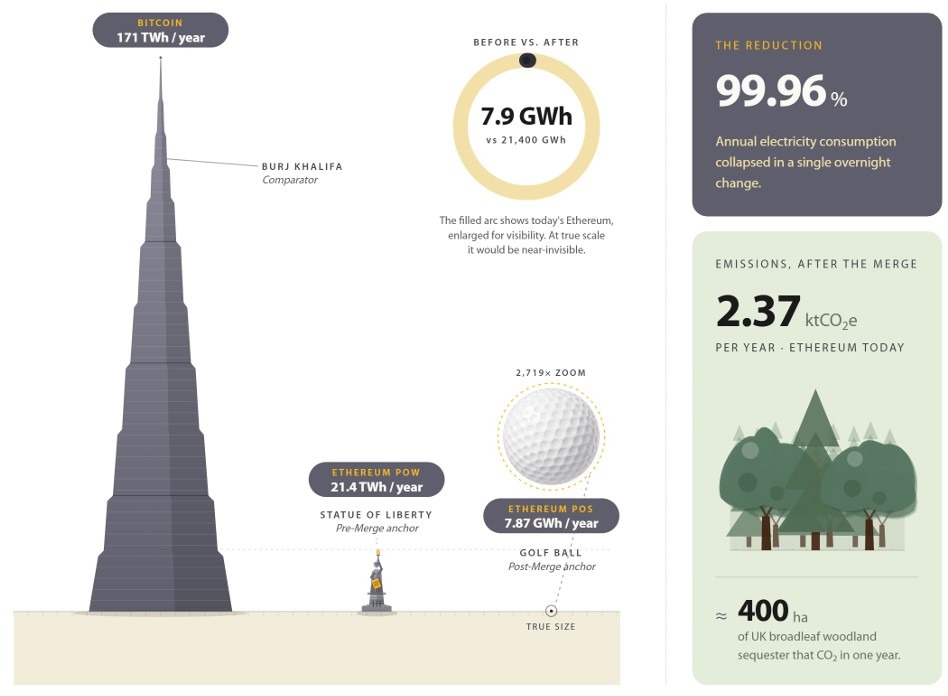
Illustration of post-Merge Ethereum consumption. Source: Cambridge
New estimates map Ethereum’s energy use
Cambridge measured how much electricity Ethereum nodes used at the wall across 20 combinations of the network’s main software clients. It found that a typical home setup used about 18 watts, while a more powerful workstation used roughly 153 watts.
Using Ethereum’s mix of residential and professionally hosted nodes, the researchers estimated an average power draw of about 105 watts per node. Cambridge counted around 8,522 discoverable full nodes, with 64% running in cloud or enterprise facilities and 36% on residential connections.
Cambridge said Ethereum’s remaining emissions are now driven mainly by the electricity grids supplying its nodes. The study estimated that about 56.4% of the network’s electricity mix came from renewable and nuclear sources, compared with 43.6% from fossil fuels.
Related: Vitalik Buterin shares priorities for new 'Lean Ethereum' strawmap
Ethereum moved from proof-of-work mining to proof-of-stake validation through the Merge in September 2022. The Merge replaced miners competing with one another using energy-intensive computing equipment with validators who secure the network by staking Ether.
After the Merge, energy estimates showed that the upgrade had reduced the network’s electricity use by more than 99.9%, as the mining process used to secure the blockchain was removed.
Magazine: Bitcoin nearing late stages of bear market: Jamie Coutts, Real Vision
Disclaimer: The content of this article solely reflects the author's opinion and does not represent the platform in any capacity. This article is not intended to serve as a reference for making investment decisions.
You may also like
Wall Street giants collectively raise rate hike forecasts, US Treasury futures continue to fall, gold drops over 1% to break 4000
After the US October CPI exceeded expectations, Goldman Sachs and Nomura added a forecast for an interest rate hike in March next year, while Deutsche Bank included a forecast for a rate hike in January next year. Currently, the market has fully priced in a 25 basis point rate hike in December, with a 13% probability for a 50 basis point hike. On Wednesday, the US Treasury spot market was closed, but Treasury futures continued to fall, with corresponding yields rising by about 2 to 4 basis points, and spot gold came under pressure, dropping by 1.1%.

No Need to Worry About the Cooling Down of AI Data Center Construction? The US Import Boom Is Unlikely to Subside in the Short Term, Real Impact May Come in 2029
It takes an average of 4.8 years from finalizing investment to starting construction of a data center project, and an additional 2.6 years from construction start to becoming operational. Servers usually cannot be installed until after the building structure and racks are completed. For trade partners such as Taiwan (China), South Korea, and Mexico who rely on US data center supply chain demand, the inertia in construction timelines provides at least a one- to two-year buffer for future exports.

Federal Reserve Major Debate: When Should the Tenure of “Number Three” Williams End?
The main point of contention is whether Williams should step down in June 2028, upon completing a full 10-year term, or in June 2027, when he reaches the mandatory retirement age of 65. Analysts point out that the Federal Reserve Board holds ultimate discretion; if he leaves early, Fed Chair Waller would be able to assert greater control over the appointment to this critical position. However, forcing Williams to shorten his term could easily be interpreted as political manipulation. Williams himself is expected to serve until June 2028.

Sunshine Silver weighs doubling mill capacity
Crypto prices
More


