Bitget App
Trade smarter
Buy cryptoMarketsTradeFuturesStocksEarnInstitutionAI & More
XRP Active Addresses Fall to Second-Lowest Level of 2026 as New Wallet Creation Hits 2024 Low

XRP Active Addresses Fall to Second-Lowest Level of 2026 as New Wallet Creation Hits 2024 Low

CryptoNewsNetCryptoNewsNet2026/07/11 12:06
By:CryptoNewsNet
Back to the list

XRP Active Addresses Fall to Second-Lowest Level of 2026 as New Wallet Creation Hits 2024 Low

XRP Active Addresses Fall to Second-Lowest Level of 2026 as New Wallet Creation Hits 2024 Low image 0  thecryptobasic.com 21 m
XRP Active Addresses Fall to Second-Lowest Level of 2026 as New Wallet Creation Hits 2024 Low image 1

The $XRP Ledger has entered a period of noticeably weaker on-chain activity, as key network metrics fall to some of their lowest levels this year.

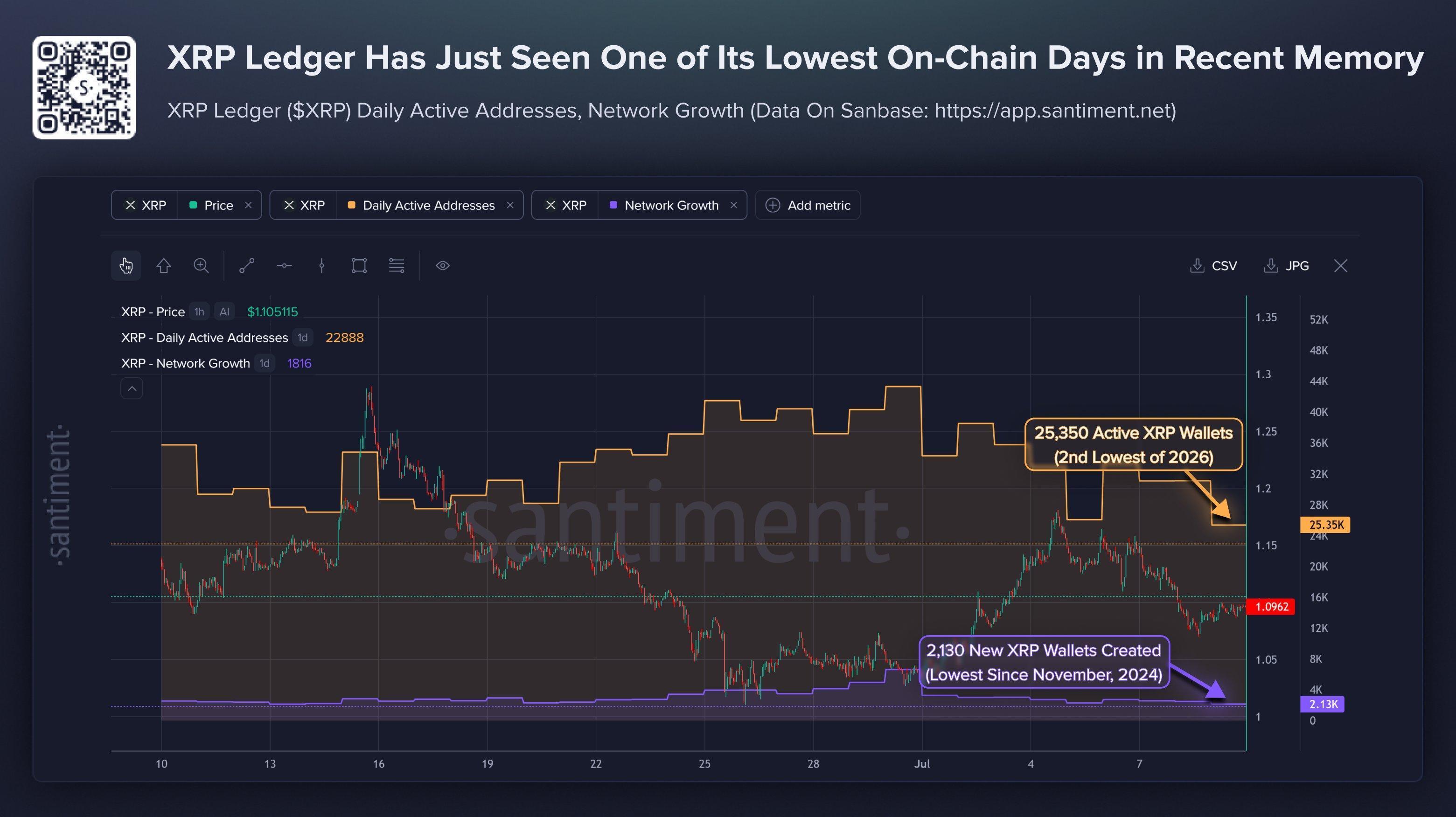
Data from Santiment shows that daily active addresses recently dropped to 25,350, marking the second-lowest level recorded this year. Meanwhile, new wallet creation fell to 2,130, its lowest point since November 2024.

Notably, these figures show that activity on the network has slowed sharply, even though $XRP continues to show resilience above the crucial $1 psychological mark.

This decline did not happen all at once, as active addresses gradually trended lower over several weeks after reaching stronger levels earlier in June. Each drop settled below the previous one until the latest reading, showing that participation on the network kept fading.

The trend has also continued beyond the lows highlighted by Santiment. Specifically, daily active addresses have since fallen further to 22,888.

Mid-June Recovery Lost Momentum

While network activity saw a decline in early June, this trend briefly paused on June 15, when increased dip buying lifted $XRP’s price and the number of active addresses. For a short time, the move suggested that interest in the network had returned and that activity could begin to recover.
XRP Active Addresses Fall to Second-Lowest Level of 2026 as New Wallet Creation Hits 2024 Low image 2 $XRP Network Activity | Santiment

However, the momentum was short-lived. $XRP soon corrected back to its familiar $1.05 to $1.15 trading range, while active addresses resumed their decline. The network never regained the activity levels seen before or during the brief rally.

Market data suggests that the rebound emerged as a result of short-term buying from existing holders rather than fresh demand entering the market. Notably, the network did not attract a noticeable wave of new users during that period.

Data on $XRP wallet creation supports this idea, as new address growth rose but failed to match the rally and uptick in wallet activity. Essentially, the increase in activity came mainly from users who were already on the network, not newcomers joining the $XRP Ledger.

Stable Price Hides Falling Network Activity

Now, the $XRP ecosystem is witnessing a widening gap between $XRP’s price and XRPL on-chain activity. Specifically, while network participation has continued to weaken, $XRP has held relatively steady around $1.0962.

The token has avoided a major price breakdown below $1 even as active addresses and wallet creation have fallen to multi-month and year-to-date lows.

This gap suggests that existing liquidity and large holders have persistently supported the price despite fewer users actively engaging with the network. In a stronger market, price stability at these levels would usually come with growing network activity.

$XRP Still Needs a Strong Catalyst

Santiment believes several developments could help reverse the current trend and support a move toward $1.50.

These include wider adoption of RLUSD, more tokenized assets on the $XRP Ledger, increased institutional payment activity, continued expansion of the EVM sidechain, and the launch of lending tools.

If these developments gain real traction, they could bring more users to the network and provide stronger support for higher prices. However, for now, the data shows little sign that those catalysts have started driving network activity.


0
0

Disclaimer: The content of this article solely reflects the author's opinion and does not represent the platform in any capacity. This article is not intended to serve as a reference for making investment decisions.

Understand the market, then trade.
Bitget offers one-stop trading for cryptocurrencies, stocks, and gold.
Trade now!

You may also like

Wall Street giants collectively raise rate hike forecasts, US Treasury futures continue to fall, gold drops over 1% to break 4000

After the US October CPI exceeded expectations, Goldman Sachs and Nomura added a forecast for an interest rate hike in March next year, while Deutsche Bank included a forecast for a rate hike in January next year. Currently, the market has fully priced in a 25 basis point rate hike in December, with a 13% probability for a 50 basis point hike. On Wednesday, the US Treasury spot market was closed, but Treasury futures continued to fall, with corresponding yields rising by about 2 to 4 basis points, and spot gold came under pressure, dropping by 1.1%.

华尔街见闻•2026/11/11 21:18
Wall Street giants collectively raise rate hike forecasts, US Treasury futures continue to fall, gold drops over 1% to break 4000

No Need to Worry About the Cooling Down of AI Data Center Construction? The US Import Boom Is Unlikely to Subside in the Short Term, Real Impact May Come in 2029

It takes an average of 4.8 years from finalizing investment to starting construction of a data center project, and an additional 2.6 years from construction start to becoming operational. Servers usually cannot be installed until after the building structure and racks are completed. For trade partners such as Taiwan (China), South Korea, and Mexico who rely on US data center supply chain demand, the inertia in construction timelines provides at least a one- to two-year buffer for future exports.

华尔街见闻•2026/11/11 21:18
No Need to Worry About the Cooling Down of AI Data Center Construction? The US Import Boom Is Unlikely to Subside in the Short Term, Real Impact May Come in 2029

Federal Reserve Major Debate: When Should the Tenure of “Number Three” Williams End?

The main point of contention is whether Williams should step down in June 2028, upon completing a full 10-year term, or in June 2027, when he reaches the mandatory retirement age of 65. Analysts point out that the Federal Reserve Board holds ultimate discretion; if he leaves early, Fed Chair Waller would be able to assert greater control over the appointment to this critical position. However, forcing Williams to shorten his term could easily be interpreted as political manipulation. Williams himself is expected to serve until June 2028.

华尔街见闻•2026/11/11 21:18
Federal Reserve Major Debate: When Should the Tenure of “Number Three” Williams End?
