Bitget App
Trade smarter
Buy cryptoMarketsTradeFuturesStocksEarnInstitutionAI & More
Bitcoin’s short-term holders remain 15% underwater—but selling pressure is easing

Bitcoin’s short-term holders remain 15% underwater—but selling pressure is easing

AMBCryptoAMBCrypto2026/07/10 22:36
By:AMBCrypto

Bitcoin [BTC] was showing a divergence between spot and derivatives markets. AMBCrypto reported that the apparent demand metric has been negative throughout 2026.

The Coinbase Premium Index was also in the red in recent weeks, showing a lack of demand from institutional players. Meanwhile, rising leverage trends were spotted, leaving the market vulnerable to a liquidation cascade.

The current bear cycle has yet to reach the lows of the previous ones. Stablecoin outflow from exchanges was another hint of defensive positioning from crypto market participants.

@media only screen and (min-width: 0px) and (min-height: 0px) { div[id^="bsa-zone_1774359638628-7_123456"] { min-height: 50px; transition: min-height 0.3s ease; } } @media only screen and (min-width: 640px) and (min-height: 0px) { div[id^="bsa-zone_1774359638628-7_123456"] { min-height: 90px; } }
AD

This lack of sustained demand was a warning, but also left a potential route higher in the short-term. Here’s what the price action and short-term holder dynamics have to say about a potential Bitcoin price bounce.

Short-term holder buying pressure is dominating BTC, just like in February
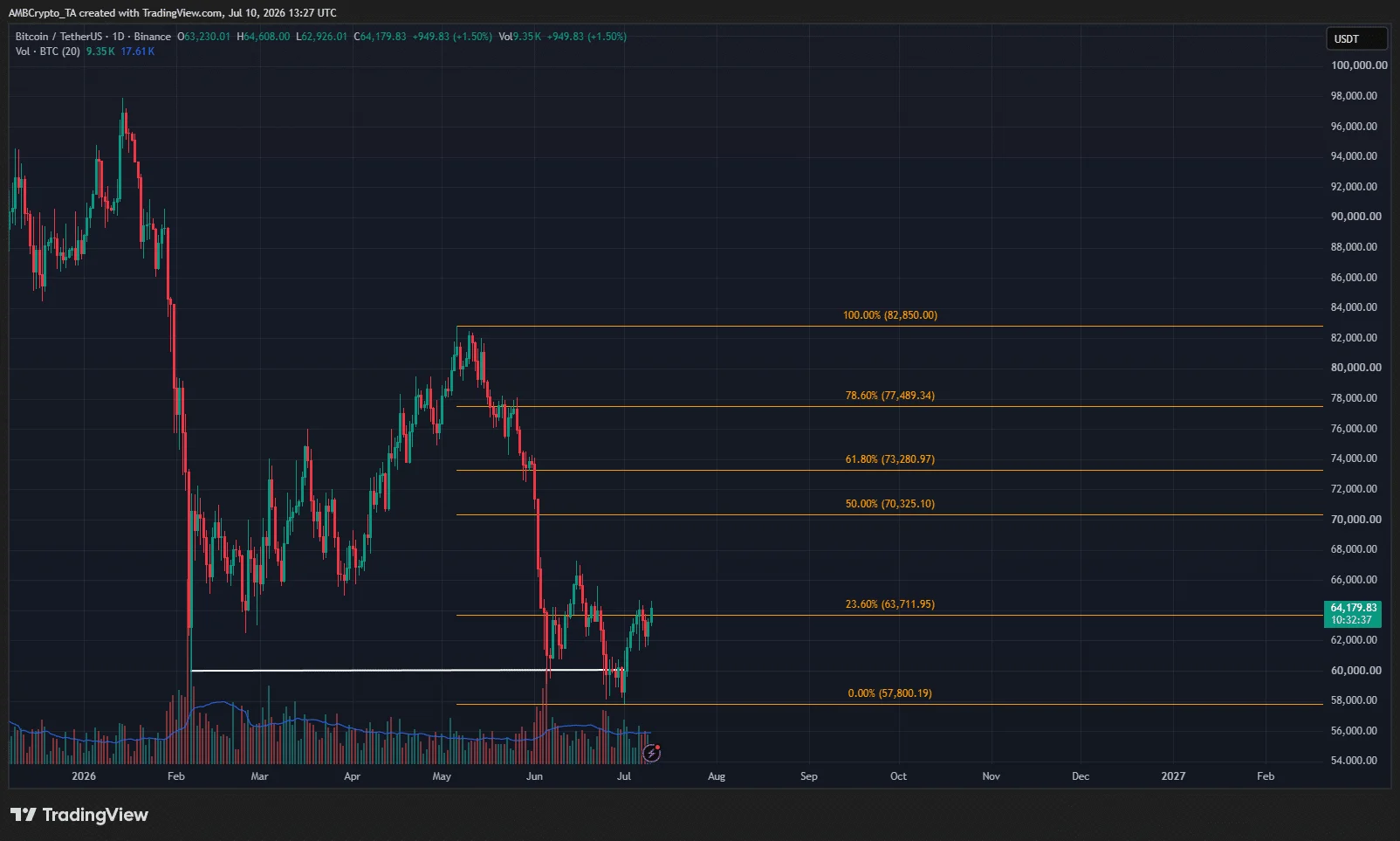
Bitcoin’s short-term holders remain 15% underwater—but selling pressure is easing image 0 Source: BTC/USDT on TradingView

The bearish swing structure saw a continuation signal when the February lows breached in the final week of June. After setting a new low at $57,800, Bitcoin has crept higher.

From a technical analysis standpoint, this bounce can extend up to the $73.2k-$77.5k area, the golden pocket in the Fibonacci retracement levels.
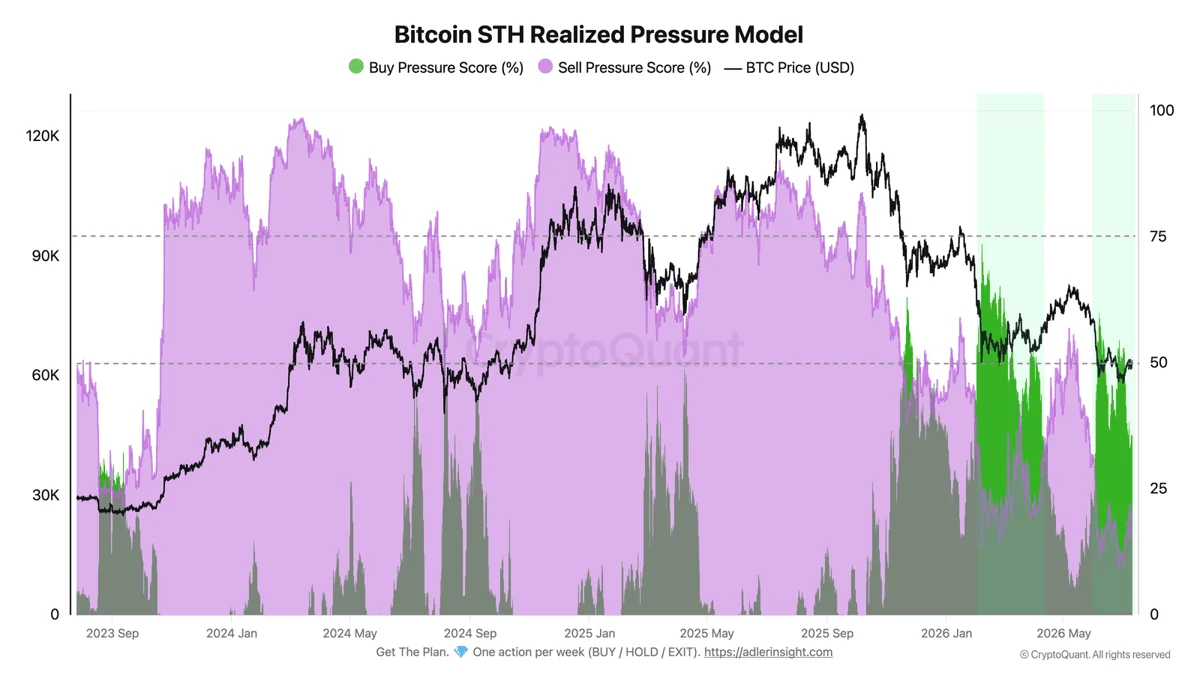
Bitcoin’s short-term holders remain 15% underwater—but selling pressure is easing image 1 Source: Axel Adler Jr.

The Bitcoin Realized Pressure Model metric compares realized buying and selling pressure from short-term holders compared to current BTC prices. Crypto analyst Axel Adler Jr. used this metric to demonstrate that, for now, selling pressure was compressed, and buyers have an advantage, pointing to an accumulation phase.

In February, the buying pressure average score was 61%, compared to the selling average score of 22%. As BTC rallied, the situation shifted. In May, the selling pressure was 43%, compared to the buying score of 11%.

In June and July, short-term holder buying pressure was dominant once again, with 37%-46%, while selling was compressed to 16%.

Until these scores deteriorate, a bounce like the one that commenced in February would be possible.
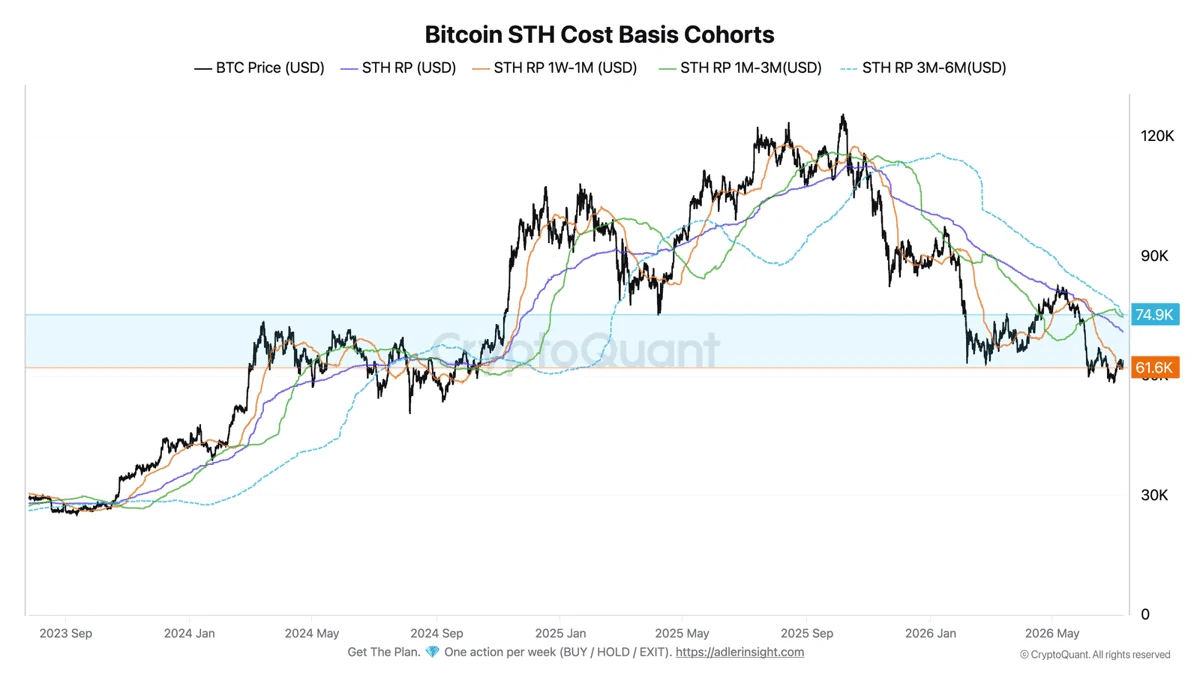
Bitcoin’s short-term holders remain 15% underwater—but selling pressure is easing image 2 Source: Axel Adler Jr.

This metric separates different cohorts of short-term holders’ purchase prices. The 1-week-1-month cohort’s realized price was at $61.6k, while the 3-month-6-month holder cohort’s average purchase price was at $74.9k.

The freshest cohort of buyers is in profit, but the older cohorts [1 to 6 months] were underwater by around 15%.

It is possible that this cohort would wait for a bigger price bounce toward or beyond $70k before beginning to sell in large numbers. In such a scenario, a short-term rally would once again be met by a wave of selling.

The analyst concluded that the current market price was within an accumulation zone with “a moderate risk-on tilt”. A reclaim of the $71k level would be a notable confirmation of a bullish pivot.

Final Summary

  • The derivatives build up, and the lack of sweeping, long-term holder accumulation trends was a threat to long-term recovery.
  • Short-term holder accumulation could push prices toward $70k, a popular crypto analyst warned.

 

0
0

Disclaimer: The content of this article solely reflects the author's opinion and does not represent the platform in any capacity. This article is not intended to serve as a reference for making investment decisions.

Understand the market, then trade.
Bitget offers one-stop trading for cryptocurrencies, stocks, and gold.
Trade now!

You may also like

Wall Street giants collectively raise rate hike forecasts, US Treasury futures continue to fall, gold drops over 1% to break 4000

After the US October CPI exceeded expectations, Goldman Sachs and Nomura added a forecast for an interest rate hike in March next year, while Deutsche Bank included a forecast for a rate hike in January next year. Currently, the market has fully priced in a 25 basis point rate hike in December, with a 13% probability for a 50 basis point hike. On Wednesday, the US Treasury spot market was closed, but Treasury futures continued to fall, with corresponding yields rising by about 2 to 4 basis points, and spot gold came under pressure, dropping by 1.1%.

华尔街见闻•2026/11/11 21:18
Wall Street giants collectively raise rate hike forecasts, US Treasury futures continue to fall, gold drops over 1% to break 4000

No Need to Worry About the Cooling Down of AI Data Center Construction? The US Import Boom Is Unlikely to Subside in the Short Term, Real Impact May Come in 2029

It takes an average of 4.8 years from finalizing investment to starting construction of a data center project, and an additional 2.6 years from construction start to becoming operational. Servers usually cannot be installed until after the building structure and racks are completed. For trade partners such as Taiwan (China), South Korea, and Mexico who rely on US data center supply chain demand, the inertia in construction timelines provides at least a one- to two-year buffer for future exports.

华尔街见闻•2026/11/11 21:18
No Need to Worry About the Cooling Down of AI Data Center Construction? The US Import Boom Is Unlikely to Subside in the Short Term, Real Impact May Come in 2029

Federal Reserve Major Debate: When Should the Tenure of “Number Three” Williams End?

The main point of contention is whether Williams should step down in June 2028, upon completing a full 10-year term, or in June 2027, when he reaches the mandatory retirement age of 65. Analysts point out that the Federal Reserve Board holds ultimate discretion; if he leaves early, Fed Chair Waller would be able to assert greater control over the appointment to this critical position. However, forcing Williams to shorten his term could easily be interpreted as political manipulation. Williams himself is expected to serve until June 2028.

华尔街见闻•2026/11/11 21:18
Federal Reserve Major Debate: When Should the Tenure of “Number Three” Williams End?

