
From the Micro Dilemma of Buying Oil from Turkey to the Macro Closed Loop of Gold Prices under Pressure

Huitong Network, July 10—— Unnoticed by many, the real interest rate in the United States has reached a new high again, and the price of gold is once more under pressure.
In today’s intricate global macroeconomic landscape, the outbreak of US-Iran geopolitical conflict has not followed the traditional “commodity surge, US economy falling into stagflation” script.
On the contrary, the current financial market is staging a twin-up movement of “high nominal rates and high real rates”, driven by expectations of slowing inflation, global safe-haven capital flowing back, and a cross-generational tech revolution.
To unravel this complex logic puzzle, we need to examine the Federal Reserve’s policy direction from the “heads” of the global macro coin, and also to glimpse the gears of the global US dollar cycle from micro “tails” such as “Turkey buying oil”.
The Misalignment of Nominal Rates and Slowing Inflation: The Fisher Effect Drives High Real Interest Rates
From a short-term macro perspective, the persistent rise and high levels of nominal US interest rates are facing a subtle economic environment: amid ongoing conflicts, critical waterways like the Strait of Hormuz have remained open, so the fuse for global energy supply has not been fully lit, and oil prices have instead retreated from highs. This phenomenon has directly driven market expectations for slower inflation ahead.
As the Federal Reserve holds nominal rates high to solidify anti-inflation gains, a decrease in forward inflation expectations means that current high interest rates—and lower future inflation—will not significantly eat into interest returns, causing real interest rates to rise as inflation expectations fall.
This mismatch—high nominal rates and easing inflation—leads to continuously climbing real interest rates for the real economy, a mechanism that structurally tightens global liquidity from its roots.
Macroeconomic Rigidity on Both Supply and Demand Sides: The Crowding Out Effect Resonates With AI Capital Expenditure
In the supply-demand landscape of loanable funds, persistently high real interest rates are supported from both sides:
This “big government” fiscal pattern dramatically consumes national savings, and as the government becomes a substantial “capital black hole” via ongoing Treasury issuance, it creates a classic “crowding out effect” on private investment, pushing up real rates from the supply side.
Demand side (AI-driven productivity boom): Unlike traditional economic downturns, today’s real economy is experiencing a transformative technological revolution led by artificial intelligence (AI). Even in the face of high financing costs, global tech giants are aggressively spending capital (Capex) to secure their future industry dominance. This exceptionally strong demand for real loans and investment locks in the high plateau for real interest rates.
Interlocking Micro Gears: The Capital Reflow Paradigm Triggered by “Turkey Buying Oil”
However, the reason the US government’s massive bond issuance has not collapsed the Treasury market—in fact, has supported the dollar’s dominance—lies in a well-choreographed “capital relay” in the global safe-haven model. We can examine this paradigm through a typical micro case: Turkey’s dilemma during crisis.
When geopolitical tensions escalate and uncertainty spikes, countries like Turkey—short of key resources and facing severe depreciation risk for their currency (lira)—act as micro gears in the global financial system:
This global, inelastic demand means that, instead of weakening, the dollar’s purchasing power soars in crises, strengthening its rise.
In theory, these sales would push up yields. However, the same geopolitical conflict spurs a global “safe-haven storm”—European funds and Asian tycoons, flush with dollars, scour the world for safe assets. Spotting newly-issued US Treasuries at bargain prices and high yields, they immediately step in as buyers.
Subsequently, Saudi Arabia, after earning huge petrodollar receipts from Turkey, cycles these dollars back into the US system through buying more Treasuries or depositing in US banks to preserve asset value.
This closed loop—“Turkey sells Treasuries for dollars, European/Saudi capital buys US bonds and dollars flow back”—perfectly offsets the pressure of massive US government bond supplies.
A continuous transfusion of global capital creates robust, inelastic demand for Treasuries, ultimately supporting US real interest rates at a high—and highly resilient—level.
The Logical Destination: Elevated Real Rates and the Inevitable Pressure on Gold’s Value
When all of these logical chains are seamlessly interconnected, the macro destination is inevitably the world’s traditional safe-haven asset—gold.
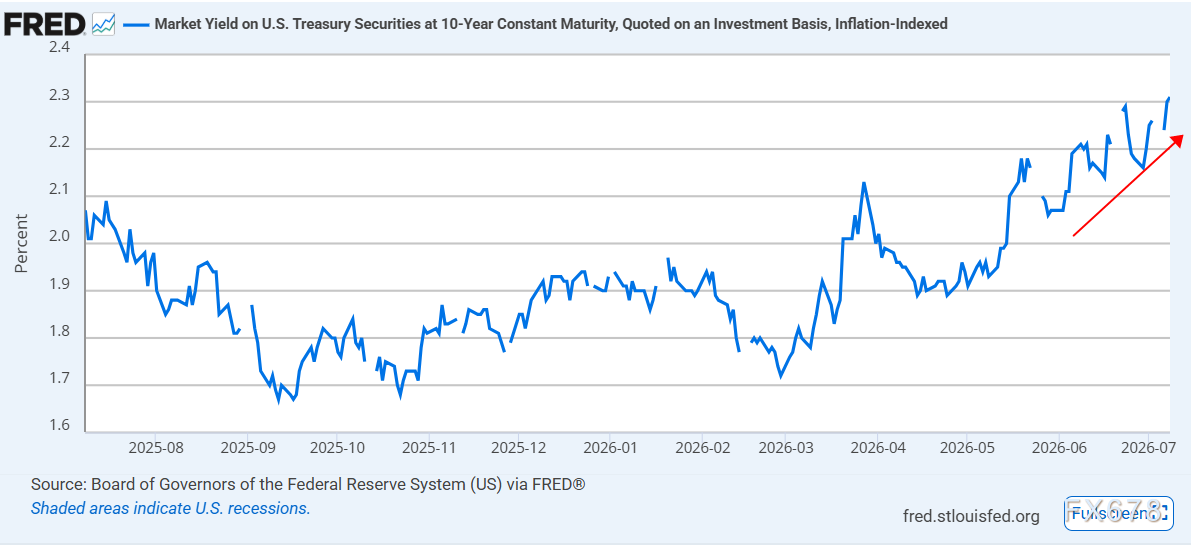
(Daily chart of real interest rates, source: New York Fed)
In conventional wisdom, geopolitical conflict is typically a catalyst for surging gold prices. However, under the sophisticated paradigm of global US dollar circulation, gold’s aura is being severely squeezed by high real interest rates.
As a “zero-yield asset”, gold does not generate any interest. The opportunity cost of holding gold is precisely the real interest rate in the marketplace. Today, with slowing forward inflation, government deficits crowding out, robust AI investment demand, and Turkey-style micro safe-haven capital return, risk-free US Treasury real yields have climbed to impressive highs.
This means the opportunity cost for investors to hold gold against geopolitical risks has become very high. Compared to gold, which generates no income, high real-yield US dollar assets, snapped up by global safe-haven funds and petrodollars, clearly offer a more attractive risk-free real return.
As a result, under the dual gravitational pull of a strong dollar and rigidly rising real interest rates, gold’s allure is systematically weakened, and its price is bound to experience pronounced volatility and technical pressure on a macro level.
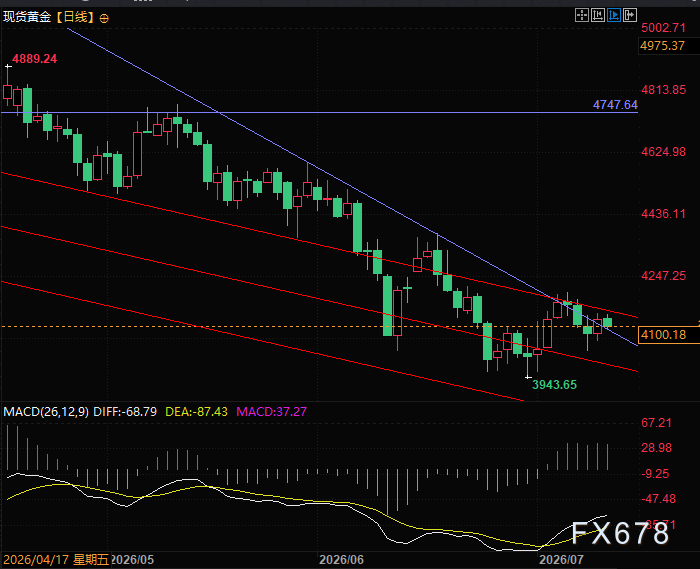
(Spot gold daily chart, source: Yihuitong)
East 8 Zone 21:55 (UTC+8), spot gold now reported at $4,100 per ounce.
Disclaimer: The content of this article solely reflects the author's opinion and does not represent the platform in any capacity. This article is not intended to serve as a reference for making investment decisions.
You may also like
Wall Street giants collectively raise rate hike forecasts, US Treasury futures continue to fall, gold drops over 1% to break 4000
After the US October CPI exceeded expectations, Goldman Sachs and Nomura added a forecast for an interest rate hike in March next year, while Deutsche Bank included a forecast for a rate hike in January next year. Currently, the market has fully priced in a 25 basis point rate hike in December, with a 13% probability for a 50 basis point hike. On Wednesday, the US Treasury spot market was closed, but Treasury futures continued to fall, with corresponding yields rising by about 2 to 4 basis points, and spot gold came under pressure, dropping by 1.1%.

No Need to Worry About the Cooling Down of AI Data Center Construction? The US Import Boom Is Unlikely to Subside in the Short Term, Real Impact May Come in 2029
It takes an average of 4.8 years from finalizing investment to starting construction of a data center project, and an additional 2.6 years from construction start to becoming operational. Servers usually cannot be installed until after the building structure and racks are completed. For trade partners such as Taiwan (China), South Korea, and Mexico who rely on US data center supply chain demand, the inertia in construction timelines provides at least a one- to two-year buffer for future exports.

Federal Reserve Major Debate: When Should the Tenure of “Number Three” Williams End?
The main point of contention is whether Williams should step down in June 2028, upon completing a full 10-year term, or in June 2027, when he reaches the mandatory retirement age of 65. Analysts point out that the Federal Reserve Board holds ultimate discretion; if he leaves early, Fed Chair Waller would be able to assert greater control over the appointment to this critical position. However, forcing Williams to shorten his term could easily be interpreted as political manipulation. Williams himself is expected to serve until June 2028.

Sunshine Silver weighs doubling mill capacity
Crypto prices
More


