
Geopolitical risks and high interest rates create double pressure, gold's rebound is hindered but its medium-term outlook remains supported

Huitong Finance, July 10 — Market analysts believe that the short-term trend of gold is currently under the dual influence of rising geopolitical risks and a high interest rate environment. The increase in energy prices may slow the global disinflation process, while elevated U.S. Treasury yields and the uncertainty of Federal Reserve policy are limiting investors' willingness to buy. However, after the recent correction, the medium-term fundamentals of gold remain somewhat supportive.
Recently, the gold market has faced the interplay of multiple factors, with short-term rebound momentum weakening. Pepperstone research strategist Ahmed Assiri stated that gold is currently repressed by both geopolitical tensions and the high interest rate environment, and the decline in market risk appetite has weakened the metal's recent recovery. 
In recent days, the back-and-forth situation between the U.S. and Iran has reignited global risk aversion, but gold has not gained sustained upward momentum for this reason, mainly because investors are simultaneously focusing on changes in the interest rate environment. The market believes that, although geopolitical risks enhance gold's safe-haven attributes, if risk events push energy prices higher and further impact inflation expectations, major central banks may maintain restrictive monetary policy for an extended period.
If oil prices continue to rise, driving inflation pressure up, the Federal Reserve may need to maintain a more cautious pace of rate cuts, which would continue to weigh on gold. However, in the medium term, gold still has certain supportive factors, including global economic uncertainty, demand for central bank asset allocation, and expectations of future shifts in monetary policy.
Compared to the massive sell-off gold faced in previous weeks, current market sentiment has improved somewhat. Investors are waiting for more economic data to confirm the direction of Federal Reserve policy, with particular attention to U.S. inflation data, labor market performance, and changes in U.S. Treasury yields.
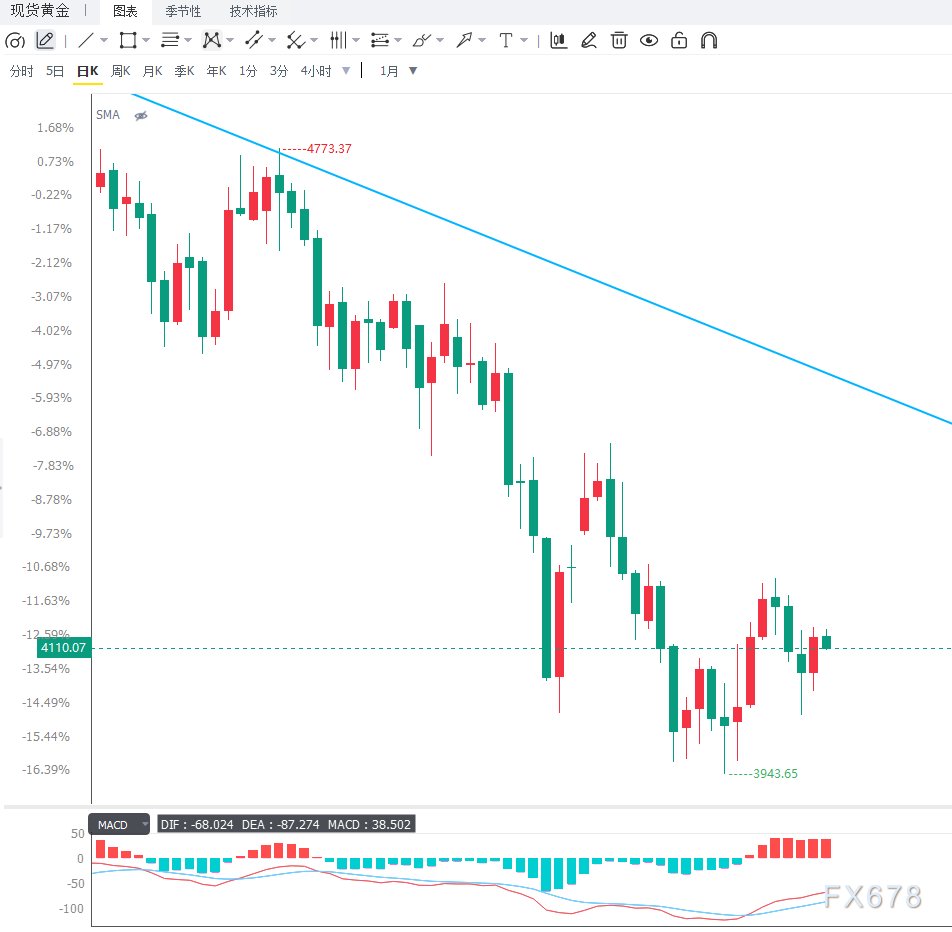
From a technical perspective, gold remains in a post-correction recovery phase in the short term. On the daily chart, although gold prices face pressure, the overall pattern is still a high-level consolidation. Key resistance is at the $4,150 to $4,180 range; if this area is broken, gold may retest the $4,200 level. On the downside, support lies at $4,080, $4,050, and $4,000. A break below $4,000 may further confirm the short-term correction trend.
In the 4-hour time frame, gold remains volatile near $4,100, with short-term bulls and bears relatively balanced. The moving average system is converging, showing the market is waiting for new directional signals. The MACD indicates a recovery in rebound momentum, but a strong upward structure has yet to form. If the price breaks above resistance near $4,150, the short term could open up further upside; if it falls below $4,050, it may retest lower support levels.
Gold is currently in a tug-of-war phase between safe-haven demand and the pressure from high interest rates. Although geopolitical risks provide some support for gold, inflation pressure from rising energy prices and the uncertainty of Federal Reserve policy are causing short-term investors to remain cautious.
In the medium to long term, gold still retains certain investment value, especially against the backdrop of increasing global economic uncertainty and the potential gradual adjustment of monetary policy. However, the short-term trend remains dependent on changes in the U.S. dollar, U.S. Treasury yields, and inflation data. In the future, the market should focus on Federal Reserve policy signals and whether geopolitical risks further intensify, as these will determine the direction of gold in its next phase.
Disclaimer: The content of this article solely reflects the author's opinion and does not represent the platform in any capacity. This article is not intended to serve as a reference for making investment decisions.
You may also like
Wall Street giants collectively raise rate hike forecasts, US Treasury futures continue to fall, gold drops over 1% to break 4000
After the US October CPI exceeded expectations, Goldman Sachs and Nomura added a forecast for an interest rate hike in March next year, while Deutsche Bank included a forecast for a rate hike in January next year. Currently, the market has fully priced in a 25 basis point rate hike in December, with a 13% probability for a 50 basis point hike. On Wednesday, the US Treasury spot market was closed, but Treasury futures continued to fall, with corresponding yields rising by about 2 to 4 basis points, and spot gold came under pressure, dropping by 1.1%.

No Need to Worry About the Cooling Down of AI Data Center Construction? The US Import Boom Is Unlikely to Subside in the Short Term, Real Impact May Come in 2029
It takes an average of 4.8 years from finalizing investment to starting construction of a data center project, and an additional 2.6 years from construction start to becoming operational. Servers usually cannot be installed until after the building structure and racks are completed. For trade partners such as Taiwan (China), South Korea, and Mexico who rely on US data center supply chain demand, the inertia in construction timelines provides at least a one- to two-year buffer for future exports.

Federal Reserve Major Debate: When Should the Tenure of “Number Three” Williams End?
The main point of contention is whether Williams should step down in June 2028, upon completing a full 10-year term, or in June 2027, when he reaches the mandatory retirement age of 65. Analysts point out that the Federal Reserve Board holds ultimate discretion; if he leaves early, Fed Chair Waller would be able to assert greater control over the appointment to this critical position. However, forcing Williams to shorten his term could easily be interpreted as political manipulation. Williams himself is expected to serve until June 2028.

Sunshine Silver weighs doubling mill capacity
Crypto prices
More


