
"The strongest El Niño" is coming? Global agricultural supply chains face further challenges

Scientific institutions have issued the strongest El Niño alert in 75 years, as the global agricultural supply chain faces multiple overlapping shocks.
The US Climate Prediction Center (CPC) warns that the ongoing El Niño event has an 81% probability of developing into an "extreme" level and a 97% probability of lasting until early spring of 2027.
Experts from the European Centre for Medium-Range Weather Forecasts have also issued warnings that this year’s El Niño could reach record levels of intensity. Many countries have already begun to strengthen their response measures; the Panama Canal Authority plans to reduce the draft allowed for passing vessels, putting additional pressure on global trade routes.
Lina Thomas, a commodities research analyst at Goldman Sachs, pointed out that global agricultural supply is highly concentrated in a few regions, making agricultural markets extremely vulnerable to localized weather events, geopolitics, and policy shocks. Protectionist policy responses remain a key source of upside risk for agricultural product prices. Vegetable oil prices have shown early signs of rising, and market concerns over food supply chain risks are intensifying.
Climate Signals: The Strongest El Niño in 75 Years is Taking Shape
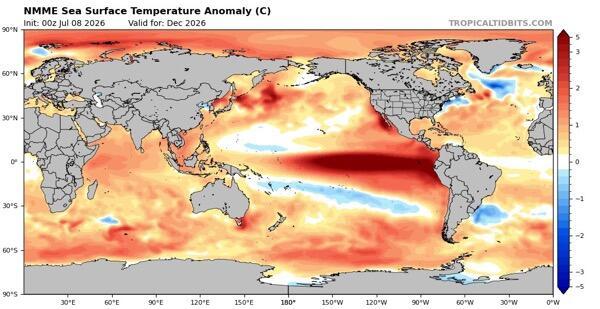
The Climate Prediction Center under the US National Oceanic and Atmospheric Administration (NOAA) noted in its latest report that the equatorial central and eastern Pacific sea surface temperature is already at least 1°C above normal, with some areas reaching deviations as high as 2.7°C last week.
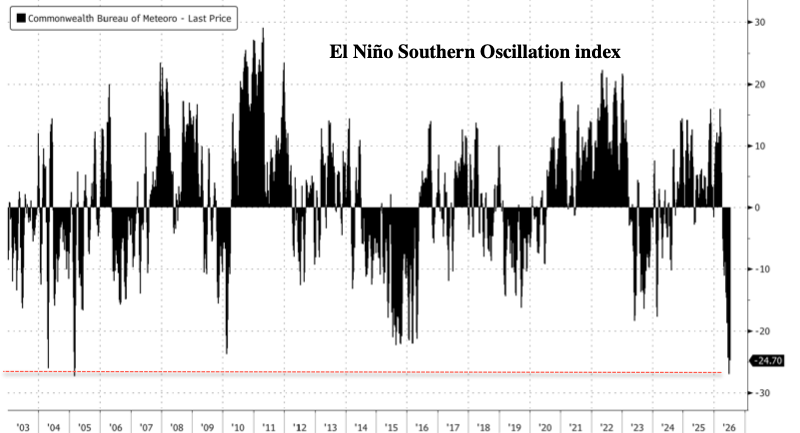
The Southern Oscillation Index (SOI) has declined to its lowest level since 2005, showing the pressure pattern consistent with El Niño — weakened Pacific trade winds and persistently warmer sea surface temperature in the central and eastern Pacific.
The CPC stated that this event has an 81% chance of developing into an "extremely strong" level, ranking among the largest El Niño events on record since 1950, with a 97% probability of lasting until early spring of 2027.
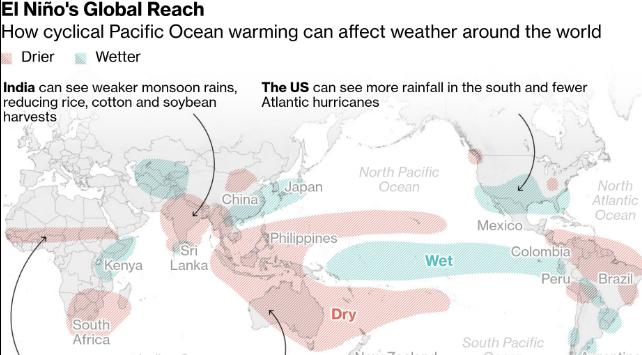
Experts from the European Centre for Medium-Range Weather Forecasts said on the 7th that the overall intensity of El Niño this year may set a new record, with elevated risks of droughts, floods, and other extreme weather events worldwide. According to recently updated data from the World Meteorological Organization, El Niño is expected to rapidly strengthen between July and September 2026, with key sea surface temperature anomalies in the monitoring region expected to exceed 2°C on a seasonal average basis, reaching the "strong El Niño" standard.
Agence France-Presse quoted climate expert Tim Stockdale as saying that this year’s El Niño is “vastly different from anything observed over the last 30 years,” with possible extreme scenarios, while forecast models offer rare but unanimous predictions. Professor Overpeck of the University of Michigan’s Department of Climate and Space Sciences also told CNN: "All signs point to this being a very strong El Niño."
High Supply Concentration Highlights Fragility in Agricultural Markets
Goldman Sachs commodity research analyst Lina Thomas warned in her report that global agricultural supply is highly geographically concentrated.
Taking major crops such as soybeans, corn, rice, sugar, and palm oil as examples, the top three exporting countries together account for 60% to 90% of global trade volume. This means that any localized weather abnormality, geopolitical event, or policy change could disproportionately impact global supply.
Lina Thomas further pointed out that as key agricultural exporters increasingly prioritize domestic food and energy security through export restrictions and biofuel policies, even minor supply disruptions — or merely concerns about possible disruptions — may trigger policy responses that reduce actual export availability much more than the original production shock. Import-dependent countries may subsequently engage in stockpiling and seek self-sufficiency strategies, further fragmenting global trade, reducing market liquidity, and amplifying price sensitivity to future shocks.
Three Recent Risks Overlap, Protectionism May Amplify Prices
Vegetable oil prices have already shown signs of an uptick, viewed as one of the early signals in the agricultural markets under rising El Niño expectations.
At the same time, Goldman Sachs cited three recent supply risks in its latest report, arguing that even if their ultimate impact is limited, they could trigger preemptive policy measures by countries and amplify price volatility.
First, El Niño conditions are already established.
Goldman Sachs estimates a 63% probability for this El Niño to develop into a "super El Niño." Main exporters of staple grains like rice, as well as biofuel crops such as sugar and palm oil, have historically suffered adverse weather during El Niño; even if the actual disruption is limited, preventative export restrictions may already reduce available global supply.
Second, higher energy prices may boost biofuel demand.
If energy prices rise in early 2026 and concerns over fuel security intensify, governments may increase the proportion of biofuels in the mix, further diverting crops like sugar and corn from export markets toward domestic fuel production.
Third, the fertilizer market faces risk at the Strait of Hormuz.
As major nitrogen fertilizer importers enter the critical procurement window for the sowing season in the latter half of the year (Q3), any renewed disruption in the Strait of Hormuz would affect the fertilizer supply chain, thereby impacting agricultural production costs and yield expectations.
Disclaimer: The content of this article solely reflects the author's opinion and does not represent the platform in any capacity. This article is not intended to serve as a reference for making investment decisions.
You may also like

Wall Street giants collectively raise rate hike forecasts, US Treasury futures continue to fall, gold drops over 1% to break 4000
After the US October CPI exceeded expectations, Goldman Sachs and Nomura added a forecast for an interest rate hike in March next year, while Deutsche Bank included a forecast for a rate hike in January next year. Currently, the market has fully priced in a 25 basis point rate hike in December, with a 13% probability for a 50 basis point hike. On Wednesday, the US Treasury spot market was closed, but Treasury futures continued to fall, with corresponding yields rising by about 2 to 4 basis points, and spot gold came under pressure, dropping by 1.1%.

No Need to Worry About the Cooling Down of AI Data Center Construction? The US Import Boom Is Unlikely to Subside in the Short Term, Real Impact May Come in 2029
It takes an average of 4.8 years from finalizing investment to starting construction of a data center project, and an additional 2.6 years from construction start to becoming operational. Servers usually cannot be installed until after the building structure and racks are completed. For trade partners such as Taiwan (China), South Korea, and Mexico who rely on US data center supply chain demand, the inertia in construction timelines provides at least a one- to two-year buffer for future exports.

Federal Reserve Major Debate: When Should the Tenure of “Number Three” Williams End?
The main point of contention is whether Williams should step down in June 2028, upon completing a full 10-year term, or in June 2027, when he reaches the mandatory retirement age of 65. Analysts point out that the Federal Reserve Board holds ultimate discretion; if he leaves early, Fed Chair Waller would be able to assert greater control over the appointment to this critical position. However, forcing Williams to shorten his term could easily be interpreted as political manipulation. Williams himself is expected to serve until June 2028.

Crypto prices
More


