
The worst quarter for gold in 13 years! The safe-haven myth is shaken as investors re-examine whether they should hold gold

Gold futures dropped more than 14% in the second quarter, marking their worst quarterly performance since 2013. According to a CNBC article, as an asset commonly used for portfolio diversification and risk hedging, gold’s recent performance has led some investors to question its effectiveness as a safe haven.
Since the outbreak of the Iran war, gold futures have declined by a cumulative 21%. Before this, gold prices had reached historical highs earlier this year. Charts show a contrast between the S&P 500 Index and gold futures over the past three months.
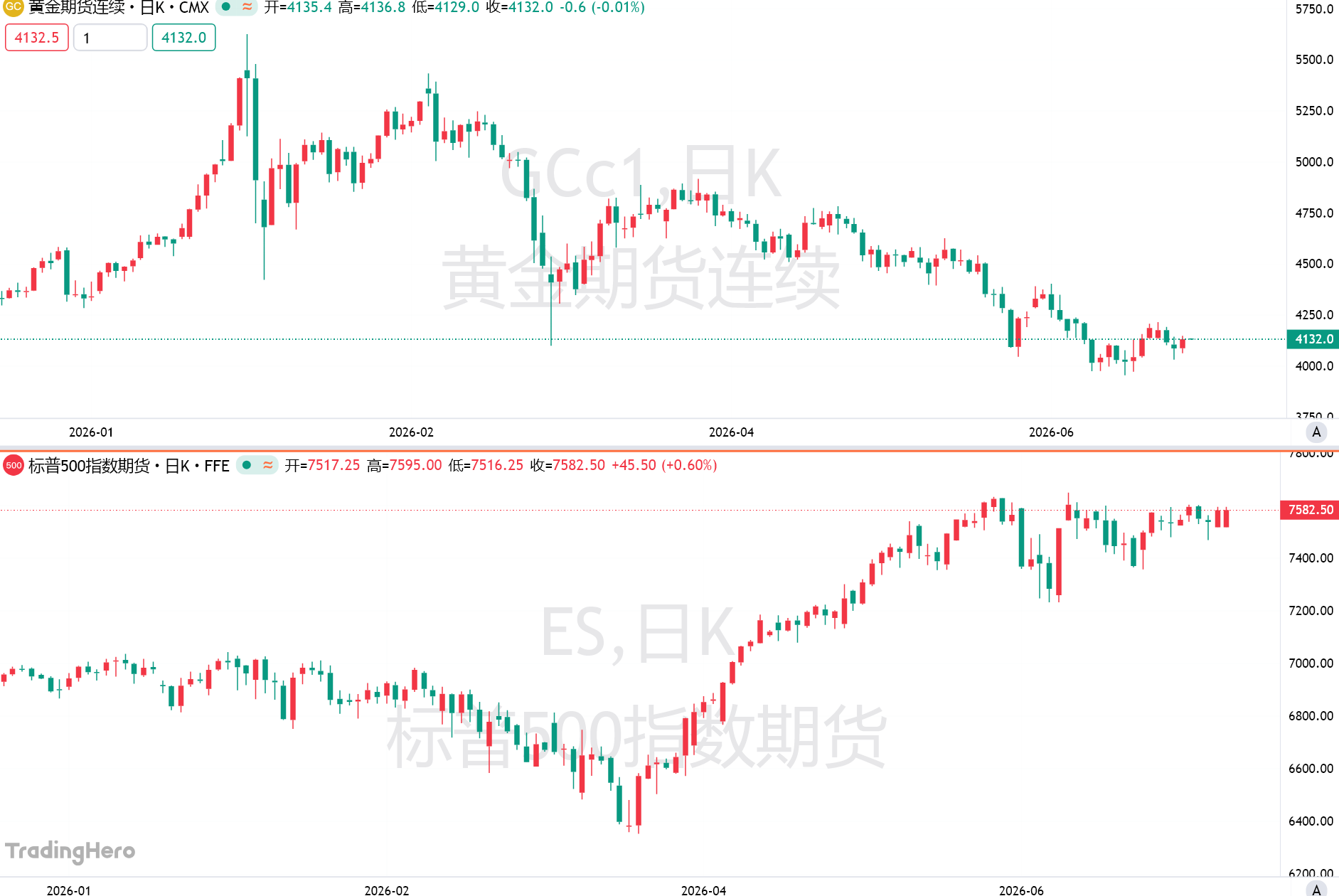
Gold’s recent performance is enough to raise concerns, but before investors remove it from their portfolios, it’s necessary to reassess their expectations for gold. The key issue is not merely a short-term drop in price, but rather the role gold is supposed to play in a portfolio.
Roger Aliaga-Diaz, Global Head of Portfolio Construction at Vanguard, said: “The hedging function does exist, but it may be less stable than people think. Not every time the stock market declines will gold conveniently rise and make up for the loss.”
Financial advisors point out that a common misconception among investors is to expect a persistent and direct inverse relationship between gold and stocks. In other words, when the stock market falls, it's not safe to assume that gold will definitely rise.
Sam Huszczo, founder of SGH Wealth Management in Lathrup Village, Michigan, Certified Financial Planner, said: “I don’t see gold as a direct hedge for the stock market, but it’s a great tool for hedging fear. With a small allocation, it serves as a decent diversification tool.”
Looking at long-term historical data, there are reasons to retain a certain proportion of gold in portfolios. An analysis by JPMorgan Private Bank shows that from 1985 to 2024, during and prior to major geopolitical shocks, the average four-week return for gold was 1.8%, with a median return of 3%. Over the same period, the average four-week returns of 10-year U.S. Treasuries and stocks both declined by 1.6%, with a median drop of 1.9% for both.
Aliaga-Diaz also noted that gold can serve as a tool for hedging U.S. dollar risk. He stated, “When the value or stability of the dollar, or the credibility of the Federal Reserve comes into question, you’ll most likely see money flow into gold.”
However, gold is not a low-volatility asset. Aliaga-Diaz stated that investors often overlook gold’s volatility, which in reality is quite similar to equities.
For this reason, gold exposures need to be kept within controllable limits. Most financial advisors recommend that gold allocations should not exceed 5%.
Losing money on gold in the second quarter doesn’t necessarily mean investors should sell off the asset class entirely. What matters more is assessing gold’s role in long-term plans, one’s personal tolerance for volatility, and whether its current allocation is too high.
Rafia Hasan, Chief Investment Officer of Perigon Wealth Management, said: “You should think about gold allocation over a longer time frame, not focus on just a quarter’s performance in isolation.”
Hasan recommends keeping gold allocations between 1% and 2%. She added: “I think commodities, as a broader diversification tool, indeed have their potential role. That said, commodity prices tend to be more volatile. I think last quarter just proved that point.”
Disclaimer: The content of this article solely reflects the author's opinion and does not represent the platform in any capacity. This article is not intended to serve as a reference for making investment decisions.
You may also like

Wall Street giants collectively raise rate hike forecasts, US Treasury futures continue to fall, gold drops over 1% to break 4000
After the US October CPI exceeded expectations, Goldman Sachs and Nomura added a forecast for an interest rate hike in March next year, while Deutsche Bank included a forecast for a rate hike in January next year. Currently, the market has fully priced in a 25 basis point rate hike in December, with a 13% probability for a 50 basis point hike. On Wednesday, the US Treasury spot market was closed, but Treasury futures continued to fall, with corresponding yields rising by about 2 to 4 basis points, and spot gold came under pressure, dropping by 1.1%.

No Need to Worry About the Cooling Down of AI Data Center Construction? The US Import Boom Is Unlikely to Subside in the Short Term, Real Impact May Come in 2029
It takes an average of 4.8 years from finalizing investment to starting construction of a data center project, and an additional 2.6 years from construction start to becoming operational. Servers usually cannot be installed until after the building structure and racks are completed. For trade partners such as Taiwan (China), South Korea, and Mexico who rely on US data center supply chain demand, the inertia in construction timelines provides at least a one- to two-year buffer for future exports.

Federal Reserve Major Debate: When Should the Tenure of “Number Three” Williams End?
The main point of contention is whether Williams should step down in June 2028, upon completing a full 10-year term, or in June 2027, when he reaches the mandatory retirement age of 65. Analysts point out that the Federal Reserve Board holds ultimate discretion; if he leaves early, Fed Chair Waller would be able to assert greater control over the appointment to this critical position. However, forcing Williams to shorten his term could easily be interpreted as political manipulation. Williams himself is expected to serve until June 2028.

Crypto prices
More


