
RMB: Why has RR volatility risen significantly?

Morning FX
For the recent Renminbi exchange rate market, an important signal is:whether onshore or offshore, RR implied volatility has risen significantly.
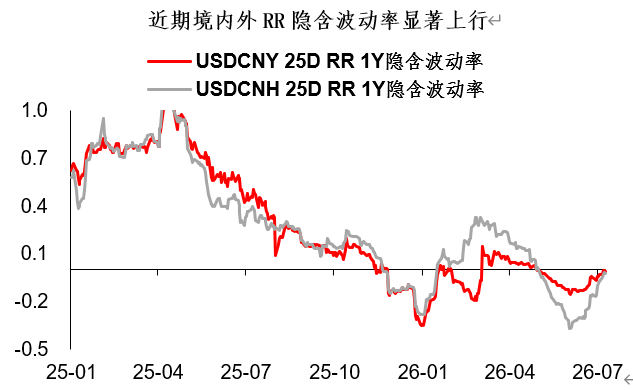
The so-called RR (Risk Reversal option) refers to buying out-of-the-money call options while selling out-of-the-money put options. The higher the RR implied volatility, the more bullish the forex market is on USDCNH (bearish on RMB); conversely, the lower the RR implied volatility, the more bearish the market is on USDCNH (bullish on RMB).Does the rebound in RR this time mean that expectations for RMB appreciation are fading?
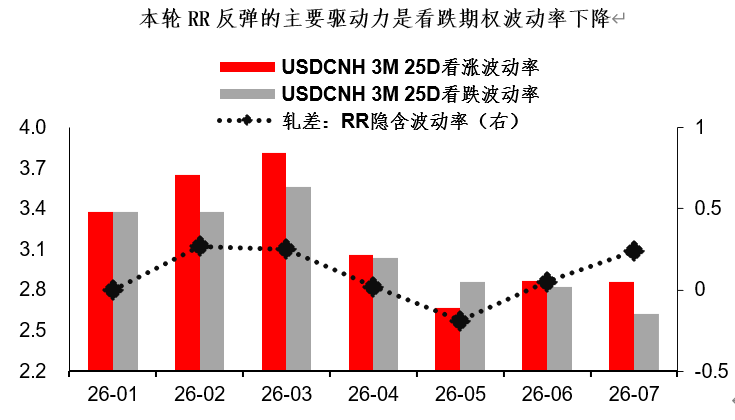
To answer this question, it's necessary to break down the structure of RR.In February-March this year, there was previously a rebound in onshore and offshore RR, mainly driven by a strong US dollar, with capital buying call options, causing call option volatility to rise faster; but this time, the options market is different, with the main driver being capital closing out put options, causing put option volatility to fall more rapidly.
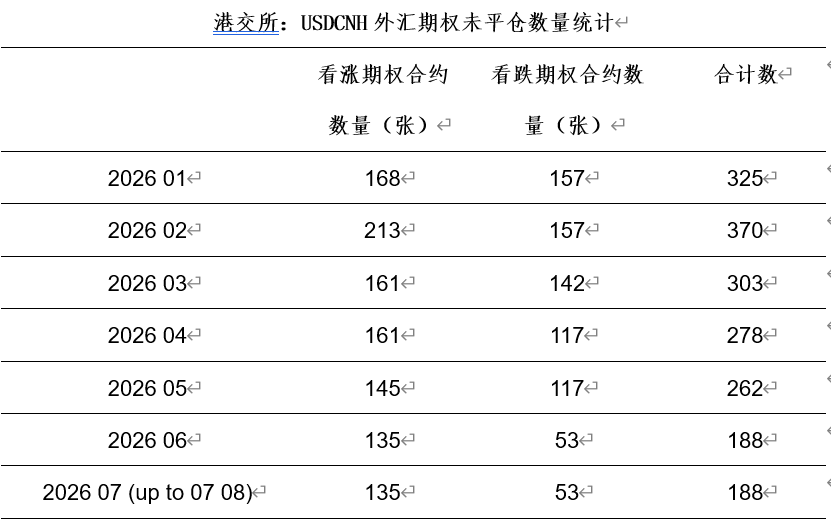
Coincidentally, FX options open interest data from HKEX also provides verification.As seen in the table below, over the past month open interest for USDCNH call options on HKEX dropped from 145 to 135, while put option open interest dropped from 117 to 53.Clearly, the number of put options is decreasing more quickly, with clear signs of proactive closing out by capital.
Looking at both price and volume signals, the main driver for this rebound in onshore and offshore RR volatility is USDCNY/USDCNH short covering.Behind this, around the midyear point, the market's view on RMB is shifting from bullish to neutral.
Why is the market’s view on RMB turning neutral? There are many reasons, but fundamentally, it is due to a divergence in the economy—strong external demand and weak domestic demand. Such a sharp divergence is rare in history and explains many phenomena in this year's domestic interest rate and forex markets.How will domestic demand look in the second half of the year? Will there be additional policy measures? Market expectations seem low, with the zzj meeting at the end of July serving as an observation window.
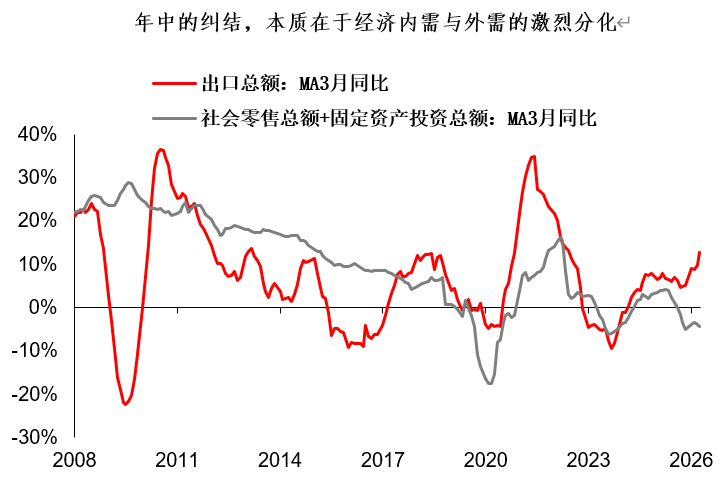
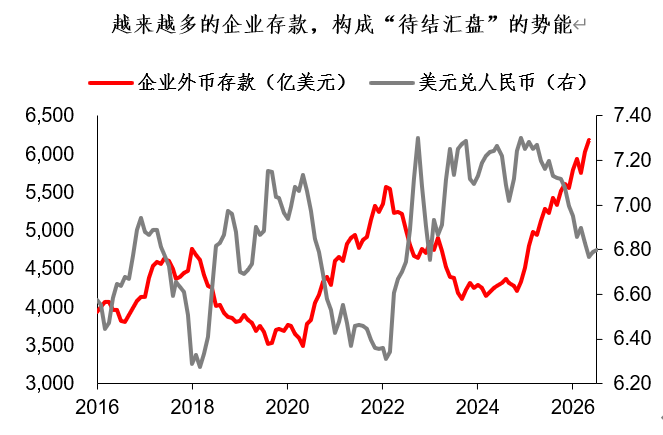
For RMB bulls in the second half of the year, the strongest logical support lies in robust exports and an ever-growing amount of “pending FX settlements.”Data from the central bank show that as of midyear, total onshore FX deposits reached USD 1.1 trillion, with corporate FX deposits at USD 620 billion—both record highs.
More and more corporate FX deposits mean increasing “pending settlement momentum.” When will this momentum be released? The third quarter is not traditionally a peak season for settlements. Ultimately, everything comes down to our understanding and grasp of the phrase “settling FX on rallies.”
Summary of today’s discussion:
1. In the recent RMB FX market, whether onshore or offshore, RR implied volatility has risen sharply. The key driver for this round’s rebound in RR volatility is USDCNY/USDCNH short covering. Behind this, at midyear, the market’s stance on RMB is shifting from bullish to neutral;
2. Why is the market’s view on RMB becoming neutral? There are many reasons, but fundamentally it is due to sharp economic divergence. How will domestic demand look in the second half, and will there be additional policy supports? The zzj meeting at the end of July is a window to observe;
3. For RMB bulls, the primary logical support lies in strong exports and ever-increasing “pending FX settlements.” However, the third quarter is not a traditional peak for settlements, so the key is understanding and grasping the phrase “settling FX on rallies.”
Disclaimer: The content of this article solely reflects the author's opinion and does not represent the platform in any capacity. This article is not intended to serve as a reference for making investment decisions.
You may also like

Wall Street giants collectively raise rate hike forecasts, US Treasury futures continue to fall, gold drops over 1% to break 4000
After the US October CPI exceeded expectations, Goldman Sachs and Nomura added a forecast for an interest rate hike in March next year, while Deutsche Bank included a forecast for a rate hike in January next year. Currently, the market has fully priced in a 25 basis point rate hike in December, with a 13% probability for a 50 basis point hike. On Wednesday, the US Treasury spot market was closed, but Treasury futures continued to fall, with corresponding yields rising by about 2 to 4 basis points, and spot gold came under pressure, dropping by 1.1%.

No Need to Worry About the Cooling Down of AI Data Center Construction? The US Import Boom Is Unlikely to Subside in the Short Term, Real Impact May Come in 2029
It takes an average of 4.8 years from finalizing investment to starting construction of a data center project, and an additional 2.6 years from construction start to becoming operational. Servers usually cannot be installed until after the building structure and racks are completed. For trade partners such as Taiwan (China), South Korea, and Mexico who rely on US data center supply chain demand, the inertia in construction timelines provides at least a one- to two-year buffer for future exports.

Federal Reserve Major Debate: When Should the Tenure of “Number Three” Williams End?
The main point of contention is whether Williams should step down in June 2028, upon completing a full 10-year term, or in June 2027, when he reaches the mandatory retirement age of 65. Analysts point out that the Federal Reserve Board holds ultimate discretion; if he leaves early, Fed Chair Waller would be able to assert greater control over the appointment to this critical position. However, forcing Williams to shorten his term could easily be interpreted as political manipulation. Williams himself is expected to serve until June 2028.

Crypto prices
More


