
After weak non-farm payrolls, what is the outlook for 10-year US Treasury bonds?

In June, the US non-farm payrolls increased by 57,000, lower than the market expectation of 113,000; data for April and May was revised down by a combined 74,000. On the surface, this appears to be positive for US Treasuries and negative for the US dollar, but the market response was not entirely in line: On July 2nd, the US 2-year Treasury yield dropped from 4.17% to 4.14%, while the 10-year yield rose from 4.48% to 4.49%, causing the 2s10s yield spread to widen from 31bp to 35bp. In other words, the market did buy at the short end, but not at the long end. The primary implication of weak payrolls is a decrease in the necessity for further rate hikes, not an immediate switch to recession trades.
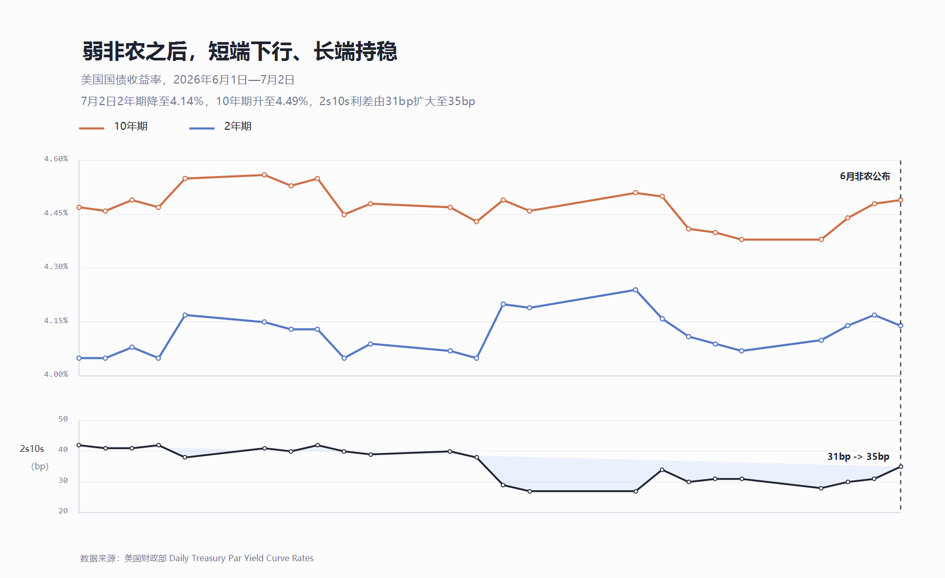
The short end dropping is not hard to understand: the obvious slowdown in non-farm payrolls, combined with downward revisions in the previous two months, shows the labor market is not overheating. For the 2-year yield, the most direct trade is the decreased tail risk of further rate hikes by the Federal Reserve. In other words, weak payrolls first and foremost reduce the probability of an immediate or possible additional hike.
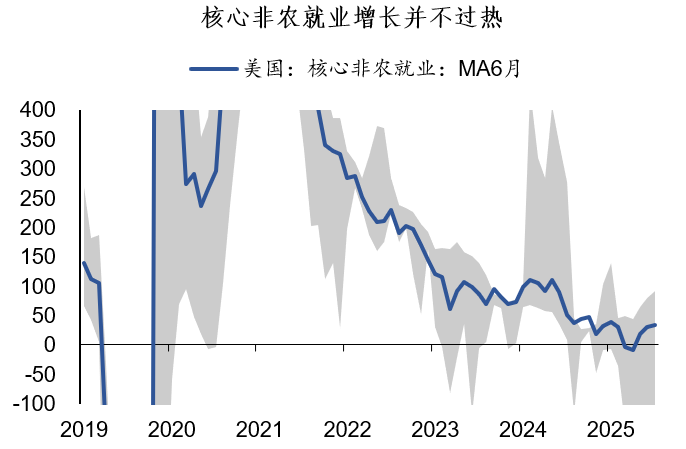
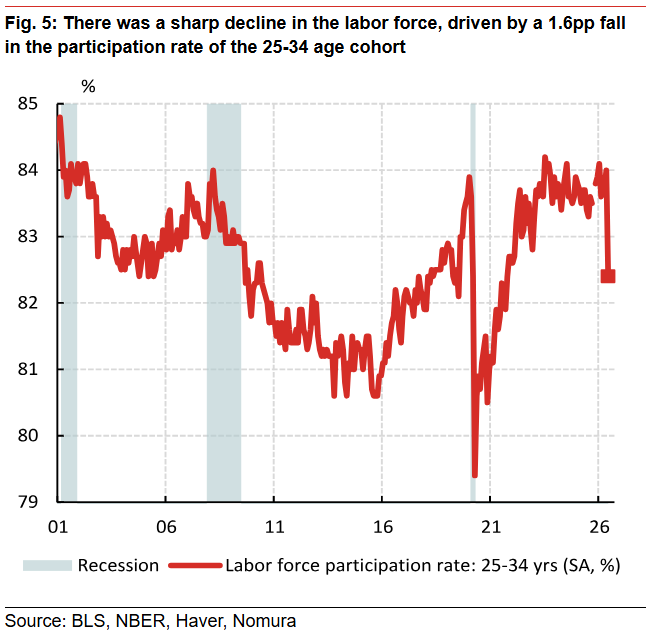
However, this data is not weak enough to push the market directly toward recession pricing. There are several temporary factors in the report: leisure and hospitality jobs fell due to earlier hiring, and the participation rate for the 25–34 age group dropped by 1.6 percentage points, among other things. The signal to the Federal Reserve is to be less hawkish and more patient, not to immediately pivot to easing.
A single month of weak payrolls only indicates a marginal deceleration in job gains; it's not enough to prove long-term growth or that the real interest rate center will be quickly suppressed,which is also the key reason why the 10-year yield did not fall significantly. Meanwhile, fiscal financing, Treasury supply, and capital expenditure for AI data centers continue to generate financing demand. Weak credit in the private sector does not mean overall US funding demand is declining; government and AI investments still support the long-end rate center.
Therefore, after weak payrolls, the market is not trading an overall decline in the yield curve. With falling rate hike expectations, the short end benefits more directly, while the 10-year just sees its upward pressure eased—it hasn't shown a confirmed downward trend and is still seen as oscillating.
Looking forward, CPI is the main data point; if June CPI is significantly below expectations, the 10-year yield could test the 4.35%–4.40% range; if core inflation remains around or above 0.3%, it may revisit above 4.50%. In the medium term, only when job market cooling further spreads to rising layoffs and weakening consumption, along with falling inflation, will the long end truly see space for downward movement.
BFC Exchange Talk
Together with you in 2026
Welcome to leave us a message in the background
Connect with us
Disclaimer: The content of this article solely reflects the author's opinion and does not represent the platform in any capacity. This article is not intended to serve as a reference for making investment decisions.
You may also like
Wall Street giants collectively raise rate hike forecasts, US Treasury futures continue to fall, gold drops over 1% to break 4000
After the US October CPI exceeded expectations, Goldman Sachs and Nomura added a forecast for an interest rate hike in March next year, while Deutsche Bank included a forecast for a rate hike in January next year. Currently, the market has fully priced in a 25 basis point rate hike in December, with a 13% probability for a 50 basis point hike. On Wednesday, the US Treasury spot market was closed, but Treasury futures continued to fall, with corresponding yields rising by about 2 to 4 basis points, and spot gold came under pressure, dropping by 1.1%.

No Need to Worry About the Cooling Down of AI Data Center Construction? The US Import Boom Is Unlikely to Subside in the Short Term, Real Impact May Come in 2029
It takes an average of 4.8 years from finalizing investment to starting construction of a data center project, and an additional 2.6 years from construction start to becoming operational. Servers usually cannot be installed until after the building structure and racks are completed. For trade partners such as Taiwan (China), South Korea, and Mexico who rely on US data center supply chain demand, the inertia in construction timelines provides at least a one- to two-year buffer for future exports.

Federal Reserve Major Debate: When Should the Tenure of “Number Three” Williams End?
The main point of contention is whether Williams should step down in June 2028, upon completing a full 10-year term, or in June 2027, when he reaches the mandatory retirement age of 65. Analysts point out that the Federal Reserve Board holds ultimate discretion; if he leaves early, Fed Chair Waller would be able to assert greater control over the appointment to this critical position. However, forcing Williams to shorten his term could easily be interpreted as political manipulation. Williams himself is expected to serve until June 2028.

Crypto prices
More


