
Second Day After "Ceasefire Ends": U.S. Military Expands Strikes, Iran's Retaliation Affects Qatar Base, Trump Fights While Negotiating

After Trump announced the ceasefire agreement had "ended," the US-Iran conflict entered its second day, with hostilities escalating rapidly.
On July 9, according to Xinhua News Agency, the US Central Command posted on social media, stating that another round of strikes against Iran had been completed, covering approximately 90 Iranian military targets, including air defense systems, coastal surveillance facilities, missile and drone storage facilities, as well as military logistics infrastructure in Iran’s coastal regions.
Furthermore, as reported by Xinhua News Agency, Iran’s Islamic Republic of Iran Broadcasting reported on the 9th that the Iranian military’s public relations department issued a statement saying that not long ago, the Iranian military used drones to strike several US military targets in the Middle East in response to US aggression against Iran. The statement said, the Iranian military used a large number and variety of attack drones to target the US “Patriot” air defense system in Kuwait, US satellite antennas in Qatar, and US fuel storage facilities in Bahrain.
Previously, Trump sent mixed signals during the NATO summit. According to Xinhua News Agency, US President Trump said at the NATO Summit on the 8th that he considers the US-Iran Memorandum of Understanding “terminated.” Later, on Wednesday in Ankara, Turkey’s capital, Trump stated that the current escalation between the US and Iran would calm down soon, and he does not expect another war to break out with Iran.
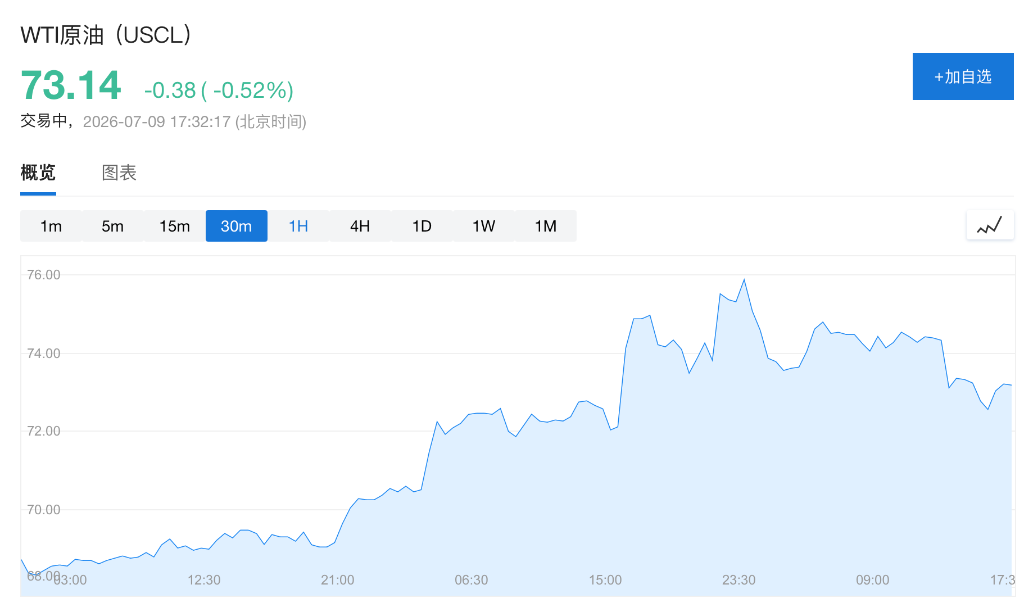
This pattern of “fighting while negotiating” has cast doubt on the conflict’s outlook, causing dramatic fluctuations in international oil prices. Brent crude briefly broke above the $80 mark before quickly retreating, key straits shipping was nearly stalled, and the global energy market faces fresh uncertainty.
Second Round of Airstrikes Escalate, US Hits Iran’s Bushehr Region
The second round of US airstrikes have clearly escalated in both scale and target selection. US Central Command posted on social media that the US military conducted further strikes on Iran to further weaken Iran’s ability to threaten navigation in the Strait of Hormuz.
According to Xinhua News Agency citing Iran’s Mehr News Agency, the US military also attacked Iran’s Bushehr region late at night on the 8th, but did not cause any damage to the local nuclear power plant. Mehr News Agency, citing Iranian health officials on the 9th, reported that US strikes on Iran between the 7th and 8th have resulted in 14 deaths and 78 injuries.
Previously, according to CCTV International News, Trump said that the US has not yet targeted Iran’s bridges, power facilities, or desalination plants, but if necessary, the US will destroy them. Trump also claimed that the US military had struck Iran’s key oil export hub, Khark Island, the night before but requested not to strike its pipelines as the US might “take control of Khark Island.”
Iran’s Retaliation Further Expands, Gulf States on Full Alert
Iran’s retaliatory actions have also broken previous geographical boundaries, and confrontation is further spreading.
According to Xinhua News Agency, the Islamic Revolutionary Guard Corps of Iran stated on the 9th that Iran struck several US military bases in Kuwait and Bahrain in response to the US’s breach of promise and warned that if US aggression is repeated, Iran will broaden its counterattack to other US bases in the Middle East.
On the 9th, the Speaker of Iran’s Islamic Consultative Assembly, Ghalibaf, posted on social media that America still does not understand that bullying and betrayals are no longer “zero-cost.” The Strait of Hormuz can only remain open under “Iran’s arrangement rather than US threats.” He wrote: “If you dare to attack, I will strike back.”
Meanwhile, the Kuwaiti military announced the activation of air defense systems to respond to hostile missile and drone attacks. According to Xinhua News Agency, Bahrain’s Ministry of Interior stated that air defense alerts sounded twice in Bahrain on the 9th. Qatar’s Ministry of Interior also issued a statement on social media the same day, announcing that alarms sounded within the country. On the same day, the Kuwaiti military issued a statement saying its air defense system was intercepting “hostile” aerial targets.
Disclaimer: The content of this article solely reflects the author's opinion and does not represent the platform in any capacity. This article is not intended to serve as a reference for making investment decisions.
You may also like

Wall Street giants collectively raise rate hike forecasts, US Treasury futures continue to fall, gold drops over 1% to break 4000
After the US October CPI exceeded expectations, Goldman Sachs and Nomura added a forecast for an interest rate hike in March next year, while Deutsche Bank included a forecast for a rate hike in January next year. Currently, the market has fully priced in a 25 basis point rate hike in December, with a 13% probability for a 50 basis point hike. On Wednesday, the US Treasury spot market was closed, but Treasury futures continued to fall, with corresponding yields rising by about 2 to 4 basis points, and spot gold came under pressure, dropping by 1.1%.

No Need to Worry About the Cooling Down of AI Data Center Construction? The US Import Boom Is Unlikely to Subside in the Short Term, Real Impact May Come in 2029
It takes an average of 4.8 years from finalizing investment to starting construction of a data center project, and an additional 2.6 years from construction start to becoming operational. Servers usually cannot be installed until after the building structure and racks are completed. For trade partners such as Taiwan (China), South Korea, and Mexico who rely on US data center supply chain demand, the inertia in construction timelines provides at least a one- to two-year buffer for future exports.

Federal Reserve Major Debate: When Should the Tenure of “Number Three” Williams End?
The main point of contention is whether Williams should step down in June 2028, upon completing a full 10-year term, or in June 2027, when he reaches the mandatory retirement age of 65. Analysts point out that the Federal Reserve Board holds ultimate discretion; if he leaves early, Fed Chair Waller would be able to assert greater control over the appointment to this critical position. However, forcing Williams to shorten his term could easily be interpreted as political manipulation. Williams himself is expected to serve until June 2028.

Crypto prices
More


