

-
Cardano remains pinned within a critical support zone after suffering a sharp sell-off in the opening days of the month.
-
Failure to defend the pivotal support could trigger a deeper correction, dragging ADA toward price levels last seen in November 2020.
The Cardano price has remained one of the weakest-performing large-cap cryptocurrencies in 2026, facing relentless selling pressure throughout the year. As a result, ADA has plunged nearly 68% since the start of the year, slipping to multi-year lows and dampening investor sentiment. However, despite the prevailing skepticism, derivatives data suggest the token could be approaching a critical turning point, even as the broader market structure continues to favor the bears.
As the market enters the second half of 2026, Cardano’s ability to defend its long-term support zone and attract fresh buying interest will likely determine whether ADA can stage a sustained recovery or extend its downtrend through the remainder of the year.
Liquidation Heatmap Signals a Short Squeeze Opportunity
While the broader market structure continues to favor the bears, liquidation data suggests ADA could witness heightened volatility in the near term. The 48-hour liquidation heatmap reveals a dense concentration of leveraged positions on both sides of the current price, placing Cardano at a critical turning point.
At the time of writing, ADA is trading near $0.168, with the largest upside liquidity cluster positioned around $0.170–$0.171. A move into this region could force short sellers to close their positions, triggering a wave of buy orders that may accelerate the rally toward the next resistance around $0.175–$0.180.

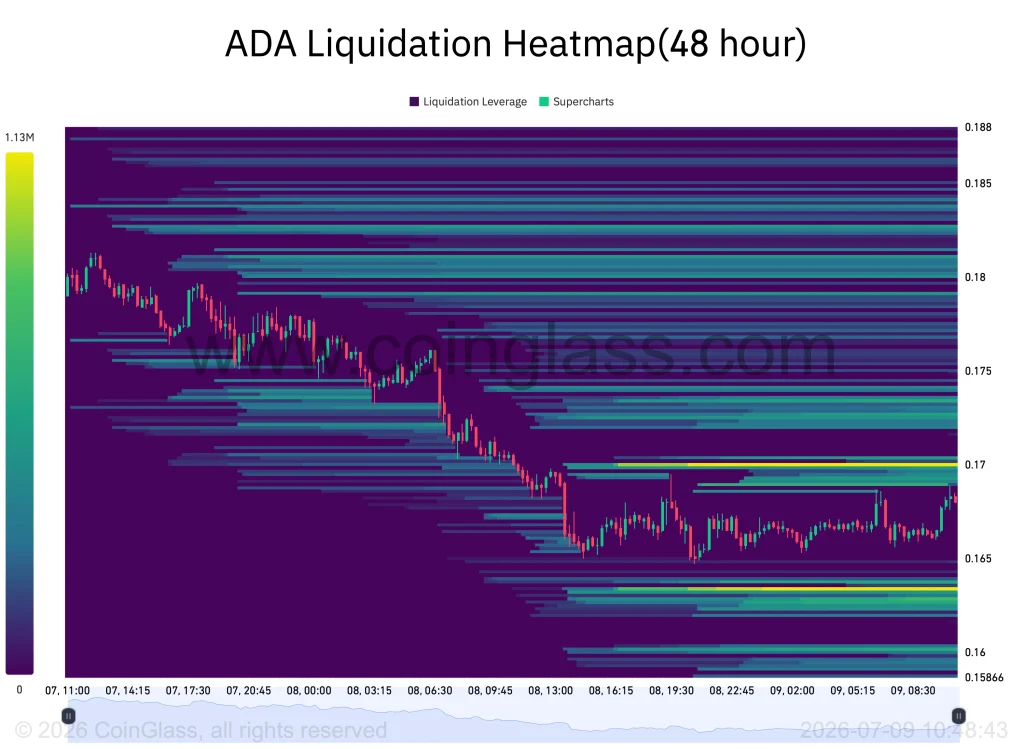
On the downside, another significant liquidity pocket is located near $0.163–$0.164. If sellers regain control and push ADA below its immediate support, long liquidations in this zone could intensify the decline, reinforcing the prevailing bearish trend.
Overall, the liquidation landscape suggests that the market is heavily positioned for a directional move rather than continued consolidation. The side that loses control around the current trading range is likely to fuel the next leg of ADA’s price action through a cascade of forced liquidations.
Derivatives Data Hints at a Potential Shift in Market Sentiment
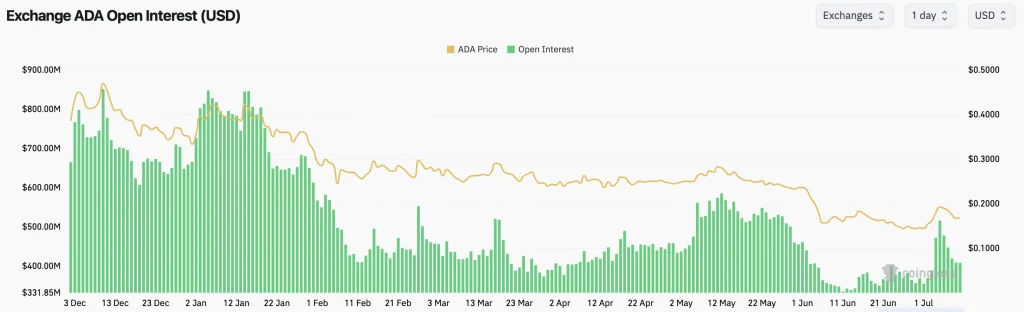
Beyond the price action, derivatives data suggest that bearish momentum may be gradually losing strength. Open Interest (OI), which measures the total value of outstanding futures positions, has declined significantly from its yearly peak of nearly $850 million to around $400 million. This sharp reduction indicates that a large portion of leveraged positions has already been flushed out, reflecting months of market-wide deleveraging rather than fresh bearish bets.
Meanwhile, the OI-weighted funding rate has shown early signs of improvement after remaining largely negative through June. The recent shift into positive territory indicates that traders are gradually turning optimistic and opening long positions. However, the recovery in funding has not yet been accompanied by a decisive breakout in price, suggesting that bullish conviction remains tentative.
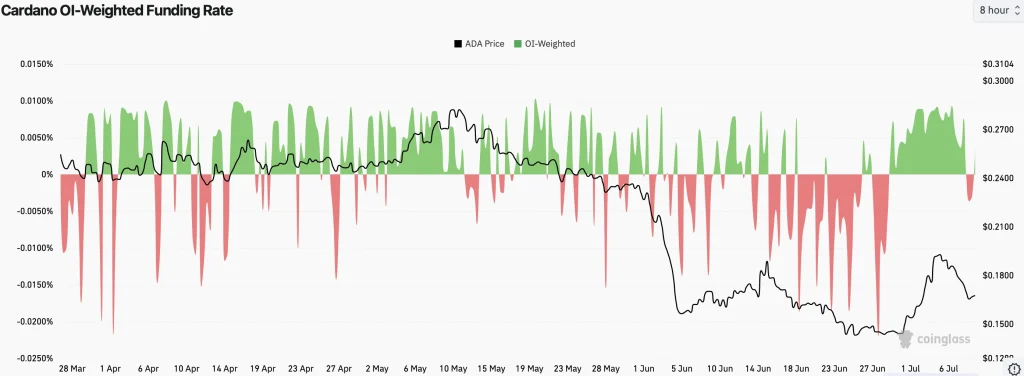
For a sustained recovery to take shape, ADA would need to witness rising open interest alongside a continued positive funding rate and higher spot buying activity.
Cardano Price Prediction 2026: Can ADA Defend Its Final Major Support?
At the time of writing, ADA is trading around $0.168, just above a crucial long-term support zone between $0.160 and $0.170. This region previously acted as a major accumulation area before Cardano’s 2021 bull run, making it one of the most important levels for bulls to defend. The Volume Profile indicates that the current price is trading well below the Point of Control (POC), which is positioned near the $0.35–$0.40 range.
This suggests that a significant portion of historical trading activity occurred at much higher prices, leaving a substantial overhead supply that could act as resistance during any recovery attempt.
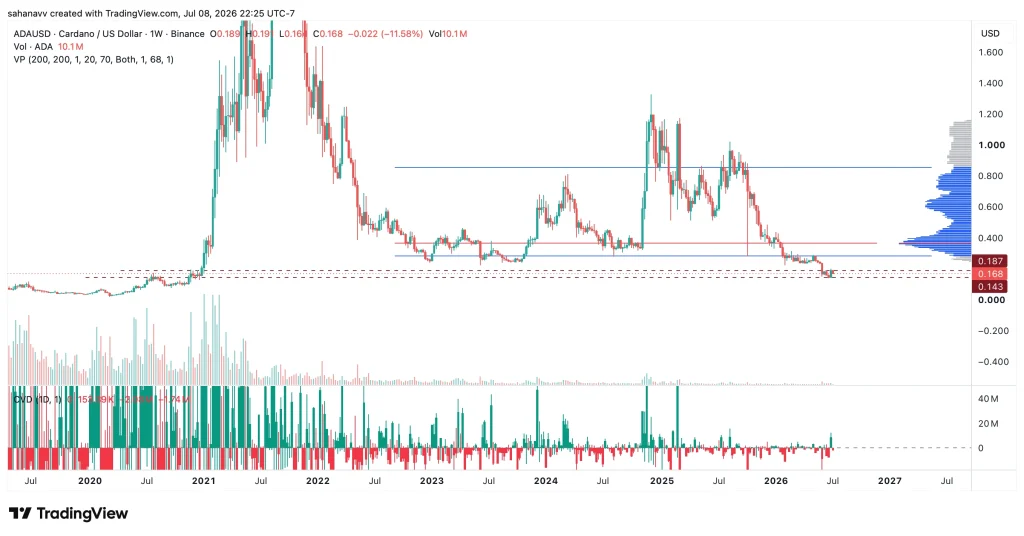
Meanwhile, the Cumulative Volume Delta (CVD) is showing an early sign of stabilization. While the ADA price has continued to trade near fresh multi-year lows, the CVD has not declined at the same pace, suggesting that aggressive spot selling has started to fade. On the upside, the first hurdle for bulls lies around $0.170–$0.175, where recent price rejection and short-term liquidity are concentrated.
A sustained move above this region could expose the next resistance near $0.20, followed by the broader supply zone between $0.30 and $0.35. Conversely, a decisive breakdown below $0.160 would invalidate the current support zone and could accelerate selling pressure toward levels not seen since late 2020.
Why $0.17 Could Define ADA’s Next Major Move
Cardano’s price action in H2 2026 is likely to revolve around the $0.17 level, making it the most critical zone for traders to monitor. A decisive reclaim and sustained move above this resistance could trigger a short squeeze and pave the way for a broader recovery. However, repeated rejection or a breakdown below the nearby support would reinforce the prevailing bearish trend and increase the risk of fresh multi-year lows. For now, $0.17 remains the line in the sand that could determine ADA’s next major directional move.






