
Hyperliquid shows how onchain perps could challenge Wall Street: Pantera

Perpetual futures are on track to become one of the dominant trading instruments in global finance, with decentralized exchange Hyperliquid demonstrating how blockchain-based infrastructure could challenge traditional markets, according to Pantera Capital.
The blockchain-focused asset manager said in a Wednesday X post that perpetual futures offer structural advantages over traditional derivatives, including 24/7 trading, no contract expiries, simpler position management and continuous price discovery, making them increasingly attractive beyond crypto markets.
Pantera, an investor in the Hyperliquid ecosystem, said Hyperliquid has become the leading example of that shift by expanding perpetual futures beyond cryptocurrencies into equities, commodities and stock indices as part of founder Jeff Yan's vision of “housing all of finance.”
Hyperliquid's growth has drawn attention from traditional finance, including NYSE parent Intercontinental Exchange (ICE), whose CEO, Jeffrey Sprecher, urged regulators to create a "level playing field" for launching 24/7 onchain perpetual futures contracts.
Pantera Capital said Hyperliquid has increased the market share of onchain perps, as DEX perps volumes rose to 14% of centralized exchange (CEX) perps volume, up from less than 1% in early 2023 when Hyperliquid first launched.
Hyperliquid accounts for roughly 40% of onchain perpetual futures trading volume, according to Pantera. It ranks as the fourth-largest fee-generating protocol in the crypto industry, generating $13.5 million in weekly fees in the past seven days, according to DefiLlama data.
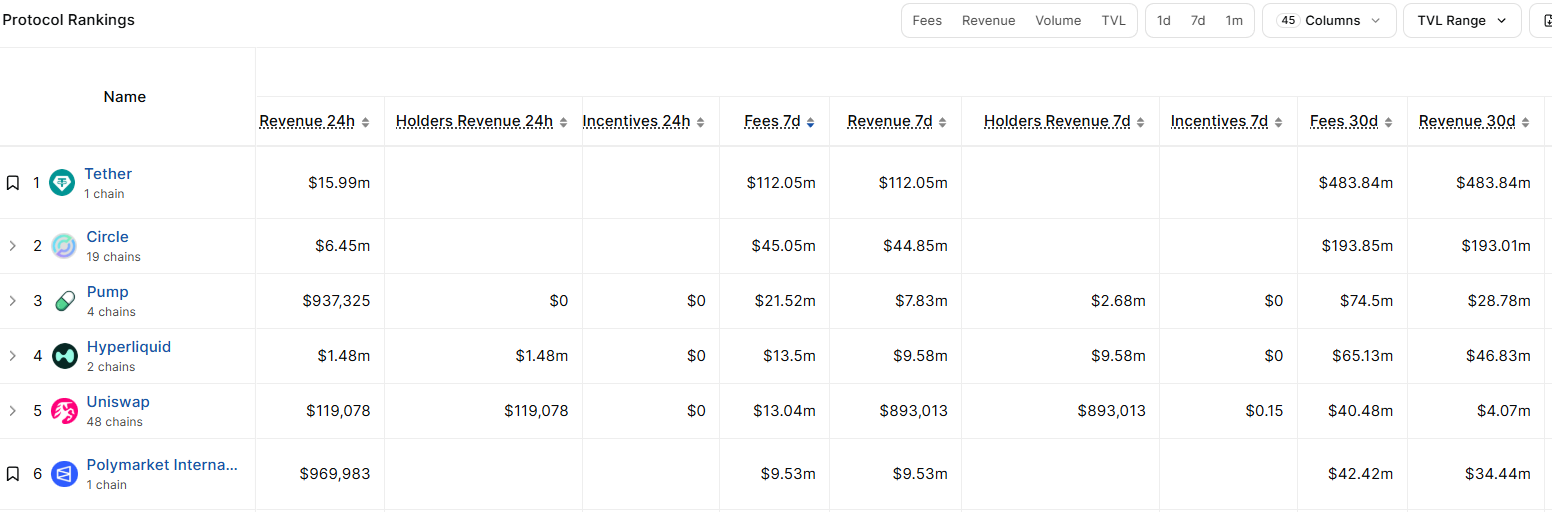
Top protocols by weekly fees generated. Source: DefiLlama
Related:
Traditional finance embraces 24/7 markets
Cryptocurrency platforms and TradFi institutions are bringing more traditional investment products under blockchain wrappers.
On May 22, OKX announced plans to launch perpetual futures based on ICE's Brent crude and West Texas Intermediate crude benchmarks under a partnership with the exchange operator.
Earlier in March, the NYSE partnered with tokenization platform Securitize as part of a broader effort to develop blockchain-based stock trading infrastructure with 24/7 trading and settlement for Wall Street.
In January, the NYSE’s parent company, the Intercontinental Exchange (ICE), shared plans for a tokenized securities venue designed for 24/7 trading, instant settlement, stablecoin-based funding and onchain settlement.
Magazine:
Disclaimer: The content of this article solely reflects the author's opinion and does not represent the platform in any capacity. This article is not intended to serve as a reference for making investment decisions.
You may also like

Wall Street giants collectively raise rate hike forecasts, US Treasury futures continue to fall, gold drops over 1% to break 4000
After the US October CPI exceeded expectations, Goldman Sachs and Nomura added a forecast for an interest rate hike in March next year, while Deutsche Bank included a forecast for a rate hike in January next year. Currently, the market has fully priced in a 25 basis point rate hike in December, with a 13% probability for a 50 basis point hike. On Wednesday, the US Treasury spot market was closed, but Treasury futures continued to fall, with corresponding yields rising by about 2 to 4 basis points, and spot gold came under pressure, dropping by 1.1%.

No Need to Worry About the Cooling Down of AI Data Center Construction? The US Import Boom Is Unlikely to Subside in the Short Term, Real Impact May Come in 2029
It takes an average of 4.8 years from finalizing investment to starting construction of a data center project, and an additional 2.6 years from construction start to becoming operational. Servers usually cannot be installed until after the building structure and racks are completed. For trade partners such as Taiwan (China), South Korea, and Mexico who rely on US data center supply chain demand, the inertia in construction timelines provides at least a one- to two-year buffer for future exports.

Federal Reserve Major Debate: When Should the Tenure of “Number Three” Williams End?
The main point of contention is whether Williams should step down in June 2028, upon completing a full 10-year term, or in June 2027, when he reaches the mandatory retirement age of 65. Analysts point out that the Federal Reserve Board holds ultimate discretion; if he leaves early, Fed Chair Waller would be able to assert greater control over the appointment to this critical position. However, forcing Williams to shorten his term could easily be interpreted as political manipulation. Williams himself is expected to serve until June 2028.

Crypto prices
More


