
Bank of America: Meta selling computing power aims to tell a better AI investment return story


Hard·AI
Author | Zhang Yaqi
Editor | Hard AI
Meta is planning to monetize its massive AI computing power assets, a layout that is not only the prototype of a new business line but also a strategic signal responding to investor concerns about returns on high capital expenditures.
According to reports, Meta is formulating plans to launch a cloud infrastructure business that would provide external customers with access to AI computing power and model services. Following the announcement, Meta’s shares surged by about 10% in a single day, far outpacing the S&P 500’s increase of around 0.25%, indicating positive market response to this potential new business line.
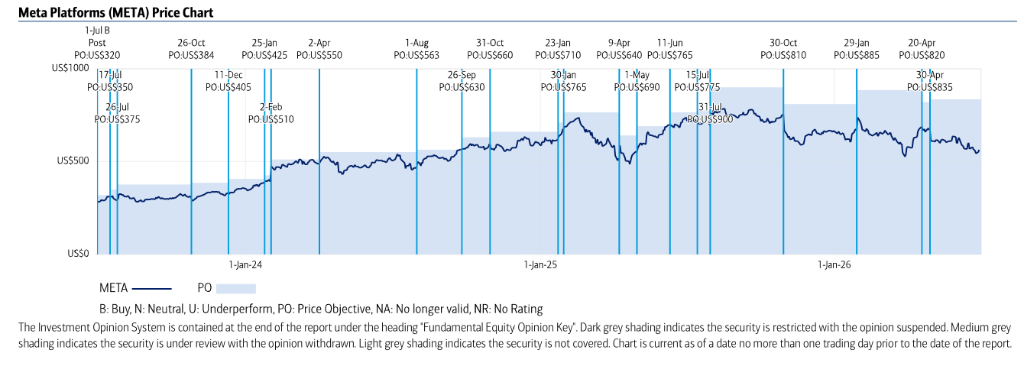
According to Wind Trading Desk, Bank of America Securities analysts Justin Post and Nitin Bansal stated in a July 1 research report that the development of the cloud business helps highlight the potential value of Meta’s computing assets and model R&D, thus easing investors’ concerns over continued AI infrastructure investments without visible returns. Bank of America maintains a ‘Buy’ rating for Meta with a target price of $835.
01
Meta Cloud Plan Surfaces: Advancing Along Two Paths
According to Bloomberg, citing sources, Meta’s cloud business plan currently follows two directions: First, to provide AI model hosting services, allowing developers access to various models running on Meta’s existing AI infrastructure, including the Muse Spark series, with fees based on access volume—this is similar to Amazon AWS’s Bedrock product; second, to sell raw computing capacity directly, with a positioning closer to emerging cloud computing providers such as CoreWeave.
This plan falls under Meta’s internal strategic initiative called “Meta Compute,” focused on the construction and management of AI infrastructure. Meta’s CEO has publicly hinted at commercial opportunities in the enterprise market and has stated that the company is poised to sell computing power externally at prices higher than the cost of construction.
Bank of America’s report points out that from a macro perspective, if Meta’s capital expenditures in 2026 can support up to 3GW computing construction (estimated at $4–4.5 billion per GW), the establishment of a cloud platform in the near term will give the company greater strategic flexibility—In the event of surplus capacity, it may be leased externally at a price of $1–1.5 billion per GW annually, providing positive support for the company.
02
Doubts on Competitive Positioning, Strategic Controversies Hard to Avoid
Despite the strong market response, Bank of America bluntly pointed out potential doubts. Meta’s self-developed chips appear to be lagging behind mature hyperscale cloud providers such as Amazon, Microsoft, and Google. Meanwhile, the company is still actively purchasing computing power from third parties—including a recent 1.6GW purchase agreement with Crusoe.
This has led the market to question Meta’s strategic rationale: Can a company that still needs to purchase external computing power convincingly build a computing resale business? How should its competitiveness in the hyperscale cloud market be positioned?
Bank of America believes,Whether Meta can gain stronger market recognition in this field depends to some extent on the advancement of its large language model (LLM) capabilities—the more advanced the models, the higher the external demand for Meta’s computing resources, and the more solid the business logic of its cloud operations.
03
Improvements in AI Unit Economics: a Double-Edged Sword for Cloud Providers
Beyond Meta’s cloud plan, there are also signals of note on the cost side of AI computing power. According to The Information, OpenAI has reportedly found a system-level optimization that reduces the inference cost of specific models by about half. This optimization is achieved by utilizing existing server infrastructure more efficiently without new hardware or new model architecture. Reportedly, OpenAI has applied this optimization to non-logged-in ChatGPT traffic, which requires only a few hundred Nvidia GPUs to support. The specific principle and whether it can be extended to logged-in users, API workloads, or compute-intensive inference products remains unclear.
Bank of America believes,Improvements in computational cost efficiency are overall positive for large internet companies:If this technology can be scaled across the industry, it will increase the effective output of existing computing capacity with no further hardware investment required, alleviate the urgency of new capex, and improve the unit economic model of AI business operations. As agentic application scenarios drive a sharp increase in token consumption, the strategic value of computing power optimization will become even more prominent.
However, for hyperscale cloud service providers, declining inference costs do pose some pricing pressure risks. Meanwhile, better gross margin structure and a broader addressable market are expected to drive continued growth in AI workload demand, making the overall impact still positive.
Hard·AI

Disclaimer: The content of this article solely reflects the author's opinion and does not represent the platform in any capacity. This article is not intended to serve as a reference for making investment decisions.
You may also like

Wall Street giants collectively raise rate hike forecasts, US Treasury futures continue to fall, gold drops over 1% to break 4000
After the US October CPI exceeded expectations, Goldman Sachs and Nomura added a forecast for an interest rate hike in March next year, while Deutsche Bank included a forecast for a rate hike in January next year. Currently, the market has fully priced in a 25 basis point rate hike in December, with a 13% probability for a 50 basis point hike. On Wednesday, the US Treasury spot market was closed, but Treasury futures continued to fall, with corresponding yields rising by about 2 to 4 basis points, and spot gold came under pressure, dropping by 1.1%.

No Need to Worry About the Cooling Down of AI Data Center Construction? The US Import Boom Is Unlikely to Subside in the Short Term, Real Impact May Come in 2029
It takes an average of 4.8 years from finalizing investment to starting construction of a data center project, and an additional 2.6 years from construction start to becoming operational. Servers usually cannot be installed until after the building structure and racks are completed. For trade partners such as Taiwan (China), South Korea, and Mexico who rely on US data center supply chain demand, the inertia in construction timelines provides at least a one- to two-year buffer for future exports.

Federal Reserve Major Debate: When Should the Tenure of “Number Three” Williams End?
The main point of contention is whether Williams should step down in June 2028, upon completing a full 10-year term, or in June 2027, when he reaches the mandatory retirement age of 65. Analysts point out that the Federal Reserve Board holds ultimate discretion; if he leaves early, Fed Chair Waller would be able to assert greater control over the appointment to this critical position. However, forcing Williams to shorten his term could easily be interpreted as political manipulation. Williams himself is expected to serve until June 2028.

Crypto prices
More


