
Institution: Gold Ends Its Worst Quarter in Twelve Years; Rebound Expected in the Second Half with Full-Year Gains Likely

FX168 Finance July 9 -—— Invesco's latest quarterly gold report analyzes that in Q2 2026, gold was impacted by persistent inflation, stronger expectations of Fed rate hikes, a stronger US dollar, and fading safe-haven premiums, resulting in the worst quarterly performance in twelve years. However, this pullback is seen as a healthy correction after a long-term rally, and continuous gold accumulation by global central banks provides solid structural support. Institutions remain optimistic about a recovery in gold prices in the second half of the year and expect gold to close the year with gains.
The latest quarterly gold outlook report from Invesco points out that Q2 2026 saw gold suffer its worst quarterly performance in twelve years. Surging energy prices drove up inflation expectations, expectations of rate hikes increased, compounded by a strong US dollar and diminishing geopolitical safe-haven premiums, leading to a deep correction in gold prices. However, institutions have clarified that this adjustment is a healthy correction following a prolonged uptrend. Supported structurally by continued large-scale gold buying from global central banks, gold prices are expected to stabilize and recover in the second half of the year, and the overall trend for an annual gain remains intact. The logic for medium- to long-term allocation remains robust.
Deep Correction in Q2 Gold Prices, Worst Performance in 12 Years
According to joint analysis by Sam Whitehead, Head of Alternative Assets and ESG ETF Strategies at Invesco, Benjamin Jones, Global Head of Research, and David Scales, Senior ETF Investment Editor, gold prices fell by 14.1% in Q2, entirely giving back all gains from Q1, and retreating significantly from the all-time intra-day highs recorded at the end of January this year.
This decline was mainly concentrated in May and June. On June 24, gold prices fell below the key psychological threshold of $4,000 per ounce for the first time since November 2025, fluctuated around this level towards the quarter-end, and finally settled at $4,008 per ounce.
This quarterly drop marks the worst since Q2 2013, when gold plunged by 22.7%. Analysts indicate that a deep correction after a long-term surge is normal market behavior; this round of adjustment has effectively released previous overbought risks, and gold has still gained 21.3% over the past twelve months, meaning the long-term uptrend remains unbroken.
Multiple Headwinds Dampened Q2 Gold Performance
Gold prices in Q2 were pressured by compounded macroeconomic negatives. US-Iran tensions pushed up energy prices, fuelled fears of persistent inflation, and markets predicted the Fed would maintain a higher-for-longer rate policy, sharply increasing the opportunity cost of holding non-interest-bearing gold. Meanwhile, the US dollar strengthened periodically, raising the cost of acquiring gold for investors outside the US and weakening overseas demand. In addition, markets optimistically anticipated a breakthrough in US-Iran negotiations, gradually pricing out the geopolitical safe-haven premium from gold, which further burdened gold prices.
In May, US inflation data surged again: the Personal Consumption Expenditures (PCE) price index rose to 4.1%, with the core PCE reaching 3.4%—both marking new recent highs, confirming the risks of sticky inflation. The newly appointed Fed Chair, Kevin Warsh, led the Federal Open Market Committee (FOMC) in sending a clear hawkish signal, stating that with inflation exceeding the Fed's target for five consecutive years, it would be committed to anchoring prices, leading to rapidly rising expectations for rate hikes. Market pricing reversed significantly, shifting from a widespread expectation of rate cuts early in the year to a high probability of hikes by year-end, putting considerable pressure on gold.
Short-term Risks Remain, Key Factors for Future Market Clear
Analysts caution that short-term downside risk for gold has not been fully priced in, and the next few months will be a key window for the direction of the market.
The market will focus on two core variables: first, whether inflation can cool consistently as oil prices drop, shedding its stickiness at high levels; second, whether the US dollar will continue its strength. The combination of high inflation and a strong dollar remains the main short-term negative for gold prices, and volatility risks persist.
Structural Support Remains Solid, Second Half Outlook Promising
Despite overlapping short-term headwinds, Invesco remains bullish on gold’s performance for the second half of 2026, with continued central bank gold purchases as the core support.
According to the World Gold Council, a record 45% of surveyed central banks plan to increase their gold reserves in the next year, and 89% of institutions expect global central bank gold reserves to keep rising. In recent years, most central banks have continued to increase their gold allocations to hedge against geopolitical risks, withstand inflation volatility, and optimize forex reserve composition. Central bank gold purchases are largely price-insensitive, capable of providing durable support for gold prices.
Compared to the stable demand from central banks, market investment demand is more sensitive to price trends, with retail purchases of physical gold and institutional portfolio rebalancing behaviors changing with market movements. Analysts stress that gold’s allocation value is multi-faceted; with its low correlation, lack of credit risk, and ability to preserve value and withstand volatility, it remains an indispensable hedging tool in global investment portfolios.
Summary
Overall, the deep correction in Q2 gold prices resulted from concentrated macro headwinds and represents a healthy technical adjustment, not a break in the long-term bullish trend. In the short term, markets still need to process the pressures of rate hikes and a strong dollar, but the structural benefits of continued central bank gold buying underpin the market.
As inflation and monetary policy expectations gradually become clearer, gold is expected to end its weak consolidation, and gradually recover to the upside in the second half, achieving gains for the full year.
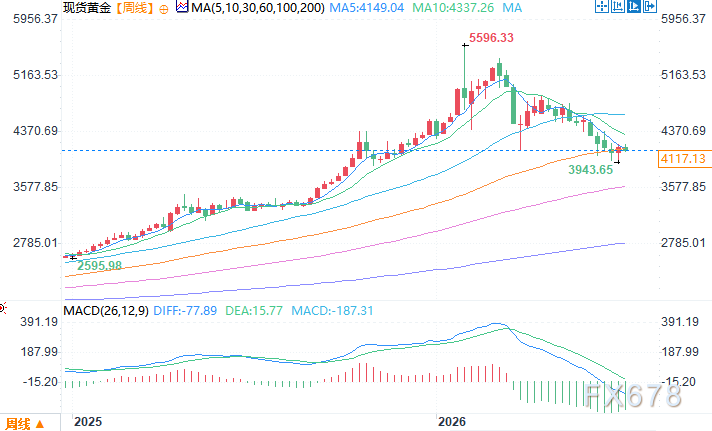
Spot gold weekly chart Source: Yihuicom
East 8 Zone July 9, 11:24 spot gold quoted at $4,058.88/oz
Disclaimer: The content of this article solely reflects the author's opinion and does not represent the platform in any capacity. This article is not intended to serve as a reference for making investment decisions.
You may also like

Wall Street giants collectively raise rate hike forecasts, US Treasury futures continue to fall, gold drops over 1% to break 4000
After the US October CPI exceeded expectations, Goldman Sachs and Nomura added a forecast for an interest rate hike in March next year, while Deutsche Bank included a forecast for a rate hike in January next year. Currently, the market has fully priced in a 25 basis point rate hike in December, with a 13% probability for a 50 basis point hike. On Wednesday, the US Treasury spot market was closed, but Treasury futures continued to fall, with corresponding yields rising by about 2 to 4 basis points, and spot gold came under pressure, dropping by 1.1%.

No Need to Worry About the Cooling Down of AI Data Center Construction? The US Import Boom Is Unlikely to Subside in the Short Term, Real Impact May Come in 2029
It takes an average of 4.8 years from finalizing investment to starting construction of a data center project, and an additional 2.6 years from construction start to becoming operational. Servers usually cannot be installed until after the building structure and racks are completed. For trade partners such as Taiwan (China), South Korea, and Mexico who rely on US data center supply chain demand, the inertia in construction timelines provides at least a one- to two-year buffer for future exports.

Federal Reserve Major Debate: When Should the Tenure of “Number Three” Williams End?
The main point of contention is whether Williams should step down in June 2028, upon completing a full 10-year term, or in June 2027, when he reaches the mandatory retirement age of 65. Analysts point out that the Federal Reserve Board holds ultimate discretion; if he leaves early, Fed Chair Waller would be able to assert greater control over the appointment to this critical position. However, forcing Williams to shorten his term could easily be interpreted as political manipulation. Williams himself is expected to serve until June 2028.

Crypto prices
More


