
AI boom fuels inflation fears, complicating Fed’s next rate move

Federal Reserve officials were split last month on whether to increase interest rates or keep them steady, with many seeing accelerating demand for artificial intelligence as a driver of inflation, according to meeting minutes released on Wednesday.
The minutes covered the first monetary policy meeting under Fed Chair Kevin Warsh. Many Federal Open Market Committee members said that “ongoing strong demand for AI infrastructure would likely sustain upward pressure on prices for technology products and electricity,” according to the minutes.
AI-related inflationary pressure, colloquially known as “chipflation,” stems from the rising cost of semiconductors used by data centers. This surge in demand, along with data center competition for energy, has pushed up consumer prices for a wide range of electronic goods, devices and power, and may continue as AI demand increases.
Higher inflation is generally bad news for risk assets such as crypto, as it results in lower liquidity and spending power and higher interest rates, making borrowing more expensive and cash investments more attractive.
Inflation will remain elevated in the near term
Participants anticipated that inflation would “remain elevated in the near term” but may decline as the Middle East conflict eases. However, they judged that the “risks to the inflation outlook were still tilted to the upside.”
AI growth remained a strong theme, both boosting economic growth and contributing to inflation at the same time.
“Most participants remarked that growth in economic activity that exceeded that of potential output, owing in part to strong AI business investment, could contribute to more persistent inflationary pressures.”
Related:
The Fed’s “dot plot” signals hikes, not cuts, with nine of 18 voting members projecting at least one rate hike before the end of 2026 and six expecting two 25-basis-point increases. The central bank’s PCE inflation projection for year-end also jumped from 2.7% to 3.6%.
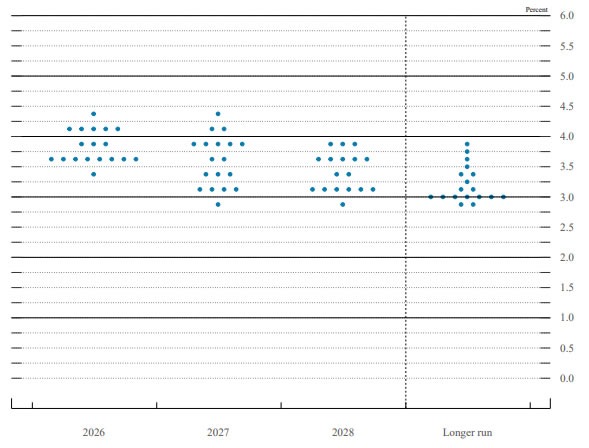
The Fed kept rates steady at 3.5% to 3.75% at its June meeting, while CME futures markets currently show a 70% probability that they will remain unchanged at the next meeting on July 29.
AI infra buildout driving higher inflation
Nick Ruck, director of LVRG Research, told Cointelegraph that the Fed’s recent meeting highlights how the massive AI infrastructure buildout is “driving higher inflation through surging demand for semiconductors, energy and data centers, even as it promises future productivity gains.”
“While this short-term pressure complicates monetary policy, it also underscores the need for innovative solutions in decentralized technologies to optimize resource allocation and ease bottlenecks in the digital economy,” he said.
Analysts said this week that crypto markets could benefit from any Fed intervention to backstop the booming US equity market in a downturn.
Features:
Disclaimer: The content of this article solely reflects the author's opinion and does not represent the platform in any capacity. This article is not intended to serve as a reference for making investment decisions.
You may also like
Wall Street giants collectively raise rate hike forecasts, US Treasury futures continue to fall, gold drops over 1% to break 4000
After the US October CPI exceeded expectations, Goldman Sachs and Nomura added a forecast for an interest rate hike in March next year, while Deutsche Bank included a forecast for a rate hike in January next year. Currently, the market has fully priced in a 25 basis point rate hike in December, with a 13% probability for a 50 basis point hike. On Wednesday, the US Treasury spot market was closed, but Treasury futures continued to fall, with corresponding yields rising by about 2 to 4 basis points, and spot gold came under pressure, dropping by 1.1%.

No Need to Worry About the Cooling Down of AI Data Center Construction? The US Import Boom Is Unlikely to Subside in the Short Term, Real Impact May Come in 2029
It takes an average of 4.8 years from finalizing investment to starting construction of a data center project, and an additional 2.6 years from construction start to becoming operational. Servers usually cannot be installed until after the building structure and racks are completed. For trade partners such as Taiwan (China), South Korea, and Mexico who rely on US data center supply chain demand, the inertia in construction timelines provides at least a one- to two-year buffer for future exports.

Federal Reserve Major Debate: When Should the Tenure of “Number Three” Williams End?
The main point of contention is whether Williams should step down in June 2028, upon completing a full 10-year term, or in June 2027, when he reaches the mandatory retirement age of 65. Analysts point out that the Federal Reserve Board holds ultimate discretion; if he leaves early, Fed Chair Waller would be able to assert greater control over the appointment to this critical position. However, forcing Williams to shorten his term could easily be interpreted as political manipulation. Williams himself is expected to serve until June 2028.

Crypto prices
More


