Bitget App
Trade smarter
Buy cryptoMarketsTradeFuturesStocksEarnInstitutionAI & More
Decoding crypto’s perp slowdown as on-chain volumes hit $147B

Decoding crypto’s perp slowdown as on-chain volumes hit $147B

AMBCryptoAMBCrypto2026/07/09 00:03
By:AMBCrypto

After a few years of unrelenting growth, centralized perpetual futures trading is now experiencing some slowdown as users are becoming increasingly selective. The selectivity is indicative of risk aversion rather than an absence of demand.

As a result, users have reduced their use of leverage and are waiting for clearer directional signals.

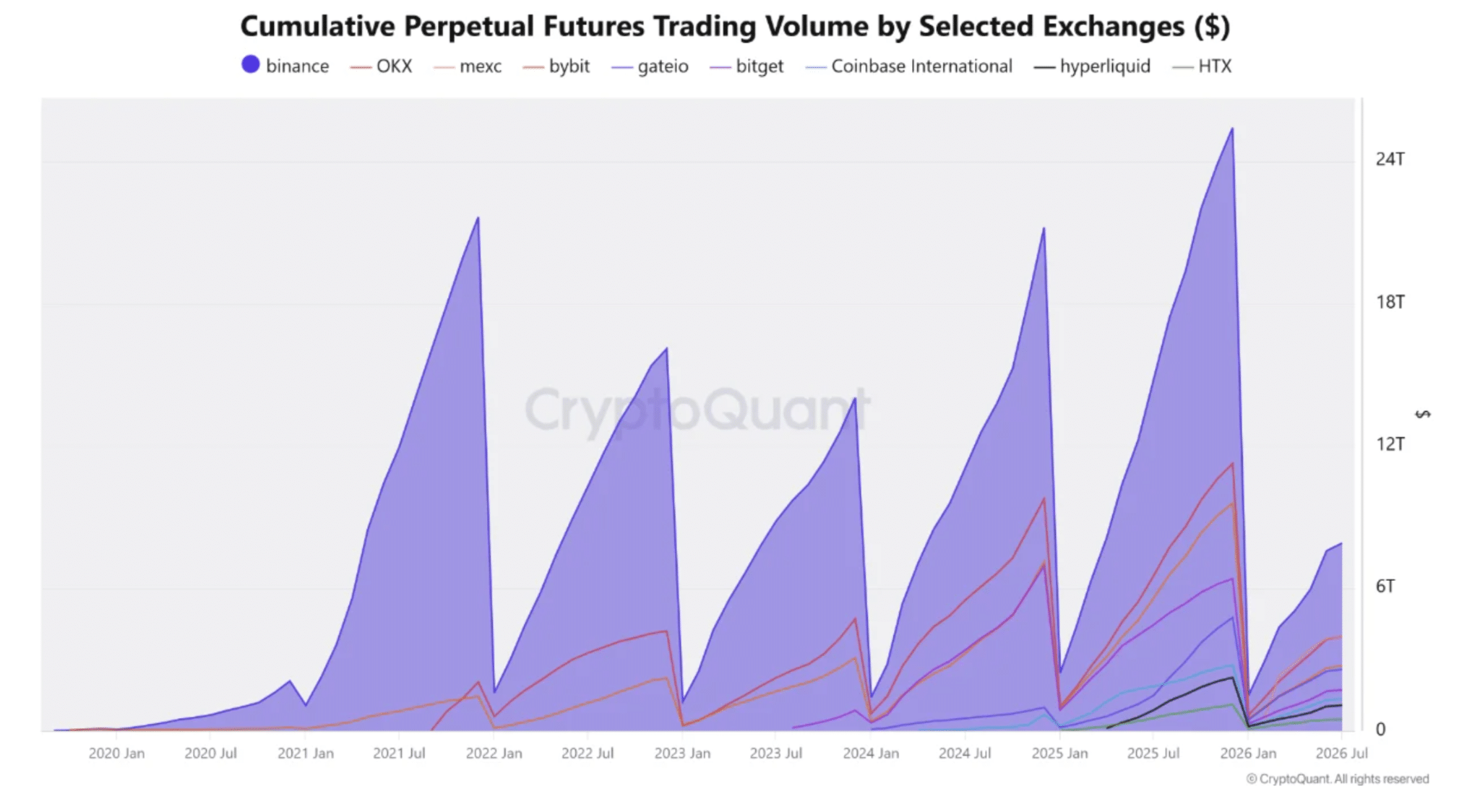
Currently, Binance leads the market in terms of cumulative perpetual volume at approximately $7.9 trillion through 2026. OKX and MEXC each reached nearly $4 trillion in cumulative perpetuals, whereas Bybit had approximately $2.7 trillion.
@media only screen and (min-width: 0px) and (min-height: 0px) { div[id^="bsa-zone_1774359638628-7_123456"] { min-height: 50px; transition: min-height 0.3s ease; } } @media only screen and (min-width: 640px) and (min-height: 0px) { div[id^="bsa-zone_1774359638628-7_123456"] { min-height: 90px; } }
AD

Decoding crypto’s perp slowdown as on-chain volumes hit $147B image 0 Source: CryptoQuant

However, cumulative trading volumes have remained below the levels recorded during the same period in 2025. This shift indicates that speculation remains high but may be cooling among the top exchanges.

Simultaneously, the adoption of decentralized perpetual futures and relatively stable open positions is increasing. This indicates that capital is simply being redeployed rather than withdrawn. If this trend persists, derivatives markets may become healthier, relying more on conviction-driven positioning than excessive leverage.

Liquidity shifts toward on-chain perpetuals

As speculative activity cools across centralized exchanges, part of that liquidity is beginning to reappear on-chain rather than leaving the derivatives market altogether.

Speculative activity on centralized perpetual exchanges has continued easing as traders reduce leverage and become more selective. However, that decrease is being partially offset by an increase in on-chain speculation.

Lower transaction fees continue driving preference for on-chain speculation. This is in comparison to centralized exchanges and allows for quicker settlement and transparent, custodian-less trading.

On-chain perpetual derivatives traded approximately $147.6 billion during Q2 of 2026, while the total open interest was approximately $344.6 million. Even though leverage has eased, capital continues flowing into on-chain perpetual markets, highlighting sustained trader conviction.
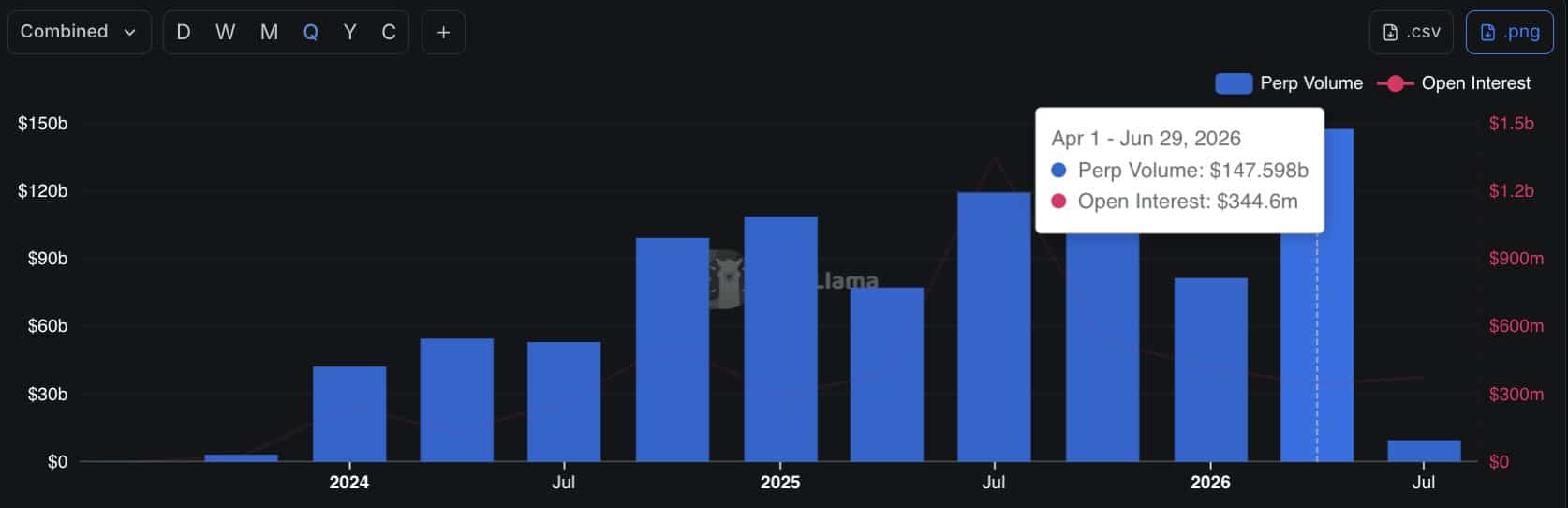
Decoding crypto’s perp slowdown as on-chain volumes hit $147B image 1 Source: X

This trend increasingly favors Solana [SOL], which continues attracting a larger share of on-chain perpetual trading activity. More importantly, this provides more opportunities for users to execute trades efficiently through various perpetual derivative products.

Even so, centralized exchanges still dominate overall derivatives activity. If on-chain innovation continues outpacing centralized offerings, derivatives liquidity may become increasingly distributed across multiple venues. As a result, this creates a more competitive and resilient trading ecosystem.

Final Summary

  • On-chain perpetual markets continue attracting derivatives liquidity as traders shift away from centralized exchanges.
  • Centralized perpetual trading remains dominant, but on-chain execution is steadily reshaping derivatives market structure.

0
0

Disclaimer: The content of this article solely reflects the author's opinion and does not represent the platform in any capacity. This article is not intended to serve as a reference for making investment decisions.

Understand the market, then trade.
Bitget offers one-stop trading for cryptocurrencies, stocks, and gold.
Trade now!

You may also like

Wall Street giants collectively raise rate hike forecasts, US Treasury futures continue to fall, gold drops over 1% to break 4000

After the US October CPI exceeded expectations, Goldman Sachs and Nomura added a forecast for an interest rate hike in March next year, while Deutsche Bank included a forecast for a rate hike in January next year. Currently, the market has fully priced in a 25 basis point rate hike in December, with a 13% probability for a 50 basis point hike. On Wednesday, the US Treasury spot market was closed, but Treasury futures continued to fall, with corresponding yields rising by about 2 to 4 basis points, and spot gold came under pressure, dropping by 1.1%.

华尔街见闻•2026/11/11 21:18
Wall Street giants collectively raise rate hike forecasts, US Treasury futures continue to fall, gold drops over 1% to break 4000

No Need to Worry About the Cooling Down of AI Data Center Construction? The US Import Boom Is Unlikely to Subside in the Short Term, Real Impact May Come in 2029

It takes an average of 4.8 years from finalizing investment to starting construction of a data center project, and an additional 2.6 years from construction start to becoming operational. Servers usually cannot be installed until after the building structure and racks are completed. For trade partners such as Taiwan (China), South Korea, and Mexico who rely on US data center supply chain demand, the inertia in construction timelines provides at least a one- to two-year buffer for future exports.

华尔街见闻•2026/11/11 21:18
No Need to Worry About the Cooling Down of AI Data Center Construction? The US Import Boom Is Unlikely to Subside in the Short Term, Real Impact May Come in 2029

Federal Reserve Major Debate: When Should the Tenure of “Number Three” Williams End?

The main point of contention is whether Williams should step down in June 2028, upon completing a full 10-year term, or in June 2027, when he reaches the mandatory retirement age of 65. Analysts point out that the Federal Reserve Board holds ultimate discretion; if he leaves early, Fed Chair Waller would be able to assert greater control over the appointment to this critical position. However, forcing Williams to shorten his term could easily be interpreted as political manipulation. Williams himself is expected to serve until June 2028.

华尔街见闻•2026/11/11 21:18
Federal Reserve Major Debate: When Should the Tenure of “Number Three” Williams End?


