Bitget App
Trade smarter
Buy cryptoMarketsTradeFuturesStocksEarnInstitutionAI & More
Ethereum and Bitcoin face historic supply squeeze – THESE 2 metrics reveal what’s next

Ethereum and Bitcoin face historic supply squeeze – THESE 2 metrics reveal what’s next

AMBCryptoAMBCrypto2026/07/08 16:03
By:AMBCrypto

Despite months of market volatility, Ethereum and Bitcoin holders continue showing little interest in returning coins to exchanges. This does represent much more than decreased investor trading enthusiasm.

Persistent withdrawals continued reducing the amount of liquid supply available on the market.

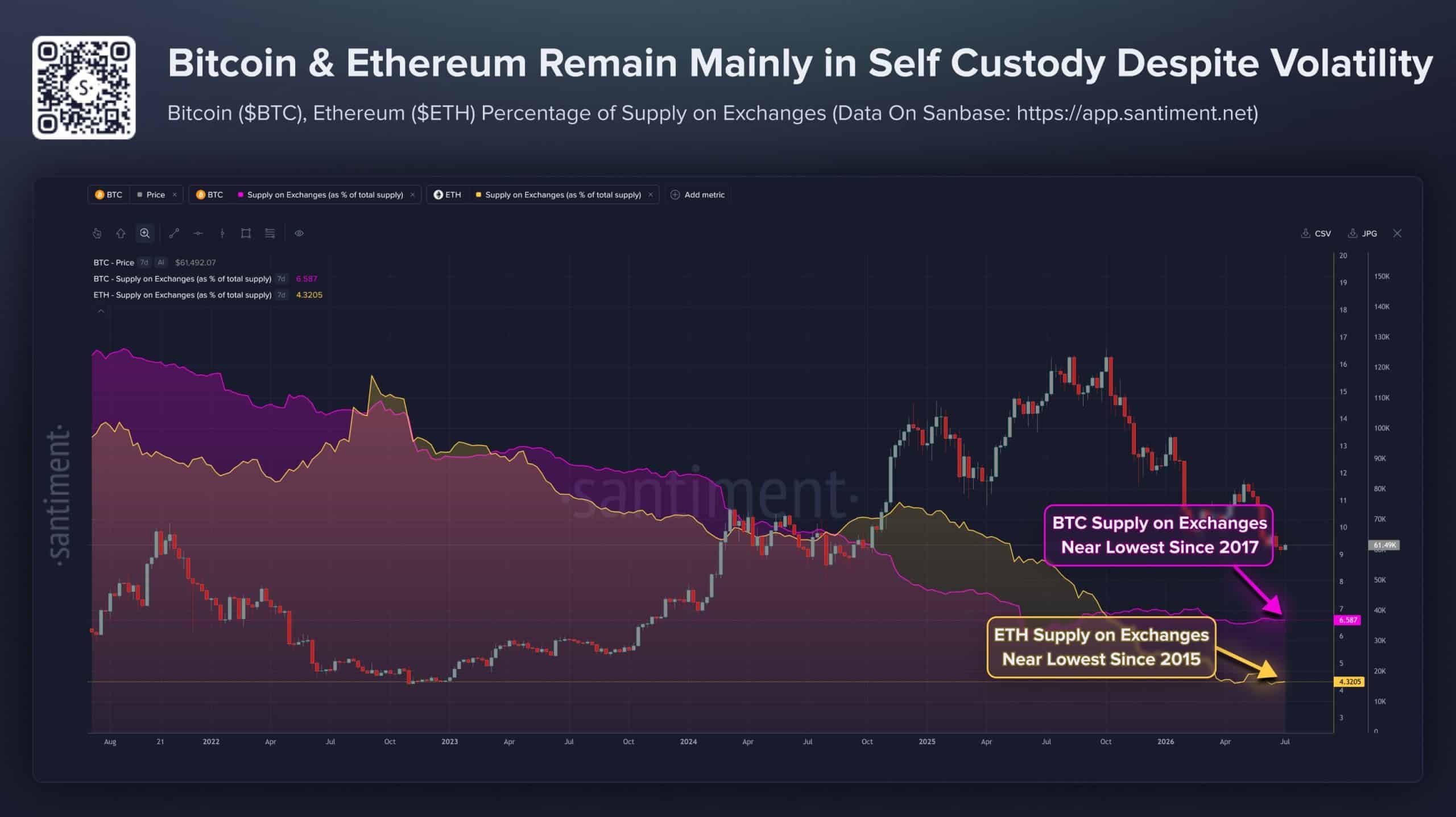
As of press time, the total number of Bitcoins stored on exchanges was at an all-time low for any time period since 2017. At the same time, the total number of Ethereum [ETH] stored on exchanges was also at an all-time low for any time period since 2015.
@media only screen and (min-width: 0px) and (min-height: 0px) { div[id^="bsa-zone_1774359638628-7_123456"] { min-height: 50px; transition: min-height 0.3s ease; } } @media only screen and (min-width: 640px) and (min-height: 0px) { div[id^="bsa-zone_1774359638628-7_123456"] { min-height: 90px; } }
AD

Ethereum and Bitcoin face historic supply squeeze – THESE 2 metrics reveal what’s next image 0 Source: Santiment

Simultaneously, ongoing negative Netflows indicate that institutional and longer-term holders prefer to store their coins using self-custody models such as ETFs or corporate treasuries rather than storing them on exchanges.

Therefore, this migration will remove additional coins from potential sales. Yet in turn, it will provide even less selling pressure in the short term to further increase the conviction behind buying. While lower exchange balances may result in lower prices for investors, they do create scarcity.

If demand continues recovering, limited liquid supply could amplify price discovery and support a more structurally driven market cycle.

Long-term holders reinforce Bitcoin’s supply floor

Behind the continued decline in exchange balances, Bitcoin [BTC] Long-Term Holders are steadily absorbing the circulating supply. That behavior reflects growing conviction rather than defensive positioning, as experienced investors continue accumulating during market weakness.

Long-Term Holder Net Position Change has returned to positive territory, confirming a shift from distribution toward renewed accumulation.

Meanwhile, HODL Waves and rising illiquid supply show older coins remaining dormant despite recent volatility.

That behavior further reduced Bitcoin’s availability for active trading. On top of that, the Accumulation Trend Score indicated continued buying across smaller and medium-sized wallets.

Supply held by Long-Term Holders approached 15 million BTC.

By contrast, Short-Term Holder supply declined to roughly 16.75 million BTC. The shift suggested Bitcoin continued moving from shorter-term participants into stronger conviction holders.
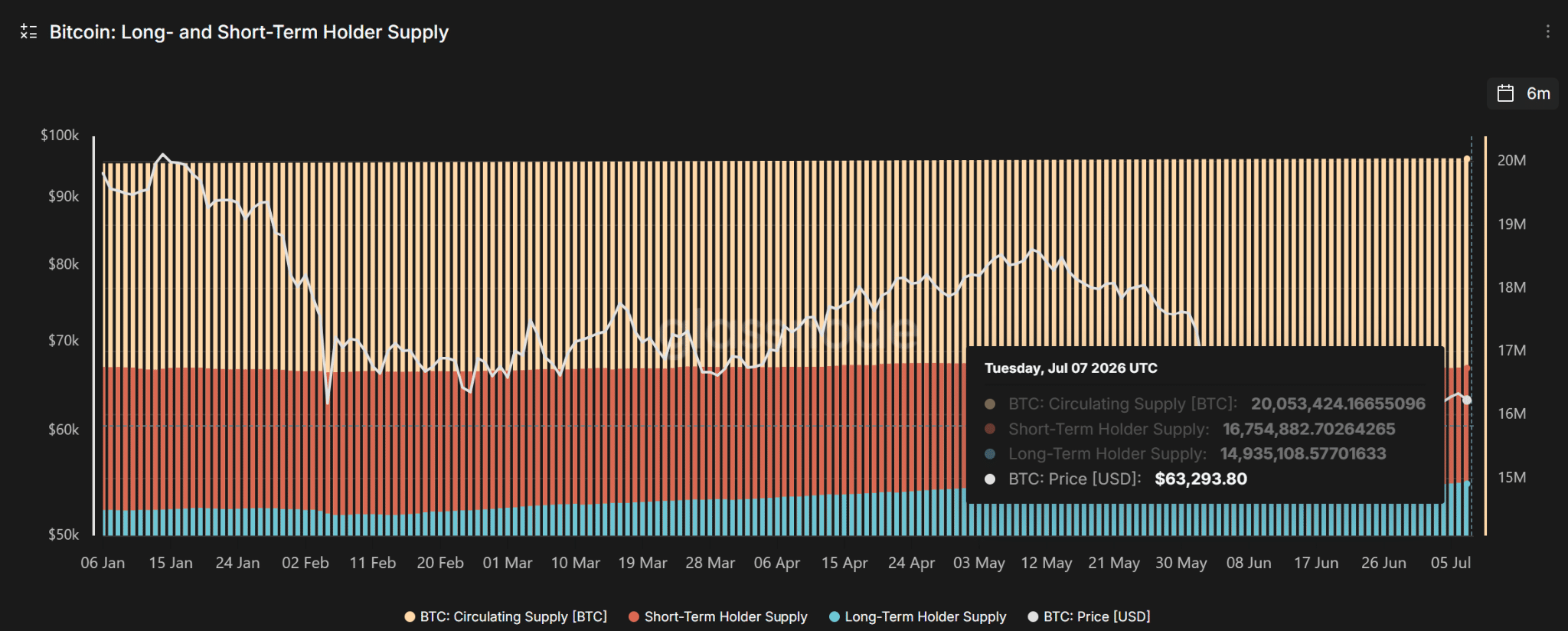
Ethereum and Bitcoin face historic supply squeeze – THESE 2 metrics reveal what’s next image 1 Source: Glassnode

Even so, tightening supply alone may not sustain Bitcoin’s recovery.

A lasting uptrend would still require stronger buying demand to absorb available liquidity. Without that support, Bitcoin could struggle to maintain momentum despite increasingly scarce exchange balances.

Final Summary

  • Bitcoin [BTC] and Ethereum [ETH] exchange supply continues tightening, reinforcing long-term accumulation.
  • Bitcoin needs stronger demand to sustain its recovery amid shrinking supply.

0
0

Disclaimer: The content of this article solely reflects the author's opinion and does not represent the platform in any capacity. This article is not intended to serve as a reference for making investment decisions.

Understand the market, then trade.
Bitget offers one-stop trading for cryptocurrencies, stocks, and gold.
Trade now!

You may also like

Wall Street giants collectively raise rate hike forecasts, US Treasury futures continue to fall, gold drops over 1% to break 4000

After the US October CPI exceeded expectations, Goldman Sachs and Nomura added a forecast for an interest rate hike in March next year, while Deutsche Bank included a forecast for a rate hike in January next year. Currently, the market has fully priced in a 25 basis point rate hike in December, with a 13% probability for a 50 basis point hike. On Wednesday, the US Treasury spot market was closed, but Treasury futures continued to fall, with corresponding yields rising by about 2 to 4 basis points, and spot gold came under pressure, dropping by 1.1%.

华尔街见闻•2026/11/11 21:18
Wall Street giants collectively raise rate hike forecasts, US Treasury futures continue to fall, gold drops over 1% to break 4000

No Need to Worry About the Cooling Down of AI Data Center Construction? The US Import Boom Is Unlikely to Subside in the Short Term, Real Impact May Come in 2029

It takes an average of 4.8 years from finalizing investment to starting construction of a data center project, and an additional 2.6 years from construction start to becoming operational. Servers usually cannot be installed until after the building structure and racks are completed. For trade partners such as Taiwan (China), South Korea, and Mexico who rely on US data center supply chain demand, the inertia in construction timelines provides at least a one- to two-year buffer for future exports.

华尔街见闻•2026/11/11 21:18
No Need to Worry About the Cooling Down of AI Data Center Construction? The US Import Boom Is Unlikely to Subside in the Short Term, Real Impact May Come in 2029

Federal Reserve Major Debate: When Should the Tenure of “Number Three” Williams End?

The main point of contention is whether Williams should step down in June 2028, upon completing a full 10-year term, or in June 2027, when he reaches the mandatory retirement age of 65. Analysts point out that the Federal Reserve Board holds ultimate discretion; if he leaves early, Fed Chair Waller would be able to assert greater control over the appointment to this critical position. However, forcing Williams to shorten his term could easily be interpreted as political manipulation. Williams himself is expected to serve until June 2028.

华尔街见闻•2026/11/11 21:18
Federal Reserve Major Debate: When Should the Tenure of “Number Three” Williams End?


