
Kazakhstan president signs decree to accelerate crypto adoption

Kazakhstan, one of the world’s largest Bitcoin mining hubs, is moving to expand its crypto sector as a new decree introduces rules for stablecoin payments, tax breaks for regulated crypto activity and new energy options for mining.
Kazakhstan President Kassym-Jomart Tokayev has signed a decree aimed at building a regulated digital asset market, the Ministry of Artificial Intelligence and Digital Development (MAIDD) announced on Wednesday.
Developed jointly by MAIDD, the central bank and the Astana International Financial Centre, the order is viewed as a tool to increase regulatory clarity for crypto businesses, investors and digital asset service providers.
The move signals Kazakhstan’s latest effort to expand its role in the crypto industry and establish itself as a major global crypto hub.
Stablecoins enter Kazakhstan’s cross-border trade plans
In one of its key directions, the decree targets modernization of Kazakhstan’s payments infrastructure, including provisions on creating mechanisms for using digital assets and stablecoins in cross-border settlements.
The government said the move could support export and import operations by adding digital assets to Kazakhstan’s financial toolkit while keeping transactions within a regulated framework.
The order also aims to move crypto activity from foreign unregulated platforms into Kazakhstan’s licensed digital asset infrastructure. Users holding digital assets abroad will be encouraged to disclose them and transfer them to approved domestic service providers.
For individuals, the government plans tax incentives for digital asset activity conducted through regulated infrastructure, including a proposed exemption from personal income tax on related income.
Gas-powered energy plans for digital mining
The action also addresses Kazakhstan’s energy resources, introducing a mechanism for associated petroleum gas and natural gas from oil and gas fields to be used for autonomous electricity generation when those resources are not needed for state purposes.
That electricity could support digital mining operations, adding an energy component to Kazakhstan’s broader crypto strategy, the announcement said.
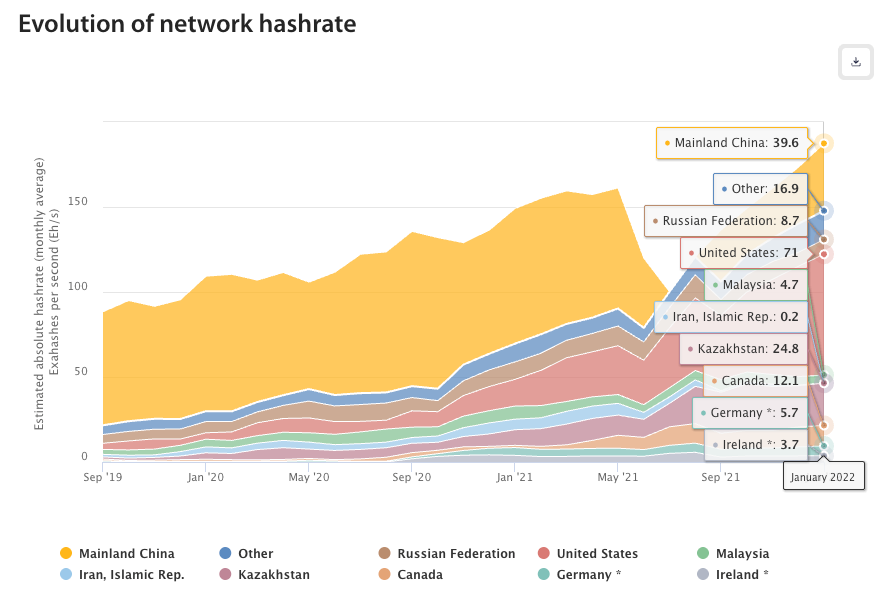
Kazakhstan ranked third globally by estimated Bitcoin mining hash rate, according to data by the Cambridge Centre for Alternative Finance (CCAF) published in 2022.
Separately, Kazakhstan’s government has introduced a “70/30” energy model that allows data centers and digital miners to directly access up to 70% of new power generation capacity created through infrastructure upgrades.
The decree also outlines plans to develop tokenized financial instruments and national trading infrastructure, as the Central Asian country seeks to attract digital asset investment.
“Our goal is to make Kazakhstan a point of attraction for global capital and expertise while ensuring maximum transparency and protection for every participant in this market,” MAIDD Minister Zhaslan Madiyev said.
Disclaimer: The content of this article solely reflects the author's opinion and does not represent the platform in any capacity. This article is not intended to serve as a reference for making investment decisions.
You may also like

Wall Street giants collectively raise rate hike forecasts, US Treasury futures continue to fall, gold drops over 1% to break 4000
After the US October CPI exceeded expectations, Goldman Sachs and Nomura added a forecast for an interest rate hike in March next year, while Deutsche Bank included a forecast for a rate hike in January next year. Currently, the market has fully priced in a 25 basis point rate hike in December, with a 13% probability for a 50 basis point hike. On Wednesday, the US Treasury spot market was closed, but Treasury futures continued to fall, with corresponding yields rising by about 2 to 4 basis points, and spot gold came under pressure, dropping by 1.1%.

No Need to Worry About the Cooling Down of AI Data Center Construction? The US Import Boom Is Unlikely to Subside in the Short Term, Real Impact May Come in 2029
It takes an average of 4.8 years from finalizing investment to starting construction of a data center project, and an additional 2.6 years from construction start to becoming operational. Servers usually cannot be installed until after the building structure and racks are completed. For trade partners such as Taiwan (China), South Korea, and Mexico who rely on US data center supply chain demand, the inertia in construction timelines provides at least a one- to two-year buffer for future exports.

Federal Reserve Major Debate: When Should the Tenure of “Number Three” Williams End?
The main point of contention is whether Williams should step down in June 2028, upon completing a full 10-year term, or in June 2027, when he reaches the mandatory retirement age of 65. Analysts point out that the Federal Reserve Board holds ultimate discretion; if he leaves early, Fed Chair Waller would be able to assert greater control over the appointment to this critical position. However, forcing Williams to shorten his term could easily be interpreted as political manipulation. Williams himself is expected to serve until June 2028.

Crypto prices
More


