Bitget App
Trade smarter
Buy cryptoMarketsTradeFuturesStocksEarnInstitutionAI & More
Ethereum holds Q3 gains as Tether burns $2.5B – Yet THIS catalyst remains

Ethereum holds Q3 gains as Tether burns $2.5B – Yet THIS catalyst remains

AMBCryptoAMBCrypto2026/07/08 12:01
By:AMBCrypto

H2 is becoming a key period for network upgrades. Notably, Ethereum is right at the center of that.

Its biggest upgrade since the Merge has entered the final testing phase. Known as Glamsterdam and targeted for H2 2026, the upgrade focuses on improving how Ethereum works at the protocol level.

It introduces parallel transaction processing and gradually raises the gas limit from 60 million toward 200 million, changes designed to boost throughput.

@media only screen and (min-width: 0px) and (min-height: 0px) { div[id^="bsa-zone_1774359638628-7_123456"] { min-height: 50px; transition: min-height 0.3s ease; } } @media only screen and (min-width: 640px) and (min-height: 0px) { div[id^="bsa-zone_1774359638628-7_123456"] { min-height: 90px; } }
AD

From an on-chain perspective, the timing couldn’t be better.

Following Q2’s back-to-back DeFi exploits, which wiped more than $10 million from Ethereum’s TVL in immediate outflows, the network is still working to rebuild on-chain liquidity and user activity. As the chart below shows, Aave, Ethereum’s largest lending protocol, has seen its TVL drop to around $13 billion from nearly $35 billion in early Q1. 
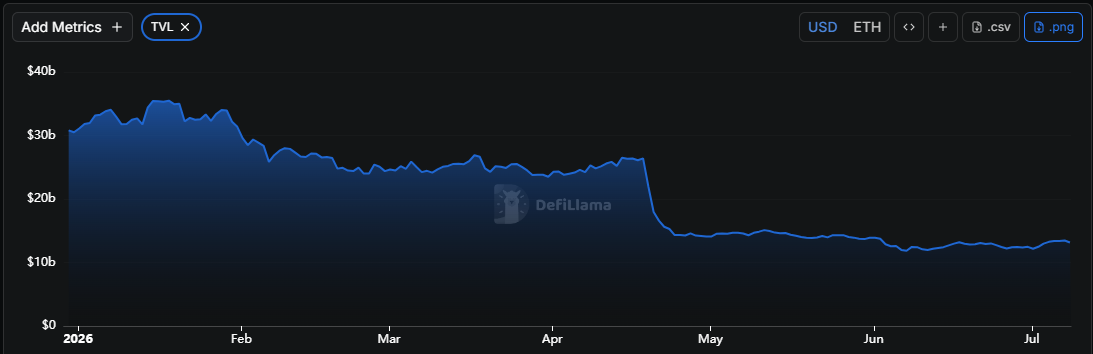
Ethereum holds Q3 gains as Tether burns $2.5B – Yet THIS catalyst remains image 0 Source: DeFiLlama

Against this backdrop, the upcoming Glamsterdam upgrade becomes a key infrastructure catalyst. 

The logic is simple: By improving scalability and expanding network capacity, the upgrade could help Ethereum handle higher DeFi demand as liquidity gradually returns to the ecosystem. This becomes particularly interesting with the planned gas limit increase toward 200 million, which could significantly expand Ethereum’s transaction capacity and reduce pressure during periods of heavy on-chain activity. 

The impact could also translate into price action.

ETH has started Q3 on a strong note, gaining 11%, but sustaining this momentum will require more than just short-term flows. A successful Glamsterdam upgrade could add a stronger fundamental narrative, supporting a more infrastructure-driven rally. 

Naturally, the question becomes: Is Ethereum [ETH] setting up for a strong H2 cycle, or will macro uncertainty and weaker on-chain activity continue to limit its upside?

Ethereum faces an H2 reality check as DeFi liquidity weakens 

Stablecoins continue to be the core liquidity engine behind DeFi activity. 

However, the broader liquidity environment is showing signs of weakness, with the total stablecoin market cap falling to a four-month low. Over the past four months, around $5.82 billion in stablecoin supply has been wiped out, highlighting a clear slowdown in capital availability across crypto markets. 

Adding to the pressure, Tether recently burned $2.5 billion in USDT on Ethereum, reducing the network’s total USDT supply to around $77 billion. This further shifts stablecoin liquidity away from Ethereum, widening the gap with TRON, which currently holds the largest USDT supply at over $87 billion. 
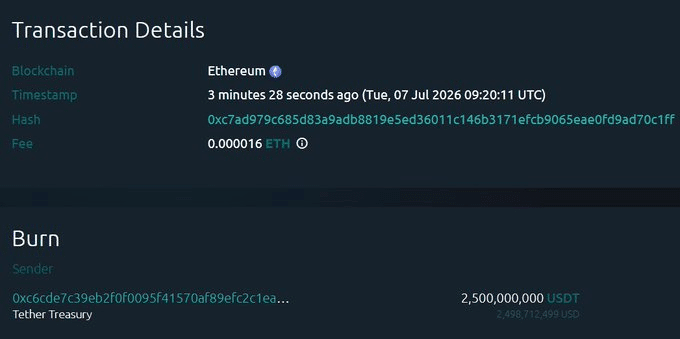
Ethereum holds Q3 gains as Tether burns $2.5B – Yet THIS catalyst remains image 1 Source: Tether Treasury

This burn highlights a key challenge for Ethereum’s H2 cycle.

On one hand, the upcoming Glamsterdam upgrade is building a bullish narrative around Ethereum’s scalability. On the other hand, weaker DeFi activity and declining stablecoin liquidity are creating on-chain pressure.

Since Ethereum’s smart contract ecosystem relies heavily on stablecoin flows, a sustained liquidity squeeze could slow DeFi recovery and make it harder for the network to regain momentum.

Meanwhile, institutional flows are adding another layer to the picture.

Final Summary

  • Ethereum’s Glamsterdam upgrade enters final testing, bringing major scalability improvements in H2 2026.
  • ETH’s rally needs stronger DeFi activity to continue.

 

0
0

Disclaimer: The content of this article solely reflects the author's opinion and does not represent the platform in any capacity. This article is not intended to serve as a reference for making investment decisions.

Understand the market, then trade.
Bitget offers one-stop trading for cryptocurrencies, stocks, and gold.
Trade now!

You may also like

Wall Street giants collectively raise rate hike forecasts, US Treasury futures continue to fall, gold drops over 1% to break 4000

After the US October CPI exceeded expectations, Goldman Sachs and Nomura added a forecast for an interest rate hike in March next year, while Deutsche Bank included a forecast for a rate hike in January next year. Currently, the market has fully priced in a 25 basis point rate hike in December, with a 13% probability for a 50 basis point hike. On Wednesday, the US Treasury spot market was closed, but Treasury futures continued to fall, with corresponding yields rising by about 2 to 4 basis points, and spot gold came under pressure, dropping by 1.1%.

华尔街见闻•2026/11/11 21:18
Wall Street giants collectively raise rate hike forecasts, US Treasury futures continue to fall, gold drops over 1% to break 4000

No Need to Worry About the Cooling Down of AI Data Center Construction? The US Import Boom Is Unlikely to Subside in the Short Term, Real Impact May Come in 2029

It takes an average of 4.8 years from finalizing investment to starting construction of a data center project, and an additional 2.6 years from construction start to becoming operational. Servers usually cannot be installed until after the building structure and racks are completed. For trade partners such as Taiwan (China), South Korea, and Mexico who rely on US data center supply chain demand, the inertia in construction timelines provides at least a one- to two-year buffer for future exports.

华尔街见闻•2026/11/11 21:18
No Need to Worry About the Cooling Down of AI Data Center Construction? The US Import Boom Is Unlikely to Subside in the Short Term, Real Impact May Come in 2029

Federal Reserve Major Debate: When Should the Tenure of “Number Three” Williams End?

The main point of contention is whether Williams should step down in June 2028, upon completing a full 10-year term, or in June 2027, when he reaches the mandatory retirement age of 65. Analysts point out that the Federal Reserve Board holds ultimate discretion; if he leaves early, Fed Chair Waller would be able to assert greater control over the appointment to this critical position. However, forcing Williams to shorten his term could easily be interpreted as political manipulation. Williams himself is expected to serve until June 2028.

华尔街见闻•2026/11/11 21:18
Federal Reserve Major Debate: When Should the Tenure of “Number Three” Williams End?


