
2008-style crisis alert sounded? Economist warns: US stock market brewing "final stage"

FX168 Financial News Agency (Asia-Pacific) - Macro strategist Henrik Zeberg has issued a warning that the US stock market is entering the so-called "end phase." He believes that the recent strong late-cycle rally in risk assets is masking the ongoing deterioration in economic fundamentals.
(Screenshot source: Finbold)
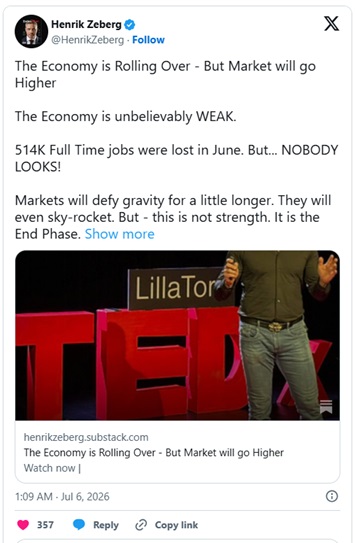
After analyzing the June US employment report, Zeberg posted on social media platform X on July 5, stating that the disconnect between the current economy and the financial markets is widening.
While official non-farm employment data showed only mild job growth, household surveys indicated that over 500,000 full-time jobs were lost in the US that month, suggesting that the real condition of the labor market is deteriorating.
Zeberg noted that despite increasingly evident signs of economic slowdown, investors continue to push the stock market higher, forming the typical characteristics of a late-stage bull market.
Though Zeberg has been long-term bearish on the market, he does not believe this rally will end immediately.
On the contrary, he thinks that supported by ample liquidity and investor optimism, the market could continue to rise and could see one final asset price surge.
(Screenshot source: X)
"Blow-off top" imminent
Zeberg says the current market environment fits the typical late-cycle "blow-off top" pattern—asset valuations continue to climb even as underlying economic conditions worsen.
His overall market model forecasts that the S&P 500 Index could further rise to the range of 6,800 to 8,200 points before a significant reversal emerges.
Currently, with the S&P 500 Index trading near 7,500, Zeberg believes the market still has room for further upside before reaching the cycle peak.
Zeberg points out that several economic indicators show growing vulnerability behind the market’s current rise.
He notes that risk factors include: slowing private sector hiring, rising consumer loan default rates, declining labor force participation, and household surveys showing a sharp drop in full-time employment.
He believes these indicators suggest that the US economy has actually already started to turn downward, even if stock prices remain near historic highs.
Zeberg argues that support measures from the Federal Reserve could help the stock market extend its rally, but if the economy continues to worsen, Fed policy ultimately won’t be able to prevent an economic downturn.
Besides the stock market, Zeberg has previously warned that should market sentiment reverse, cryptocurrencies and other risk assets could face significant declines.
From a longer-term perspective, he expects that as both leading and lagging indicators continue to deteriorate, the risk of recession in the US will further increase before the end of 2026.
Previously, he stated that if tightening financial conditions trigger a broader credit contraction, the future economic downturn could rival or even exceed the severity of the 2008 financial crisis.
Disclaimer: The content of this article solely reflects the author's opinion and does not represent the platform in any capacity. This article is not intended to serve as a reference for making investment decisions.
You may also like

Wall Street giants collectively raise rate hike forecasts, US Treasury futures continue to fall, gold drops over 1% to break 4000
After the US October CPI exceeded expectations, Goldman Sachs and Nomura added a forecast for an interest rate hike in March next year, while Deutsche Bank included a forecast for a rate hike in January next year. Currently, the market has fully priced in a 25 basis point rate hike in December, with a 13% probability for a 50 basis point hike. On Wednesday, the US Treasury spot market was closed, but Treasury futures continued to fall, with corresponding yields rising by about 2 to 4 basis points, and spot gold came under pressure, dropping by 1.1%.

No Need to Worry About the Cooling Down of AI Data Center Construction? The US Import Boom Is Unlikely to Subside in the Short Term, Real Impact May Come in 2029
It takes an average of 4.8 years from finalizing investment to starting construction of a data center project, and an additional 2.6 years from construction start to becoming operational. Servers usually cannot be installed until after the building structure and racks are completed. For trade partners such as Taiwan (China), South Korea, and Mexico who rely on US data center supply chain demand, the inertia in construction timelines provides at least a one- to two-year buffer for future exports.

Federal Reserve Major Debate: When Should the Tenure of “Number Three” Williams End?
The main point of contention is whether Williams should step down in June 2028, upon completing a full 10-year term, or in June 2027, when he reaches the mandatory retirement age of 65. Analysts point out that the Federal Reserve Board holds ultimate discretion; if he leaves early, Fed Chair Waller would be able to assert greater control over the appointment to this critical position. However, forcing Williams to shorten his term could easily be interpreted as political manipulation. Williams himself is expected to serve until June 2028.

Crypto prices
More


