Bitget App
Trade smarter
Buy cryptoMarketsTradeFuturesStocksEarnInstitutionAI & More
Here’s why XRP’s RWA market is now 4x larger than its entire ETF sector

Here’s why XRP’s RWA market is now 4x larger than its entire ETF sector

CryptoNewsNetCryptoNewsNet2026/07/08 06:15
By:CryptoNewsNet
Back to the list

Here’s why XRP’s RWA market is now 4x larger than its entire ETF sector

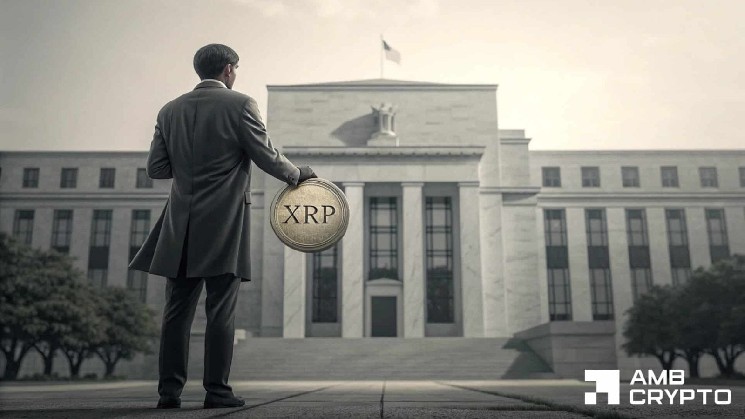
Here’s why XRP’s RWA market is now 4x larger than its entire ETF sector image 0  ambcrypto.com 5 h
Here’s why XRP’s RWA market is now 4x larger than its entire ETF sector image 1

Institutional positioning around Ripple appears to be taking a different path.

The key takeaway is that this isn’t the usual whale accumulation or strategic buyback designed to create scarcity and fuel a sudden parabolic move.

Instead, the focus seems to be shifting toward growing conviction in XRPL’s infrastructure, with tokenization momentum increasingly becoming the main theme.

As the chart below shows, around $4 billion in tokenized RWAs are now live on XRPL, spanning more than 500 products. More importantly, there are already early examples of institutional usage.

Earlier this year, a treasury redemption involving JPMorgan Chase, Ondo Finance, and Mastercard was settled on XRPL in roughly four seconds, according to the companies involved.
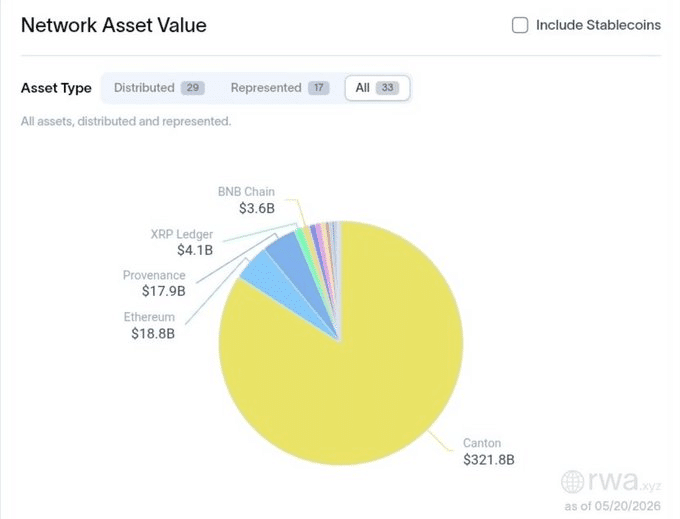
Here’s why XRP’s RWA market is now 4x larger than its entire ETF sector image 2 Source: RWA.xyz

Unlike scarcity-driven rallies, this momentum points to a different type of market dynamic.

From a psychological perspective, rising tokenization activity on XRPL shifts the focus away from pure speculation and toward network utility. The narrative is gradually shifting from investors accumulating Ripple [$XRP] as an asset to institutions using XRPL as infrastructure for real-world financial applications.

This becomes even clearer when comparing Ripple’s tokenization growth with ETF momentum, showing how institutional capital is positioning around the ecosystem. This is especially notable with $XRP already up more than 8% in June.

In this context, this divergence could be setting the stage for $XRP’s Q3 momentum.

Tokenization emerges as XRPL’s key institutional growth driver

While tokenization is growing across the market, what makes Ripple’s RWA momentum different?

Notably, $4 billion in total tokenized real-world assets [RWAs] sat on XRPL at press time. Roughly 4x the size of its entire ETF market.

To put this into perspective, $XRP’s ETF market is around $1 billion. This means tokenization activity on XRPL is already four times larger than ETF exposure. This shows where the ecosystem’s growth is starting to concentrate, with more focus shifting toward real-world asset adoption.

Notably, this becomes even more interesting when paired with Ripple’s ETF momentum. Spot $XRP ETFs have seen consistent demand, recording net inflows for eight straight weeks. They brought in around $23 million during the final full week of June, pushing cumulative inflows to roughly $1.47 billion.
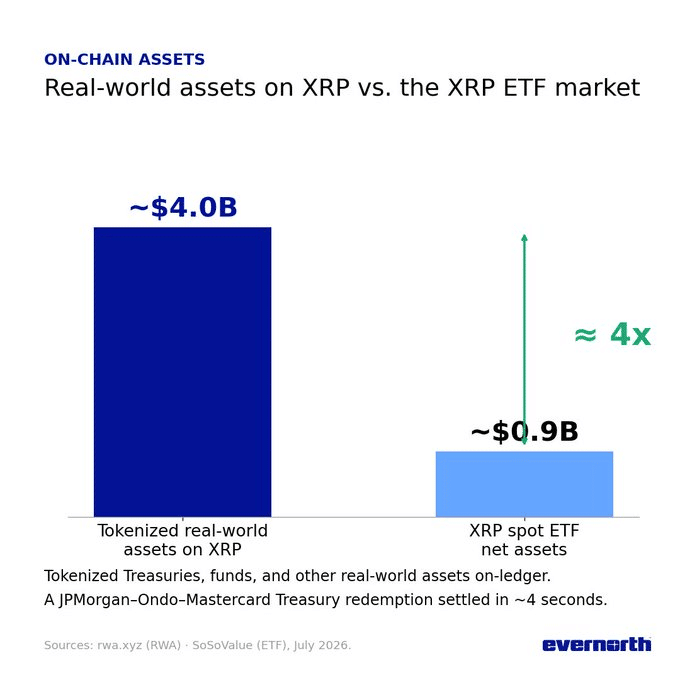
Here’s why XRP’s RWA market is now 4x larger than its entire ETF sector image 3 Source: SoSoValue

In this context, a 4x larger RWA market puts XRPL’s tokenization growth into perspective.

Technically speaking, if ETF inflows represent around $1.47 billion, a 4x RWA market would imply roughly $5.9 billion in tokenized asset activity. This highlights the growing scale of capital shifting toward RWA adoption, not just traditional $XRP exposure.

This is especially notable as $XRP ETF flows have outperformed both BTC and ETH flows during the same period. This adds to Ripple’s Q3 momentum, suggesting that the current cycle is being driven less by speculation and more by growing institutional conviction in the XRPL network.

Final Summary

  • XRPL’s tokenization growth shows a shift from speculation toward real-world adoption.
  • Institutional interest is expanding beyond $XRP ETFs and into the broader XRPL ecosystem.

0
0

Disclaimer: The content of this article solely reflects the author's opinion and does not represent the platform in any capacity. This article is not intended to serve as a reference for making investment decisions.

Understand the market, then trade.
Bitget offers one-stop trading for cryptocurrencies, stocks, and gold.
Trade now!

You may also like

Wall Street giants collectively raise rate hike forecasts, US Treasury futures continue to fall, gold drops over 1% to break 4000

After the US October CPI exceeded expectations, Goldman Sachs and Nomura added a forecast for an interest rate hike in March next year, while Deutsche Bank included a forecast for a rate hike in January next year. Currently, the market has fully priced in a 25 basis point rate hike in December, with a 13% probability for a 50 basis point hike. On Wednesday, the US Treasury spot market was closed, but Treasury futures continued to fall, with corresponding yields rising by about 2 to 4 basis points, and spot gold came under pressure, dropping by 1.1%.

华尔街见闻•2026/11/11 21:18
Wall Street giants collectively raise rate hike forecasts, US Treasury futures continue to fall, gold drops over 1% to break 4000

No Need to Worry About the Cooling Down of AI Data Center Construction? The US Import Boom Is Unlikely to Subside in the Short Term, Real Impact May Come in 2029

It takes an average of 4.8 years from finalizing investment to starting construction of a data center project, and an additional 2.6 years from construction start to becoming operational. Servers usually cannot be installed until after the building structure and racks are completed. For trade partners such as Taiwan (China), South Korea, and Mexico who rely on US data center supply chain demand, the inertia in construction timelines provides at least a one- to two-year buffer for future exports.

华尔街见闻•2026/11/11 21:18
No Need to Worry About the Cooling Down of AI Data Center Construction? The US Import Boom Is Unlikely to Subside in the Short Term, Real Impact May Come in 2029

Federal Reserve Major Debate: When Should the Tenure of “Number Three” Williams End?

The main point of contention is whether Williams should step down in June 2028, upon completing a full 10-year term, or in June 2027, when he reaches the mandatory retirement age of 65. Analysts point out that the Federal Reserve Board holds ultimate discretion; if he leaves early, Fed Chair Waller would be able to assert greater control over the appointment to this critical position. However, forcing Williams to shorten his term could easily be interpreted as political manipulation. Williams himself is expected to serve until June 2028.

华尔街见闻•2026/11/11 21:18
Federal Reserve Major Debate: When Should the Tenure of “Number Three” Williams End?


